
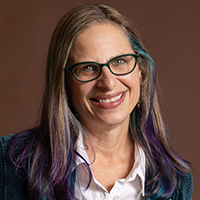
When Amanda Abarbanel-Rice told family members a Conservative rabbi would officiate at her nuptials, their reaction — especially her grandmother’s — was “Wow! Are you sure?”
Since when have Conservative rabbis blessed unions between two women?
“I didn’t quite realize what a big deal it was,” the Berkeley resident said.
But big deal it is. The Conservative movement is explicit that its rabbis should not officiate at gay or lesbian unions. Yet a rabbi who transgresses will not be expelled from the movement’s rabbinical organization, which is the penalty for rabbis who participate in interfaith weddings.
Bay Area Conservative rabbis, no doubt, have taken that into account in their decision to perform gay nuptials. But perhaps the biggest reason Bay Area rabbis are trail-blazers results from the large gay and lesbian population here.
The majority of them, it seems, are choosing to follow their consciences to push forward an idea whose time, they believe, has come.
Of the 12 local Conservative rabbis interviewed for this story, only two said they felt bound by the movement’s restrictions and would not officiate at same-sex unions until the movement changed its policy.
Four have already officiated at same-sex unions, and two will do their first in the coming months. Four said they most likely would, if asked.
When Rabbi Alan Lew of San Francisco’s Congregation Beth Sholom wed Abarbanel-Rice to her partner Lisa Zeiler in November, it was the first same-sex union he performed.
However, Lew announced his willingness to do so three years ago. “Halachah requires you to break it when you feel there has been a significant change and people are being hurt as a result,” he said. “I recognize that in performing this wedding, I circumvented the halachic process of the Conservative movement, but I felt morally bound to do so.”
The reason for the dissent among Conservative rabbis is the biblical verse from Leviticus, 18:22, which states: “Do not lie with a male as one lies with a woman; it is an abhorrence.”
As the Conservative movement considers itself bound by halachah, there is little way around the verse in question.
But as some rabbis point out, the Hebrew word toevah, which is often translated as “abomination,” in addition to “abhorrence,” is also applied to those who eat non-kosher food, those who worship idols and those who falsely weigh items for sale.
Rabbi Ted Alexander of San Francisco Congregation B’nai Emunah concurred with Lew, saying that the times have changed since that verse was written. Alexander, who believes “people are born this way or acquire it before they are 5 years old,” will perform his first same-sex union later this spring.
“This is the way God has created them, and if God has created them this way, I’m willing to give them the blessings,” he said.
Furthermore, he added, “anyone who has any hesitation to give blessings to same-sex people should not say the Sabbath psalm, ‘How great are your works, oh God,’ because that includes everybody.”
Nationally speaking, rabbis like Lew and Alexander are in the minority among their Conservative peers. Rabbi Elliot Dorff, rector and professor of philosophy at the University of Judaism in Los Angeles, estimates that only about 15 to 20 Conservative rabbis in the country will perform a same-sex ceremony. Since several of them are in Los Angeles, that means the overwhelming majority are in California.
“I do think San Francisco is on the cutting edge of this,” said Rabbi Lavey Derby of Tiburon’s Congregation Kol Shofar as well as the president of the Northern California Board of Rabbis. Derby will perform his first same-sex ceremony later this spring, and said he “was delighted to be asked.”
Dorff has emerged as one of the most vocal proponents within the Conservative movement in favor of performing same-sex unions. As vice chair of the Conservative Movement’s Committee on Jewish Law and Standards, “I’ve written about 15 rabbinic rulings for the law committee and all have gotten unanimous support,” he said. “But on this issue, I’m way out on the left end.”
The Reform movement takes no such position, leaving it up to the individual rabbi to decide, much as they do in performing an interfaith marriage.
But for Conservative rabbis, it’s a stickier issue. For the most part, they maintain gays and lesbians must be fully integrated into the fabric of their congregations, but sanctifying their unions is crossing a line.
“On one hand, we know deeply of the pain of being excluded,” said Conservative Rabbi Sheldon Lewis of Palo Alto’s Congregation Kol Emeth. “On the other hand, we want to be reverent towards our tradition.”
While Lewis acknowledged the important role gays and lesbians have in his congregation, he said, “I have great respect for those [rabbis] who act in accordance with their consciences, but I’m not there yet. I may be among those who will lobby for change, but until the movement changes, I can’t do it.”
Rabbi Daniel Pressman of Congregation Beth David in Saratoga agreed with Lewis, saying “I don’t condemn those who are doing it, but I’m not comfortable doing it myself.”
Rabbi Joel Meyers, executive director of the national body of Conservative rabbis, the Rabbinical Assembly in New York, said, “There is a certain freedom that rabbis have” on this issue.
Nevertheless, “I don’t investigate my colleagues or watch what they do. But if there is something that bears following up, we will follow up and talk about it. But we wouldn’t take any further action.”
Such disapproval though, actually is a sort of tacit approval, some rabbis believe.
“It is not the preferred route of the Conservative movement,” Rabbi Leah Sudran of Congregation B’nai Israel in Petaluma said, “but if it’s not permitted, then sanctions would be taken, so it is permitted.”
So far, Sudran has not been asked to perform a same-sex union, but she would.
Rabbi Amy Eilberg, who lives in Palo Alto and is the first woman to be ordained a Conservative rabbi, said that when she sat on the Conservative movement’s committee on human sexuality in the early 1990s, Dorff’s argument made sense to her. She officiated at a ceremony between two women shortly after.
“First we ask them to reject promiscuity and embrace monogamous relationships and then, when they ask us to sanctify them,” the movement says no, she said. “If I support long-term committed relationships among [gays and lesbians] as I do among heterosexuals, I can’t say [the relationship] isn’t holy.”
Rabbi Stuart Kelman of Berkeley’s Congregation Netivot Shalom undertook a study of the issue back in 1995, when he was first asked by a lesbian couple for an aufruf at the synagogue. (The celebration involves a blessing on the Shabbat preceding the wedding.) Kelman has performed one same-sex union, but hasn’t done more, simply because he hasn’t been asked.
“I think some gay and lesbian couples may be upset with me, because I don’t call it a marriage,” he said. “I don’t call it kiddushin.”
Kiddushin has no English translation but it means a sanctified Jewish marriage between a man and a woman. For two men or two women, Kelman prefers the term brit rayut, which he defines as a covenant of love.
What the rabbis who will perform same-sex unions disagree upon most is whether a same-sex ceremony can be considered kiddushin.
Kelman explained that he made certain adjustments to the ceremony he performed, using a sukkah-like canopy rather than the traditional chuppah, and changing the language of four of the seven blessings.
Rabbi Jonathan Slater of Congregation Beth Ami in Santa Rosa said he had never been asked to perform a same-sex union. However, “I believe some sort of ceremony is not only appropriate but necessary.”
But like Kelman, he made distinctions such a ceremony and a heterosexual wedding. “It wouldn’t be called kiddushin,” he said.
Rabbi Nathaniel Ezray of Temple Beth Jacob in Redwood City made some minor adjustments as well, when holding an aufruf for Janice and Marti Sands-Weinstein of Redwood Shores in December.
“I asked for God to bring blessings upon this couple, but I did not use the word ‘wedding,'” Ezray said. “I used ‘commitment’ to keep peace in the congregation.”
Ezray’s decision to hold the aufruf at the synagogue was only done after he consulted its members as well as his colleagues.
Among them were Rabbi Marvin Goodman of Peninsula Sinai Congregation in Foster City and Rabbi Gordon Freeman of Congregation B’nai Shalom in Walnut Creek.
“My gut feeling was that I would like to say I would do as he did,” said Goodman. “But until you’re confronted with a real situation with real people, it’s hard to make a real decision.”
Others were more emphatic. Freeman said he would help create appropriate liturgy for any two people wanting to enter into a covenantal relationship, whether they be roommates, business partners or a gay or lesbian couple. “As long as they were both Jewish, I would be happy to help them.”
In addition to explaining his own position, Ezray presented members of the Religious Practices Committee with the various arguments on both sides. They backed him by six votes to one. The board then voted 18-3. Ezray then sent out a letter to every congregant, explaining his decision.
“I wanted a process of education,” he said. “I didn’t want to rip the shul apart.”
While a few congregants were disturbed by the aufruf, Ezray said, “I got scores of calls from people who are directly impacted by this. So many people said they have gay family members or, if not, they still supported this step.”
Once the Sands-Weinsteins recognized that Ezray was doing something controversial, they asked him to co-officiate at their ceremony, which had already been scheduled at Congregation Beth Am in Los Altos Hills, with Rabbi Janet Marder. A Reform rabbi, Marder has been doing same-sex unions for years.
“We realized how he was really going out on a limb and the risk he was taking,” said Marti Sands-Weinstein. “We were then so touched that we wanted to honor him with co-officiating.”
Although no member left the congregation over the news of Ezray’s co-officiation, some members made their displeasure very clear.
And while they may be in the minority, their thinking is still more in line with those at the helm of Conservative movement.
When asked whether he saw the movement changing in the coming years, Joel Meyers of the Rabbinical Assembly said that while he couldn’t predict the future, “I don’t see that happening.
“There are those who feel strongly that halachah should change and those who feel equally adamantly that it should not.”
Adding that it was incumbent upon Conservative rabbis to make gays and lesbians feel welcome in their congregations, he said that doing so is “quite different than saying there is halachic permissibility for a marriage ceremony.”
But others offered different opinions.
“I believe that it’s our job to assert that this is Torah, this is halachah, this is a limb on the tree,” said Rabbi Rona Shapiro, the former U.C. Berkeley Hillel director. She is now director of education and outreach for Ma’yan, the Jewish Women’s Project of the Jewish Community Center of the Upper West Side in New York City.
Shapiro has officiated at two Jewish same-sex unions, which she insists are weddings. “Eventually I’m confident that Jewish law will catch up with us.”
Derby agreed. “The Rabbinical Assembly as an institution is not on the cutting edge,” he said. “It’s not anywhere near where the Conservative movement is or needs to go.”
Other Page One Stories
When will Sharon hit back hard, Israelis ask