

Update on June 4
Rabbi Jason Gwasdoff still remembers his first food fair at Stockton’s Temple Israel more than 30 years ago.
The new rabbi showed up in jeans and a T-shirt, eager to pitch in and help volunteers run the event. The annual celebration and fundraiser featured a community brunch, vendors selling “Jewish fusion” cuisine and a bakery-deli. And yet, the synagogue’s powers-that-be promptly sent him home to change into a suit, more fitting attire for the spiritual leader of one of the oldest Jewish congregations west of the Rockies.
“To be part of that ongoing history of something that goes back to the very beginning of California, that was always an exciting thing,” Gwasdoff told J.
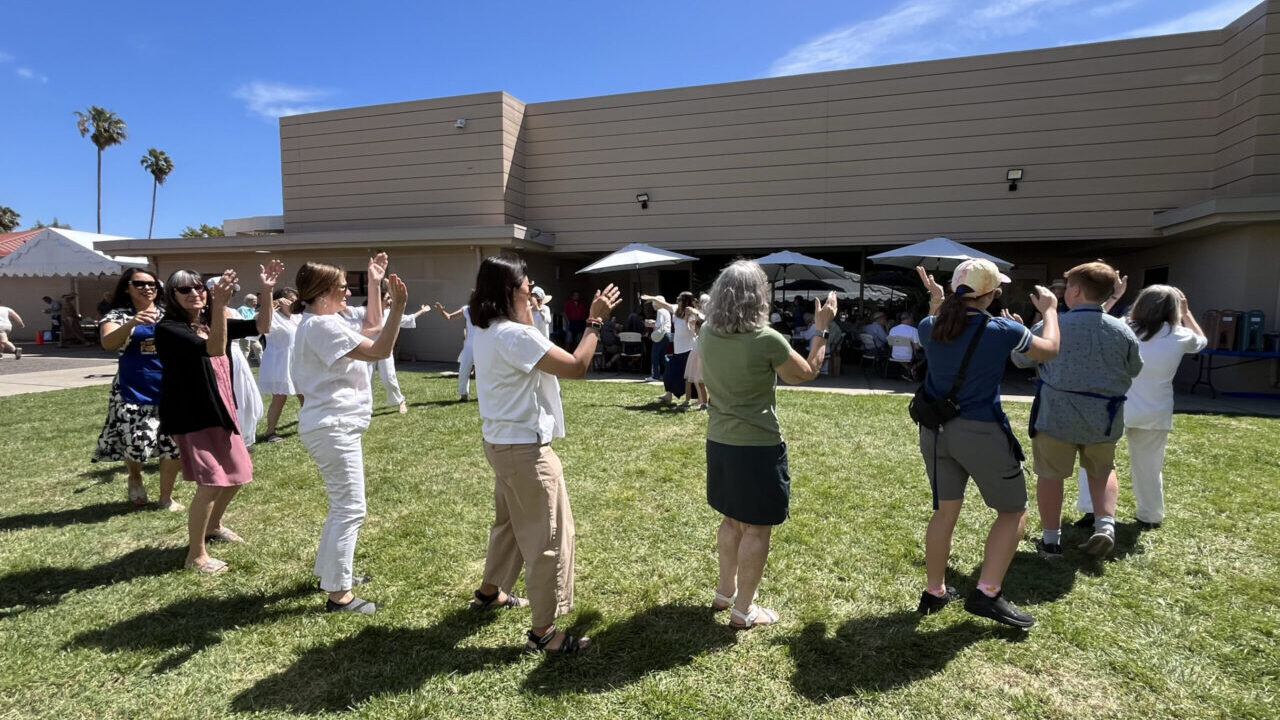
On Sunday, at Temple Israel’s 50th annual food fair, Gwasdoff again arrived in an unconventional uniform: matching white linen shirt and pants, a colorful kippah and brown boat shoes. Fit for dancing.
This was no ordinary food fair for the congregation, though. It was a celebration of the synagogue’s 175th anniversary. Yes, 175.

The congregation was established as a benevolent society under the name Rhyim Ahoovim (Beloved Friends) in 1850 (or even late 1849 as some historical accounts suggest), according to a Temple Israel’s website.
At the time, the congregation consisted of just over 40 Jews, mostly of Russian and Ukrainian descent, who came to Stockton in search of economic opportunity during the early years of the California Gold Rush. Many of these Jewish pioneers worked as merchants, selling clothes, books and furniture.
Temple Israel now serves around 220 households, according to Gwasdoff. It is also a hub for Jews from neighboring towns throughout San Joaquin County.
Congregants and community members came to Temple Israel on Sunday to learn about the history of its community, hear from elected leaders about the congregation’s wider impact, and witness its rabbi perform an Israeli folk dance, joined by Lindy Passer, Temple Israel’s cantorial soloist and his wife.
“It takes a lot of volunteer hours to get ready for this day, people coming for months to work in the kitchen,” Gwasdoff told a small crowd gathered at Temple Israel’s main sanctuary. “It helps build our community, people working together for a common cause, and it’s a beautiful thing.”
As visitors dined on bagels and lox, corned beef sandwiches and “Jewcy tacos” with a mix of brisket and chuck roast, the Temple Israel Band played klezmer on the back lawn. According to Passer, about 1,500 people bought brunch tickets and even more attended without them.
The entire complex was bustling with volunteers rushing from one station to the next, children running through its playground and shoppers queuing up to buy baked goods and commemorative Temple Israel swag.

Stockton’s mayor, Christina Fugazi, was among them, eager to snatch a coveted cheesecake before they sold out. She also delivered a speech during the synagogue’s commemoration ceremony, accompanied by other dignitaries, including state Sen. Jerry McNerney (D-Stockton) and U.S. Rep. Josh Harder (D-Stockton).
Fugazi’s connection to Stockton is generations old, dating back to her great- great-grandfather, who immigrated there from Italy. She lauded the devotion to community building that Stockton’s Jewish community exemplifies.
“Those beginnings, people that were immigrants, that came here, is what makes Stockton such an amazing place,” Fugazi said.
“We just have so much history right here,” she later told J. “That history, we can’t lose, we can’t forget.”
Laura Evnin, a volunteer at Temple Israel’s Judaica shop, has been a congregant for over 25 years. Even when she lived in the countryside east of Modesto, her family would drive 40 miles north to attend Temple Israel before moving to Stockton last year. Although Modesto has Conservative and Chabad congregations, Evnin felt a special connection to Temple Israel’s Reform practice and loved its welcoming community.
“I would drive my kids to Hebrew school here every Wednesday,” Evnin told J. “It was a little bit of a schlep, but we did it because we loved it here, and the people were wonderful.”

Fellow congregant Jordan Gold agrees. Since her grandparents arrived in the area in 1994, Gold’s family has been active in the congregation, a tradition she has carried on by volunteering at the food fair since 2022.
Gold, 15, told J. that attending Temple Israel throughout her childhood has been “very fun. Everybody’s really involved. It’s a small world, everyone knows everyone, everyone’s supportive… It’s amazing here, really.”
The feeling of support extends beyond the local Jewish community. Through Family Promise of San Joaquin County, Temple Israel collaborates with local churches to provide housing and support services to families experiencing homelessness.
“There’s a church on the property next to us. There’s a church a couple miles down. It’s a very tight-knit space,” Gold said. “You always know there’s going to be people around to help you and support you. If something happens, you can go to a place across the street. It’s very nice to have that sense of security.”
The Sunday celebration also marked the beginning of a transition period for the congregation: Both Gwasdoff and Passer plan to retire in 2026 after 33 years. Their last major event as rabbi and cantorial soloist will be Temple Israel’s 51st food fair next spring.
Part of the proceeds from the food fair’s fundraiser will be set aside to help hire a new rabbi and assist in their relocation to Stockton. In the meantime, the search for an interim rabbi is set to begin in the fall.
“The ideal replacement would be a rabbi-cantor, someone who can also handle the music,” Gwasdoff told J. “And ideally it would be nice to have someone with a youthful exuberance.”
Thinking ahead to Temple Israel’s next 175 years, Gwasdoff hopes it will continue to be what he described as an “oasis of Jewish life, and that there will be a new leader who will take it in whatever direction he or she takes it, but that they’ll continue to have that feeling of being a very special family that celebrates the diversity of its members.”