
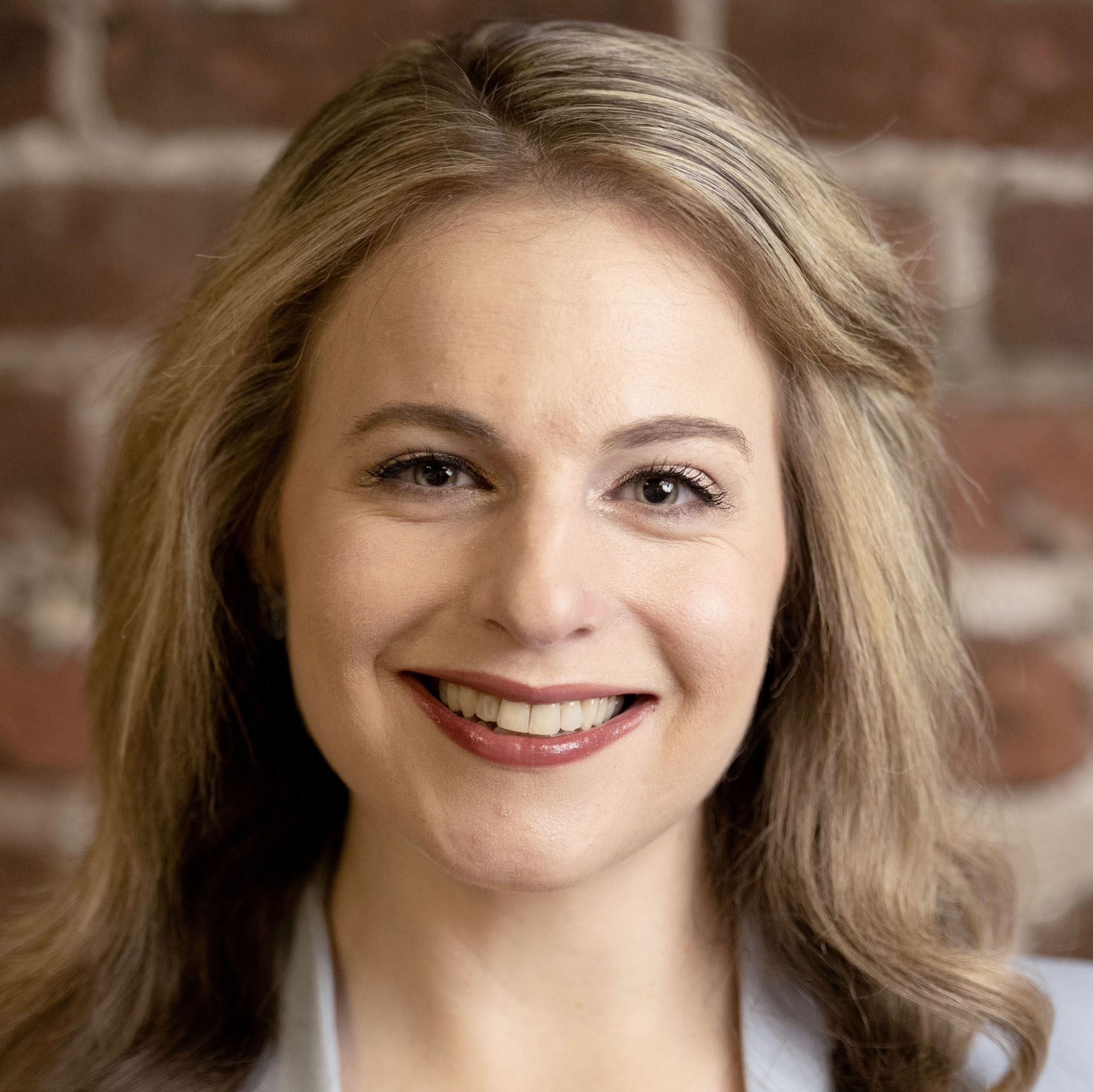
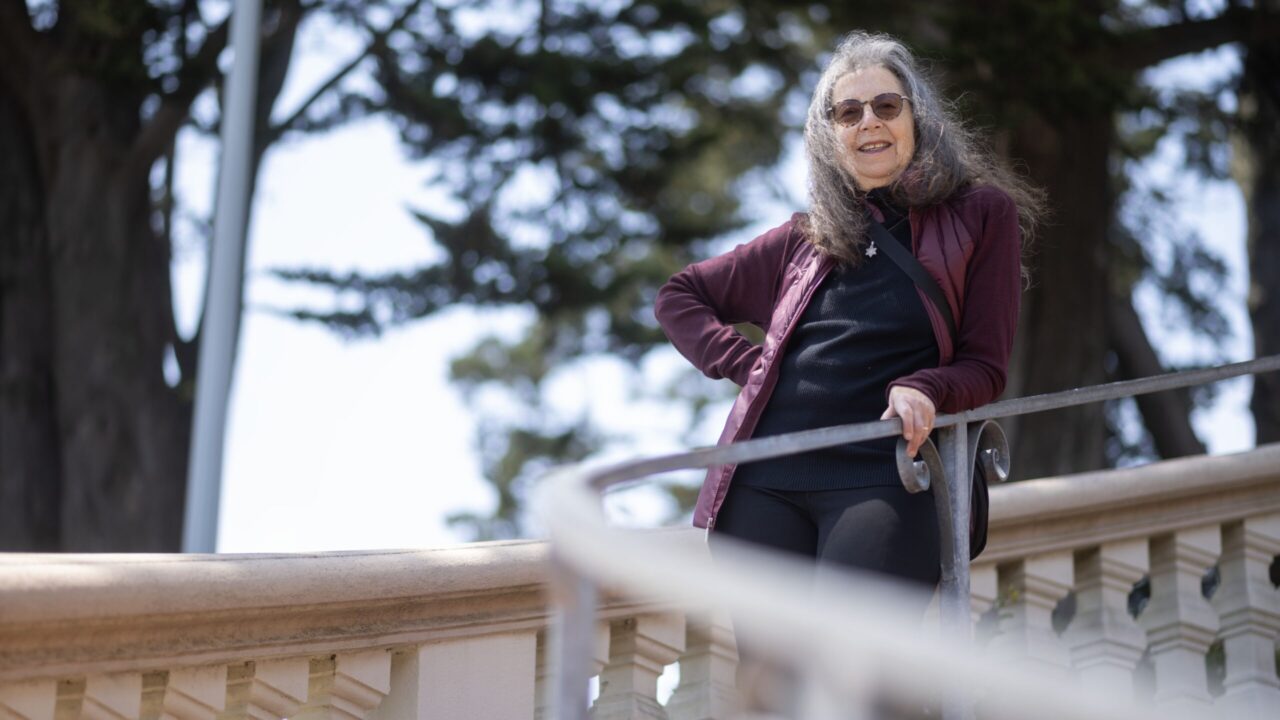
Not long after Nancy Sheftel-Gomes retired as the longtime director of education at Congregation Sherith Israel in 2018, she was already busy with her next endeavor: pursuing her master’s degree in education at age 73.
Last month, a few weeks shy of her 80th birthday on June 26, she earned her doctorate in education from the University of San Francisco.
When Sheftel-Gomes arrived in San Francisco in 1968 from Worcester, Massachusetts, she had little more than her collection of yarn, fabric and needles for sewing and knitting. She would sell her wares around San Francisco and Sausalito to pay the bills. Thanks to the encouragement of her husband, August Gomes, they opened Nancy’s Originals on Haight Street in 1974 and sold her one-of-a-kind creations.
In the mid-1980s, then a mother of two and working part time as a religious school teacher at Sherith Israel, she decided to go back to college and earn her bachelor’s degree.
She went on to become Sherith Israel’s education director, which she called her “dream job.” On top of her many regular duties, she also served as the interim executive director of the synagogue from 2016 to 2018.
Sheftel-Gomes worked with a group of congregants to start the HaMotzi program in 1993, providing meals to the homeless. She led that initiative until last year when she stepped away to write her dissertation. She has chaired the board of Sherith Israel’s Hills of Eternity cemetery, is a member of the social action and chesed committees, serves as a conversion mentor and is a regular at Torah study.
Sheftel-Gomes also is on the board of Be’chol Lashon, a nonprofit that advocates for Jews of color, and is active with the San Francisco Interfaith Council.
The interview has been edited for clarity and length.
What was your Jewish upbringing like?
My mother was Orthodox, my father was secular, and Worcester had a thriving Jewish community at that time. It was kind of a shtetl. I went to religious school, had great, inspirational experiences with getting close to rabbis, and I was very active in NFTY because it meant I could get out of the house.
As a family, we observed holidays, we did rituals. We had family Hanukkah parties. And actually, it really inspired me when I was teaching and the education director at Sherith Israel. What I wanted the experience for children to have when they stepped in the door was to feel like they were a part of a Jewish community because I think that’s an enduring experience.
Growing up, you volunteered, you did mitzvot. When I was 7 and 8, old enough to walk home from school, I used to meet my mother at the Jewish Home where she was the treasurer. So I had this model from my parents to do these kinds of things.
How did you end up working in education? And coming to the Bay Area?
I went to Clark University in Worcester. I left at the end of my junior year because I was unsure of my major and all the rest of it, and life seemed much more exciting. I traveled a bit and ended up in San Francisco, where I decided I wanted to stay while I figured out what to do with the rest of my life.
When I came to San Francisco, I sewed and knitted one-of-a-kind items, and I was selling them. I met my husband here, and in 1974 we actually opened a store on Haight Street. I taught my husband to sew, and he made caps. We closed the store when my husband turned 65.
When we had kids, I started sending my son to the SFJCC preschool. His teacher said, don’t you want to send your daughter — she was in first grade — to a good religious school? I said, sure. Then we walked up the street and walked in the door at Sherith Israel.
One Sunday, I was standing outside the synagogue after having dropped off my kids, and David Meyer, the associate rabbi at that time, came out looking for the teacher that didn’t show up. He roped me into coming in and covering for the teacher. Over the summer, he and the principal of the school said we want you to teach classes here.
When did you ultimately get your undergraduate degree?
In the mid-’80s I went back to school. First I went to City College, and I’d take classes at night. Then I heard about this program at USF for working adults, weekends and evenings, to complete degrees. I took a 16-month program in applied economics and got a bachelor’s of science degree.
What inspired you to pursue your master’s degree — your thesis was “#YouNeverToldMe: What Jewish American Children Learn about Palestinian Displacement During the Founding of the State of Israel” — and later your doctorate?
Right before I took the job as the education director at Sherith Israel, I had been over at USF looking into getting a teaching credential. I was on the mailing list for the School of Education and they started this master’s in human rights education. And I thought, oh, gee, that sounds like me. I’m very into mitzvot.
For my thesis, I studied former students of mine, and the topic of how they learned about Israel/Palestine. I had a lot of ideas about things that I wanted to accomplish, looking at books and artifacts and curriculum and all the rest of that. My adviser kept saying: Oh, no, no, save that for your doctorate.
And so it planted the seed, crazy as it is. USF was also starting a new doctoral concentration, which was racial justice and education. And so I got in that program, and the rest is history.
What was it like taking on this challenge in your 70s?
I was always the oldest person in the room. One of the things I thought when I went back to school was I’m reading anyhow, I might as well read something that somebody else tells me to read. So that was my logic in terms of the reality of the effort that it would take. The doctorate I started in January of 2021, and now I’m finished.
Your doctoral dissertation is titled “Conflicts Teaching About Conflicts: How Jewish Educators Engage with Israel-Palestine.” What did you find in your research?
Prior to Oct. 7, 2023, very few religious schools included Israel/Palestine in the curriculum. With older students, the study of the conflict — thanks to organizations like the ADL and JCRC — has mainly been focused on preparing teenagers to go on college campuses to be able to understand Israel’s position in those protests and activism that they’re seeing, and then, to some degree, to be ambassadors [for Israel].
I also found out that it’s not part of the curriculum in Israel, either, and it’s not talked about in schools in Israel. I also found out that because it’s so contentious, to some degree, teachers are afraid of rocking the boat. They would like to find a way to tell that story, but they don’t want to do it alone.
I think talking about the research humanizes one part of the conflict, and I think it’s important. I think I have a responsibility to share it even outside of Jewish circles. And I do think it’s valuable information for other places of conflict.