
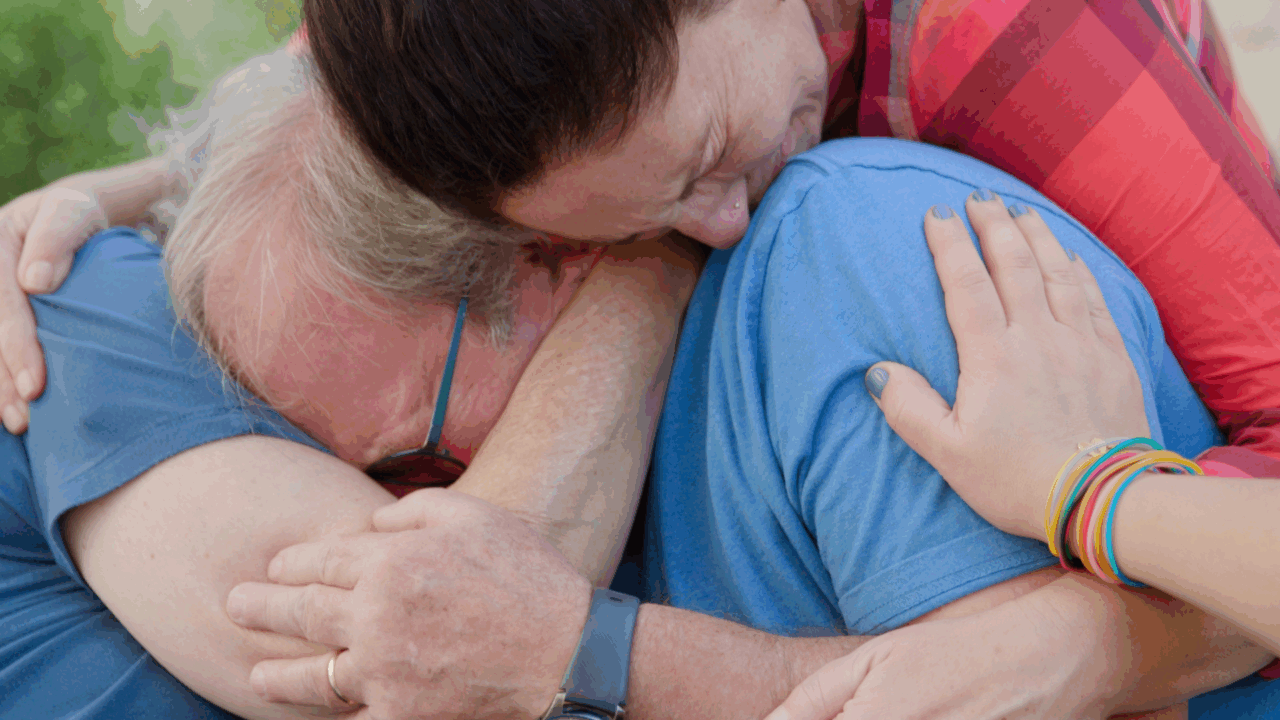
The 251 people who were taken hostage by Hamas on Oct. 7, 2023 — whether alive or dead, released or still held — have all but disappeared from U.S. coverage of the Middle East. But the hostages and their families are front and center in “Holding Liat,” a riveting documentary screening at the 45th San Francisco Jewish Film Festival, which runs July 17 to Aug. 3.
An up-close, behind-the-scenes record of one family’s wrenching journey, “Holding Liat” encompasses the personal, political and moral quandaries in Israel with devastating immediacy.
Although the family highlighted in the film is avowedly left of center — the idealistic U.S.-born patriarch and matriarch made aliyah in the early 1970s to join a kibbutz — the film abounds with ironies, counterpoints and contradictions to engage (and sometimes implicate) viewers of any political position. Wherever one stands, it’s impossible to maintain distance amid the emotional and psychological thicket that “Holding Liat” thrusts viewers into.
As the film begins, 70-somethings Yehuda and Chaya Beinin have been informed that their daughter and son-in-law, Liat Atzili and Aviv Atzili, were taken on Oct. 7 from their community of Kibbutz Nir Oz. We subsequently learn that 70 people were abducted and 30 killed out of the 400 kibbutz residents.
On the advice of a hostage negotiation consultant — let us note the absurdity of a world where such a job exists — relatives of captives fly to Washington, D.C., to lobby members of Congress. The group includes Yehuda Beinin and Netta Atzili, Liat and Aviv’s middle child, a young adult who survived the Oct. 7 attack.
The viewer may have a visceral reaction to the differing responses of Sen. Ron Wyden, who is Jewish, and Sen. Mitch McConnell, who is not. But it is clear that Netta is disturbed by repeatedly recounting his trauma while grappling with the absence and uncertain fate of his parents.
Netta’s sole goal for the trip is Liat and Aviv’s release, but Yehuda can’t separate their plight from the larger political context. Yehuda condemns Israeli Prime Minister Benjamin Netanyahu for not taking responsibility for Oct. 7 and despises the far-right government for both its alleged corruption and for its ongoing treatment of the Palestinians.
“We are being led by crazy people, whether it’s on the Israeli side or the Palestinian side,” Yehuda says at one point. “And the result is always death and destruction.”
The tensions among family members at this early juncture is almost unbearable to watch.
Brandon Kramer, an American filmmaker who is related to Yehuda, cautiously stepped into the role of documenting the family’s agony and kept the film focused on them.
He grounds us in the banality of Chaya and Yehuda’s daily life in the face of monumental uncertainty. Poignantly, he integrates home movies of Liat and Aviv so we experience them as unique human beings, as their family does, rather than as abstractions or symbols.
Kramer doesn’t solicit interviews with politicians or military spokespeople. He includes a bare minimum of TV news coverage and is careful not to use footage from protests and marches to overly editorialize. With the exception of the rare jarring transition, he adeptly integrates and blends the overriding geopolitical picture with the personal saga.
That said, some family members have strong political views that must and do find their way into the film. But those passages — which are essential to the meaning and impact of “Holding Liat” — don’t affect our involvement in Liat and Aviv’s plight.
The audience’s emotional connection peaks when the Israeli Defense Forces are updating Yehuda on the phone about hostage releases during a short-lived cease-fire in late November 2023. Witnessing Yehuda’s and Chaya’s hope and frustration, we can scarcely breathe.
Liat was released after 54 days. Aviv’s story continued after the documentary was completed. He was killed on Oct. 7, while fighting off terrorists entering the kibbutz, and his body was taken into Gaza. The IDF recovered and returned his remains to Israel just weeks ago — in early June.
“Holding Liat,” which received the best documentary award at the Berlin International Film Festival in February, is one of those films that is made for the moment. It should be seen, and soon.