

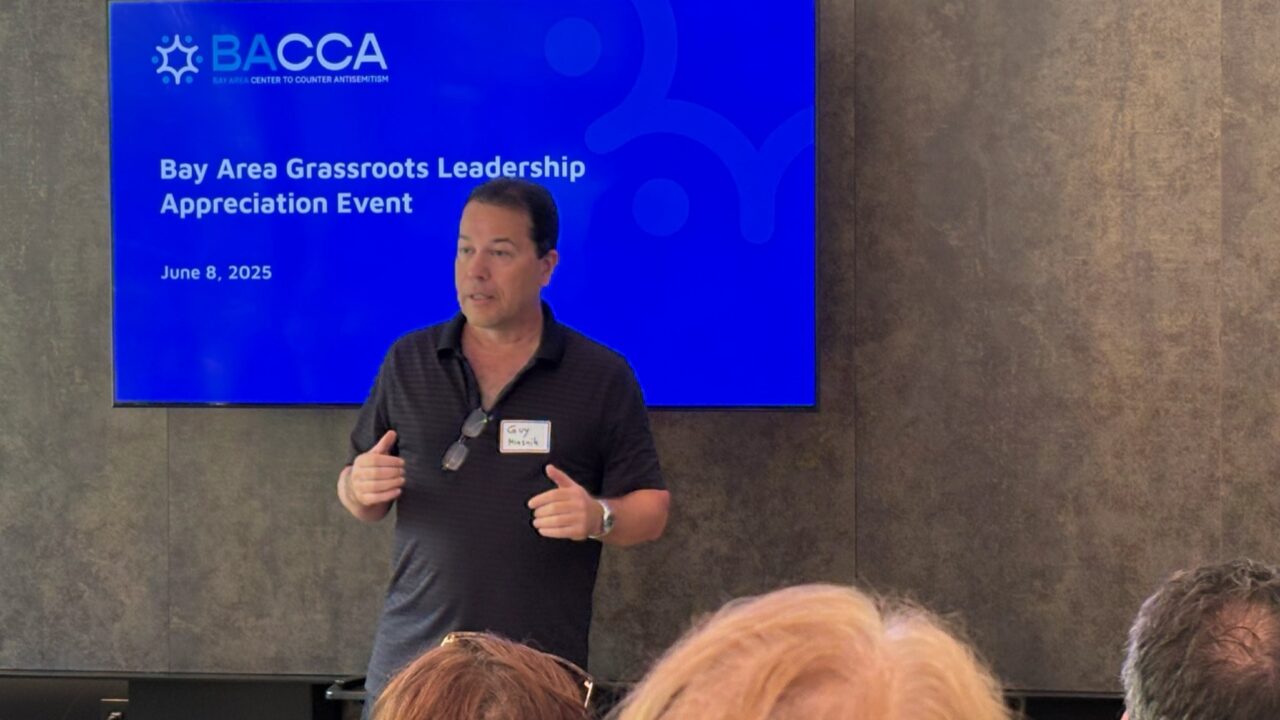
Guy Miasnik grew up in Israel in a mixed Sephardic-Ashkenazi family. But when he was a teenager, his father, then working for Israel’s Defense Ministry, got a U.S. posting in the South Bay. Miasnik spent three years there as a teenager — a period that changed his life path.
Now 55, Miasnik is a tech entrepreneur with several successful companies to his name (including a communications platform acquired by BlackBerry), and he’s making his own personal mark by straddling and connecting two worlds: the Israeli community and the American Jewish community in the Bay Area.

As a board member of many Jewish organizations, including the Jewish Community Federation and Endowment Fund in San Francisco and Gideon Hausner Jewish Day School in Palo Alto, the Los Altos resident has become a linchpin between Israel and the U.S., tech and philanthropy, institutions and innovations. He’s an investor and adviser at J-Ventures, a venture capital fund in Silicon Valley that connects Jewish investors and entrepreneurs, and is co-founder of BACCA, the Bay Area Center to Counter Antisemitism, which supports grassroots groups fighting antisemitism in their local communities.
This interview has been edited and condensed for clarity.
J.: Tell me about your background, your mixed family and the way you ended up, unexpectedly, in the Bay Area as a teenager.
Guy Miasnik: I grew up in a town called Bat Yam, which is a tough neighborhood, if you know Israel. It’s in the south of Tel Aviv.
We dealt with a lot of the issues of a hybrid [Sephardic-Ashkenazi] family in Israel at the time. We speak here in the Bay Area a lot about belonging and inclusivity. These are concepts that Israel was dealing with at that time.
As a teenager I came to the Bay Area. My father was working for the Israeli Defense Ministry, and he was sent with the delegation here for a few years, so I spent a year and a half at South Peninsula Hebrew Day School, and then I was a freshman at Homestead High School, which is a public school in Cupertino. So I had my first taste of America.
After that stint, you went back to Israel, where you became an entrepreneur. How did that come about?
I did a special program where I studied engineering at the Technion, and then went into the military for an extended period of time, about five years. It was a very tech-oriented, entrepreneurial-oriented environment in the military, and then immediately after that, I actually became an entrepreneur.
People often talk about the way the Israeli military experience fosters innovation. Do you think that’s still true?
Absolutely. Suddenly you have relatively young folks, in their early 20s, getting a huge amount of responsibility and access to innovate in a way that is very atypical in a normal environment, and that nurtured a culture of entrepreneurship that then affected the entire country for decades.
This force has only matured over the years, and is one of the main reasons I think Israel is such a startup nation.
What brought you back to the U.S.?
My first company was acquired in Israel [Kinetica, a web services company, was acquired by NetVision, an Israeli internet service provider] and I decided to go to grad school. I was accepted to Harvard Business School and went and got my MBA. Actually I also got married just before we left, so it was my wife, Michal, and myself. After I finished business school, we moved to California, literally a few miles away from where I grew up as a teenager. So that was sort of closing the loop.
What had changed, in terms of Israeli life in the South Bay, since you were there the first time?
The South Bay has always been sort of a hub for Israelis. It’s funny, even from the time that I remember as a teenager, Sunnyvale and Palo Alto were centers of Israeli presence.
But what we found at the time [when we came back] was also the challenge I think we’ve all seen for many years — the connection between the Israeli community and the American Jewish community.
What do the two groups not understand about each other, in your opinion?
They developed in a very different way. Israelis developed in a very tough neighborhood, had to develop a self-identity and strength, and were effectively a majority in the state but needed to fight every day to make that work. And if you look at it as a society, it’s still true.
Americans learn a different mindset. It’s a mindset of assimilation: We need to be part of this amazing, amazing entity called America, and we need to assimilate within it. We need to make sure that we are accepted.
As I sort of lived through both of them, I see how ingrained it is.
One is about fighting and surviving and flourishing in a very tough neighborhood. And another one is about flourishing as well, but in an integrated, assimilated way into the ecosystem. Each one had to develop a different set of skills to do that. And these skills are not always well aligned, and sometimes they’re actually contradictory in some respect.
How does that play out?
We are now fighting a level of antisemitism that we haven’t experienced in America for decades.
There are many people in Israeli society [here] who are effectively shouting: What happened here? Why? Why didn’t you deal with this? They became more aggressive, more proactive in dealing with antisemitism.
In the American community, you see that in some parts of it, but in other parts, it’s more: Hey, we need to keep quiet. We need to let it go. It’s a wave, we’re now at the peak. Let’s wait until it goes out and adjust ourselves appropriately.
These differences are affecting behavior today, in the Bay Area specifically.
What drew you, as an Israeli, into working with the established Jewish American community?
When we moved here in 2000, we already had a young kid. Unlike, frankly, many Israelis, we actually selected to go to a Jewish day school, to Hausner.
We all grew up in a place where you go to your public school and you play after that in the playground with your friends. That’s the way it goes in Israel. We tried to figure out how we can make sure that our kids grow up feeling Jewish, connected to Israel, connected to our family there, connected to Hebrew in a way that will sustain all of these relationships.
And then you ended up joining the board at Hausner. Why was that an important step?
By joining the board, suddenly I was involved in how American Jewish institutions and communities function. And that’s not something that you see from the outside, definitely not as an Israeli coming in.
As a board member and being active, both for Michal and myself, it created for us a much stronger link to the American Jewish community than your typical Israeli family.
You’re involved in so many things, from programs that promote entrepreneurial thinking in Jewish day schools to bringing Israeli entrepreneurs together. Do you consider yourself a leader?
I see it as more of a responsibility. That’s typically how I view leadership. You take responsibility for things that you’re passionate about and that you think should make an impact, and think that the world needs to be better in these respects. So leadership is really a responsibility for the community that you’re working for.