

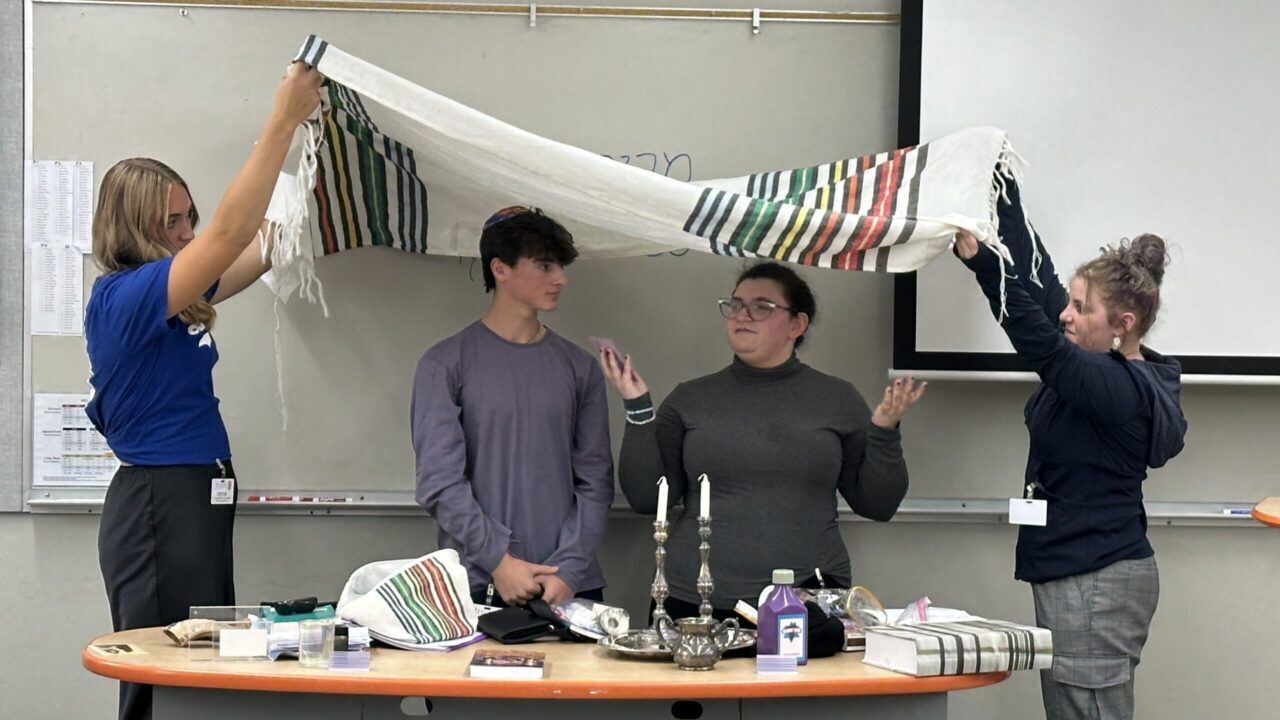
As a student at Sacramento’s C.K. McClatchy High School, Nessa Weiner has encountered plenty of ignorance among her peers when it comes to Jews.
“People just do not understand what Judaism is,” said the 17-year-old incoming senior. “Before a test, kids would ask me to pray some Jewish magic.”
That was enough to inspire her to join Student to Student, a nationwide program that runs in 38 cities in the United States and Canada, including Sacramento — the only site in Northern California.
Launched more than 30 years ago in St. Louis, Student to Student enlists Jewish high schoolers like Weiner to visit local high schools to educate teens about Jewish culture and traditions. The intention is to reduce antisemitism and stereotypes among non-Jewish youth.
Weiner said the students she met during three presentations over the past school year “were genuinely curious. It made the presentations more fun. They asked a lot about our experience with antisemitism, the Holocaust, our bar and bat mitzvahs.”

Now starting its third year, the Sacramento chapter of Student to Student is sponsored by the Jewish Federation of the Sacramento Region and supervised by the program’s national headquarters in St. Louis. The Sacramento teens have led about two dozen presentations so far.
Randi Gold, who volunteers as the Sacramento coordinator, got involved with the program for one reason. “Our kids are the future,” she said. “It’s very simple. I can make it more complicated, but it’s not.”
Gold said the students’ mission is “to talk about the Jewish people, and who they are as individuals. They talk about what it’s like for them to be a teen in Sacramento. They are able to share, to personalize: What does Shabbat mean to me? How do I keep kosher? How do I not?”
The structure of Sacramento’s program is straightforward. Synagogues and other local Jewish institutions recruit around 15 high schoolers eager to share their Jewish knowledge and enhance their public-speaking skills. After an orientation, the recruits prepare presentations, which include talking points such as descriptions of the branches of Judaism, Shabbat, kashrut, Israel, antisemitism, the Holocaust, Jewish holidays and Jewish lifecycle events such as b’nai mitzvah.
In small groups representing the Orthodox, Conservative and Reform branches, the youths head to high schools such as Lodi, Granite Bay, Davis, Rio Americano and Jesuit, a private Catholic school. In their tote bags for the high school equivalent of show and tell are everything from kiddush cups and challah loaves to Shabbat candles and prayer shawls.

Penina Rubin, 17, is a recent graduate of the Sacramento Academic and Vocational Academy. The daughter of Rabbi Evan Rubin of Sacramento’s Kenesset Israel Torah Center, she was an enthusiastic participant in the program this past school year, representing the Modern Orthodox movement. For her, showing non-Jewish teens that she wasn’t all that different from them was important.
Exhibit A: During her presentations, Rubin would whip out a copy of a Harry Potter novel. In Hebrew.
“We went to Jesuit High, an all-boys Catholic school,” she said. “The kids were very interactive. We didn’t want them to feel they’re being lectured to.”
When it comes to Israel, program organizers ask the students to keep their presentations nonpolitical.
“We made a point that we were not talking about the conflict,” Rubin said, referring to the ongoing war between Israel and Hamas, “but rather to focus on Israel as a country and as a people. We would talk about it as a democracy, not so different from America.”
Gold said that antisemitism is a tough subject for the presenters.
“Each will talk about an experience they had with antisemitism in their school — Jewish stereotypes, jokes about a nose or money, graffiti drawn on a desk in front of them, inappropriate comments from teachers, from kids. Our teens are able to stand up for themselves,” Gold said.
The impact of Student to Student has been measurable. According to its national organizers, follow-up surveys showed that 84 percent of students in the audiences report that they have “shared what they learned or have taken another step to learn more about Judaism,” while 27 percent say that they went on to “interrupt an antisemitic comment.” A whopping 94 percent of teachers reported that “students continue to discuss what they learned from Student to Student presentations in their classrooms afterwards.”
Rubin is looking forward to a gap year before moving to Israel. Weiner expects to attend college after graduation in the spring. Both said they will look back fondly on their involvement with Student to Student.
“To reach out to kids who never met a Jewish person in their life, and then connecting with them on something that interests them” was for Rubin the most gratifying aspect of the program.
“It goes one step further,” she said. “It shows them we’re just like you.”