

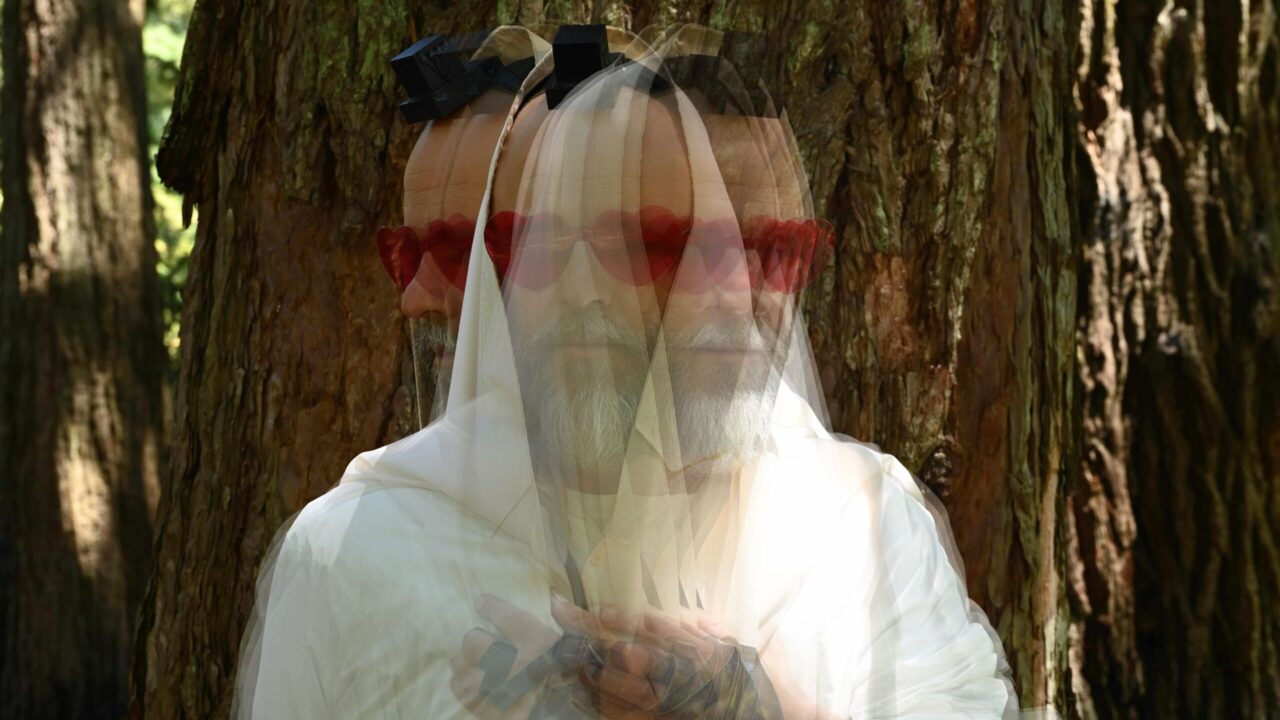
Rabbi Rena Blumenthal was lying on a bed at the Langone Center for Psychedelic Medicine at New York University, wearing headphones and an eye mask. But in her mind, she was floating on water.
For the first time in her life, she had just taken an experimental dose of psilocybin, a psychoactive compound in what is colloquially known as magic mushrooms. It was July 2018.
“I was in water, I was paralyzed, and my head was being drawn to this blue spiral cave,” she told J. in May, nearly seven years later. “It was so peaceful, and so beautiful.”
Blumenthal, a Reconstructionist rabbi from New Paltz, New York, was one of 24 religious leaders — Christian, Muslim, Buddhist and Jewish — who participated in a psilocybin study conducted by teams from NYU and from Johns Hopkins University’s Center for Psychedelic and Consciousness Research.

(Joe Lingeman)
The findings were published in the journal Psychedelic Medicine on May 30, a decade after the study began.
Researchers sought to understand how religious leaders might interpret potentially mystical experiences induced by psilocybin, which can produce euphoria, feelings of well-being and spiritual insights. None of the participants had ever taken psychedelic drugs before. There were two guided sessions, a month apart.
Even with the small sampling, researchers found, the results were decisive. Surveyed more than a year after the second session, a majority — 20 of the 24 clergy who took part — still ranked the psilocybin “journeys” among the top five most psychologically insightful experiences of their lives. All but one said the sessions were among the most spiritually significant experiences of their lives.
J. spoke with three of the five rabbis who participated in the study, asking how they used their rabbinic knowledge and understanding to interpret their psilocybin sessions and how the experience changed their personal and professional lives.
A cultural shift
Over the past decade or so, a growing number of clinical studies have looked at psilocybin for possible therapeutic benefits, including treatment for depression, anxiety and substance-abuse disorders. That represents a major shift from how psychedelics were viewed during the counterculture movement of the 1960s when recreational drug use reached new heights. But even back then, some spiritual leaders experimented with psychedelics for seemingly higher purposes. Rabbi Zalman Schachter-Shalomi, founder of the Jewish Renewal movement, had his own life-changing experiences with LSD at the time, which reflected his general willingness to explore new forms of spirituality.

For her part, Blumenthal could only describe her psilocybin-induced vision as a “pre-birth experience,” though she still doesn’t know exactly what to make of what she saw or how to put it into words.
“I don’t talk about the specifics very much, and I don’t like to,” said Blumenthal, who for 11 years served as assistant director of religious and spiritual life at Vassar College in New York. “It just doesn’t transfer into language.”
What she does know is that taking psilocybin just two times changed her life for the better.
“All my life, I have cycled in and out of these depressive periods. I haven’t been depressed in these past seven years,” she told J. “There are three moments in particular from the experiences that I can conjure up when I’m feeling dysregulated, overwhelmed or very anxious.… And they just calm me.”
The effect that Blumenthal described aligned with the study hypothesis: that participants would see improvements in their general well-being and life satisfaction, as well as in their spiritual and professional lives.
Participants filled out a questionnaire to determine whether the visions they encountered while taking psilocybin could be described as “mystical.” Did they feel an omnipresent unconditional love, discover an absolute truth or experience the unity of the universe?
Moving the energy
For Rabbi Zac Kamenetz, an Orthodox Berkeley resident and former director of Jewish living and learning at the JCC of San Francisco, the questionnaire barely touched the surface of the insights he gained.

He spoke with J. six years ago about the visions he encountered during his sessions in 2017. He reflected on it again in May during a talk at a Value Culture event for San Francisco Jewish Week. At the talk, he declared that “American Judaism is uniquely influenced by underground psychedelic activity in the ’60s.”
In one of his psilocybin-induced visions, Kamenetz said, he saw a symbol of a Kabbalistic tree of life. Two branches appeared to stretch out from either side of the tree, one representing chesed (magnanimity, love, compassion) and the other din (judgment, strictness, boundaries). In his vision, the energy appeared to move from one side of the tree to the other, from chesed to din and back.

(Aaron Levy-Wolins/J. Staff)
It wasn’t a simple “everything is love” feeling, Kamenetz said. “I am oscillating between these things. I am learning something about my own disposition … about balance. I was learning it directly from Kabbalah, and as the catalyst from the psilocybin.”
After that experience, Kamenetz said he began to hear stories from other Jews, including rabbis, about how psychedelics reinvigorated their Jewish identities.
“Stories about what is working for people are so profound,” Kamenetz told J. “That’s what made me feel like: Oh wow, I need to create a space for all of this energy that seems like it’s just out there and not collected or being held…. It felt like the conversation was ready to be had.”
In 2020, Kamenetz founded Shefa, a community for “Jewish psychedelic explorers” to connect with one another and tap resources to safely integrate their experiences into their Jewish practice. In 2021, he co-founded the first Jewish Psychedelic Summit, attended online by 1,500 people.
Kamenetz said Shefa’s focus is on providing an avenue for discussions and, according to its website, it does not “conduct illegal activities, nor do we refer people toward illegal activity.” Most psychedelics — including LSD (acid), MDMA (ecstasy or molly), DMT (an active ingredient in ayahuasca) and psilocybin — are illegal under federal and California law.
Two years ago, Oregon became the first state to legalize psilocybin use for adults. In late October, Shefa will host a new program called “The Idra Project” created specifically for Jews: a weeklong psilocybin retreat in Portland.
In addition, the Shefa website is promoting a November event in Berkeley called “Shuva: Returning to Ourselves,” which is described as a “physician-supported, trauma-informed and Jewishly-rooted small group day-long ketamine retreat.” (Ketamine can be obtained legally with a physician’s prescription in some states, including California.)
Limits of the study
According to the National Institute of Drug Abuse (NIDA), adverse reactions to psychedelic substances can vary widely, and more research is needed. Depending on the drug, short-term responses can range from paranoia, fear and panic attacks to headaches, abdominal pain and rapid heartbeat. Fatal overdoses of psychedelics are rare, however, and more commonly associated with combining substances and ingesting them simultaneously at very high doses, according to NIDA.

The findings of the Johns Hopkins/NYU research were published in a peer-reviewed journal, but the final report was delayed after the study was found to have flaws. An audit by the Johns Hopkins Institutional Review Board, which monitors the medical school’s research studies involving human subjects, found that the researchers failed to disclose that two of the team’s members were also funding sponsors of the study.
Scholars of psychedelic medicine and religious studies offered additional critiques at a June 11 panel hosted by UC Berkeley’s Graduate Theological Union (GTU), in particular addressing whether the study was limited by an “expectancy bias” that influenced participants’ experiences under psilocybin. One example mentioned at the panel and in the report was a recruitment ad that invited clergy to “take part in a research study of psilocybin and sacred experiences.”
Kamenetz, who spoke on the GTU panel, said he was not concerned about the phrasing of the ad. To him, it reflected the primary purpose of the study: to work with religious leaders who are already familiar with sacred experiences.
After all, the ad “didn’t say ‘you will have a sacred experience,’” he said. “They wanted to know something about my experience –– my Jewish experience –– in the context of this research.”
A case could also be made that the participants were primed to key in on such a study, despite having no prior experience with psychedelics. The findings noted that 83% — including all three rabbis who spoke with J. — reported having had “sacred experiences” in the past. The three rabbis also told J. that those sacred experiences were an influence in their decision to pursue the rabbinate.

For Kamenetz, it happened at the archaeological site of Tel Gezer, once an ancient Israelite city, during a high school trip to Israel. For Blumenthal, it happened during a solo trip through Africa in her late 30s. And for Renewal Rabbi Julie Danan, another study participant and former rabbi of Chico’s Congregation Beth Israel, it happened in Utopia, a tiny Texan town 80 miles west of San Antonio, when she was 12 years old.
It was early spring, and Danan remembered being surprised by “the sense of unity with all of nature. I was just a kid, right? I felt like I wanted to express it in some holy words,” she told J. “I was, from that point, kind of searching for more mystical experiences.”
What comes next
At the GTU panel, Bay Area-based journalist and author Michael Pollan, who has written about psychedelic research and policy for the past decade, spoke about interviewing the researchers for a New Yorker article about the study. The piece was published shortly before the May 30 research findings were released.
“There was this question of whether [these mystical experiences were] authentic or just a drug-induced state, and the hope on the part of the researchers … was to get some clarity on that question from people who were unusually well qualified,” said Pollan, who heads the journalism and public education team at UC Berkeley’s Center for the Science of Psychedelics. “[They] could offer a more nuanced understanding of this phenomenon, which humans appear to be wired for. It’s a literally extraordinary state, and psychedelics, obviously, are not the only way to achieve it.”
Pollan also interviewed some of the participants about their encounters with religious traditions outside of their own. It was in one of those conversations that a Baptist theologian described experiencing the essence of God during a psilocybin session — and it turns out that God reminded her of a Jewish mother.
“She was quite surprised by that,” Pollan said at the GTU panel.
Once they returned to daily schedules after the study, the rabbis who spoke with J. said, they interpreted their psilocybin-induced visions by turning to knowledge culled from their rabbinic scholarship and experience.
During Danan’s first psilocybin session in the study, she said she felt like she was standing at the edge of the Grand Canyon.
“You are both so small that you’re almost erased. And at the same time you are part of this vastness. You are everything and nothing,” Danan said. That duality brought to her mind the wisdom from 19th-century Hasidic Rabbi Simcha Bunim of Peshischa, who said we should carry two pieces of paper in our pocket: “One says ‘I am but dust and ashes,’ and the other says ‘for my sake, the world was created.’”
Kamenetz went further than most, embarking on a mission to understand the full breadth of the Jewish American attitude toward psychedelics.
Last year Shefa, in partnership with Emory University’s Center for Psychedelics and Spirituality, launched Jewish Journeys, a study to explore Jews’ self-reported experiences with and feelings about psychedelics. The study is also open to those who want to explore their spirituality without substance use, Kamenetz said. Almost 1,000 people had filled out the online screening form by mid-August. The research team’s goal is to collect at least 1,500 individual accounts and publish the results by year’s end.