

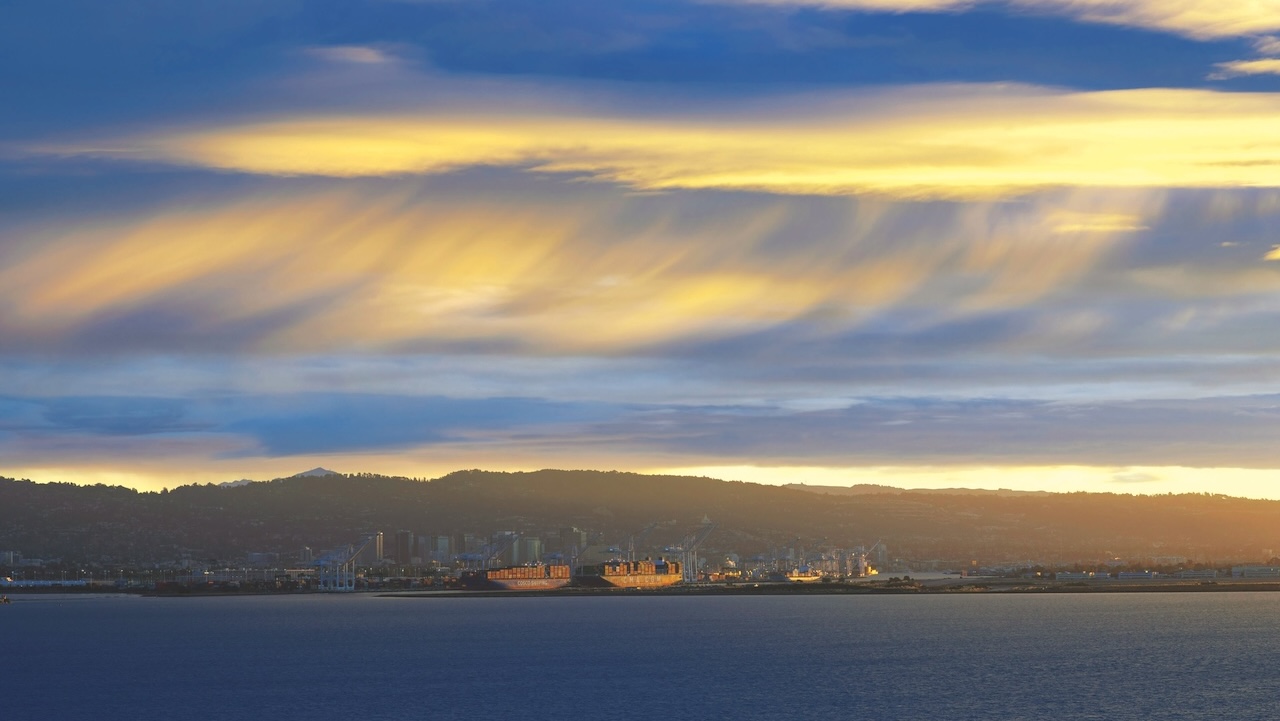
When the Covid pandemic began, I was living in a house on the shores of Point Richmond, with a westward view of the San Francisco Bay. On the morning of March 16, 2020, when the entire Bay Area went into lockdown, I stared out my window at a seascape devoid of human movement: not a single sailboat, cruiser, kayak, ferry, oil tanker or cargo ship plied the waters. The bridges were deserted, too. It was only then that I realized how much the human presence shapes our experience of the sublimely beautiful natural formation where the rivers of the Sierra Nevada meet the Pacific Ocean.
In the distance, on the south side of the Bay Bridge, giant container ships sat at anchor off the Port of Oakland, as they do today. The ships look “as if the vessels were knights and bishops resting on water as solid and stable as a chessboard,” Bay Area author Rebecca Solnit writes in her introduction to “Cargo,” a sumptuous book of photographs by Berkeley photographer Richard Misrach.
The book was released in January, following Misrach’s shows at the Fraenkel Gallery in San Francisco and the Pace Gallery in New York. It features Solnit’s incisive essay and 64 photos by Misrach of cargo ships on the Bay.
Misrach will join Solnit for a conversation in San Francisco on Oct. 23 for City Arts and Lectures. It will also air on public radio station KQED on three dates in November.
The photographer’s images of the Bay, taken at daybreak and nightfall from a single location, capture broad swaths of the water and skies. They focus attention on his true subjects: color and light.

“The Bay is just a constant, ever-changing canvas,” Misrach said in an interview from his Emeryville studio.
Then there are the ships: mysterious, disruptive, sometimes poetic and evidence of humanity’s own creative and destructive ends.
“The ships are not easy to ignore,” writes Solnit, a social and political activist. “Sometimes, they appear as a kind of transgression against the aesthetic grandeur, a disturbance in the space, an industrialization of what still seems natural. At other times, in their monumental size, the way their hulls catch the light, their own lights in the gloaming, they are beautiful themselves.”
As a writer who has long shared Misrach’s interest in the interface of society and nature, Solnit lends social perspective to the seductive beauty of his luminous images.
The cargo ships “are easy to see, but it’s less easy to perceive the immense environmental harm of the shipping industry, of mass consumption, of the fossil fuel that fills the hulls of the tankers that come to load and unload the foul stuff on which our world runs,” she writes. “These ships carry specific burdens, but they also transport the burden of the industrial age’s consumption and production and its impacts. They carry a burden, a cargo, of meanings.”
Regarding the issues that Solnit raises, “I don’t claim to have answers,” Misrach said. “A text like Rebecca’s unpacks the issues. But what my work does is make you notice. It brings you in, kind of seduces you with beauty. It’s an aesthetic strategy; I think that’s the first step” toward solutions.
Born in 1949 in Los Angeles to a middle-class Jewish family, Misrach is renowned as one of the first photographers to explore large-format color photography as an art medium after the dominance of the black-and-white tradition prior to the late 1970s.

His color studies of surfers in Hawaii, beaches, coastlines and the Golden Gate Bridge (shot over four years from his home in the Berkeley Hills) are beautiful, but they were also meant to incite a frisson of social awareness. His long-distance photos of beachgoers and swimmers suspended in the Hawaiian surf in his 2002 project “On the Beach,” for example, evoke the news photos of people falling from the twin towers on 9/11, a sight that profoundly affected Misrach.
He also elevated to the level of fine art subjects that were more directly political. He implicated human decisions in his documentation of landscapes desecrated by nuclear testing at the Nevada Test Site, the 1991 Oakland-Berkeley Hills Fire, industrial pollution in “Cancer Alley” in Mississippi and Hurricane Katrina.
Misrach credits his enrollment in UC Berkeley during the tumultuous late 1960s for his dual awakenings to politics and photography. There he was exposed to the great photographers of the American West, such as Ansel Adams and Edward Weston, and began to produce his own work as a member of the student photography club.
After graduating in 1971 with a degree in psychology, his first published project was a study of the homeless population adjacent to the Berkeley campus. “Telegraph 3 AM, 1972-1974” was well-received in photographic circles, but Misrach was frustrated by the minimal impact his documentation had on the issue itself. That initiation caused him to redirect his focus from human figures to the land itself, chiefly in the deserts of Southern California, Baja California, Nevada and Arizona. As he wandered in those places, sleeping in his VW bus and following his eye, he came to see the human imprint everywhere.
“If you look back at my work over the last 40 years, you can see this polarity, from politics to the aesthetics of photography itself. I think it’s that tension between my interest in the beauty and greatness of the photographic medium — which just leaves me in awe — to trying to use it towards a social end,” he said in a 2010 interview for the Smithsonian Archives of American Art.
Beginning in 1979 and continuing at least through 2022, Misrach took thousands of large- and medium-format photographs that he grouped thematically into a series called “Desert Cantos,” now considered his magnum opus.
In 2017, after the first election of Donald Trump, he documented the proliferation of offensive political graffiti on rock faces and the walls of abandoned buildings. In a first-person piece he penned for the Guardian, he discussed a photo he took of a swastika on a derelict building.
“This building is not atypical,” he wrote. “I found swastikas in California, Nevada, Arizona, New Mexico and Texas. It’s one of many, just beneath the surface. When I was growing up, hearing stories of the Holocaust — I’m Jewish — the idea that this could ever happen in this country was unfathomable.”
Today, Misrach’s works can be found in the collections of most major art institutions around the country; SFMOMA alone has 37 of his pieces. His contributions to contemporary photography will be highlighted in a major retrospective covering five decades, including some from the “Cargo” series, at the Fraenkel Gallery from Oct. 30 through Dec. 20.
Reflecting on “Cargo” in relation to his other projects over the years, Misrach said “some were dark, and heavy, but I didn’t want to always go after that. So I also did beautiful things, like the Golden Gate Bridge. I would say ‘Cargo’ is kind of in the center. There’s stuff to be unpacked and deciphered, but there’s also a reminder that we have this beautiful environment, and it’s absolutely extraordinary here. It’s magical.”