

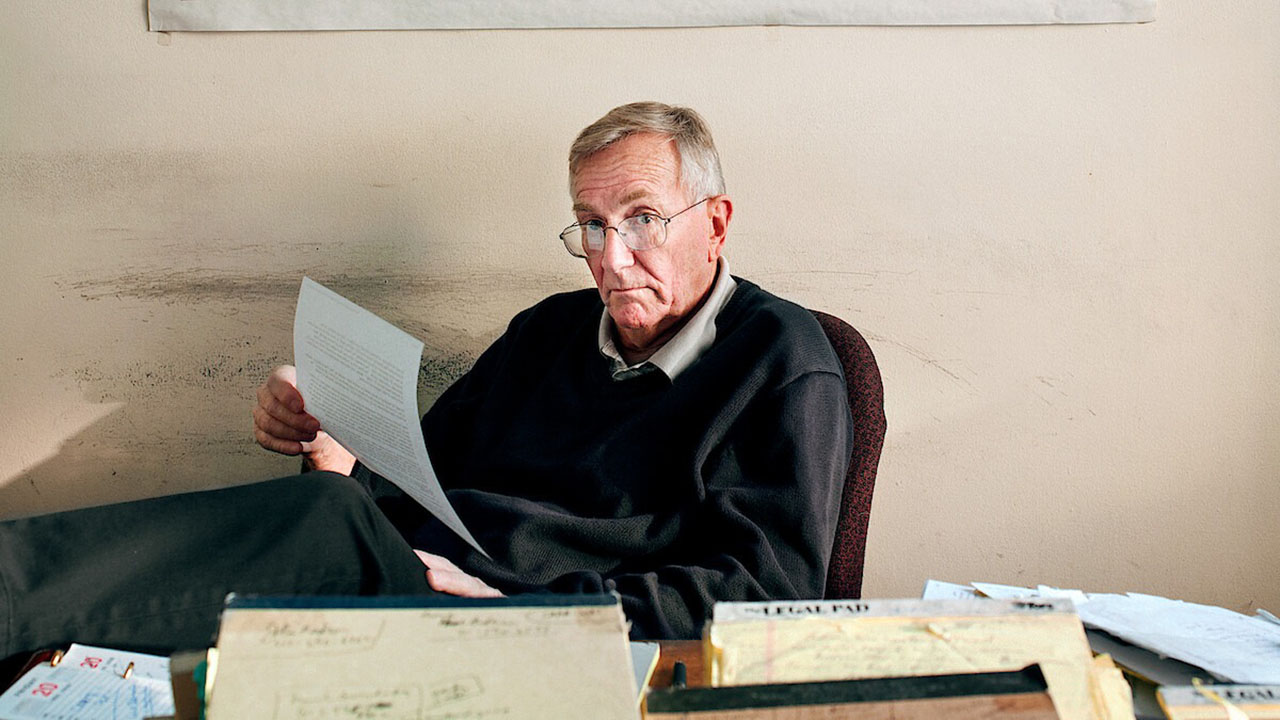
At one point in the new documentary “Cover-Up,” legendary journalist Seymour Hersh looks the camera straight in the eye and says, “It’s complicated to know who to trust.”
He takes a pause.
“You know, I barely trust you guys.”
Those words underpin the documentary by Laura Poitras and Mark Obenhaus about Hersh’s six-decade career. It will screen twice on Nov. 6 at the opening of SFFILM’s four-day “Doc Stories” festival in San Francisco. Both directors as well as Hersh are expected to attend the second showing.
A longtime reporter for the New York Times, the New Yorker and other outlets, Hersh, 88, is known for his exposés, including on the 1968 My Lai massacre in Vietnam (which won the Jewish journalist a Pulitzer Prize), CIA scandals and U.S. torture at Abu Ghraib prison in Iraq. Those are only some of the pieces he wrote in a storied career that has seen its fair share of controversy.
Poitras is an award-winning filmmaker whose work includes documentaries on Iraq, on artist Nan Goldin and on NSA whistleblower Edward Snowden. That film, “Citizenfour,” won an Oscar in 2015. She also co-founded (and was possibly fired from) the online news publication the Intercept. Poitras is a former San Franciscan, having studied at the San Francisco Art Institute (and worked in the kitchen at Masa’s).
In a panel discussion at Lincoln Center earlier this month, Poitras said she’d first broached the idea of a documentary about Hersh’s reporting back in 2005.
Hersh recalled that Poitras, whom he called “strong” and “moral,” was amazing at getting him to open up.
“Getting me to talk about my dead father? I mean, come on,” he said.
Hersh was born in 1937 in Chicago to Jewish immigrants from Lithuania and Poland; the family spoke Yiddish at home. He started as a police reporter in his hometown and worked his way up to the New York Times, which he joined in the 1970s. Hersh is also the author of numerous books of investigative journalism, including “The Samson Option: Israel’s Nuclear Arsenal and American Foreign Policy” in 1991.
He’s long been a thorn in the side of the political establishment — whichever party was in power — and through his career he’s received criticism from both ends of the political spectrum, both for his outspoken personal views as well as his copious use of anonymous sources.
At the Lincoln Center talk, Obenhaus said that he’d worked with Hersh before, so he knew he’d be great as a subject. That was the easy part. The hard part was pinning Hersh down.
“Getting Sy to agree to it was a tricky proposition,” Obenhaus said. “He routinely says no to just about everything”
Asked at Lincoln Center about the current state of journalism, with the Trump administration cutting funds to public media and suing others for billions, Hersh spoke in his characteristic blunt manner.
“It’s going to be very awful, very hard, and it’s going to be terrifying for the press,” he said. “They’re chewing up the press right now.”