

The Torah column is supported by a generous donation from Eve Gordon-Ramek in memory of Kenneth Gordon.
Lech Lecha
Genesis 12:1-17:27
It’s hard to believe that on Simchat Torah, we were able to celebrate the return of our 20 living hostages.
We danced with the Torahs as we honored both our ancient and our modern relationship to the land of Israel. We read the very end of the Israelites’ story and concluded the Torah reading cycle with the word “Yisrael.” At the end of their wandering, our ancestors looked out over the desert to the land that the next generations would inherit. And then we chanted from Bereishit, beginning our peoples’ story again for a new year.
In the beginning, there is darkness and void. Our journey starts anew. The Earth is created, along with all of its inhabitants. We meet Adam and Eve, Cain and Abel, Noah, Avram and Sarai.
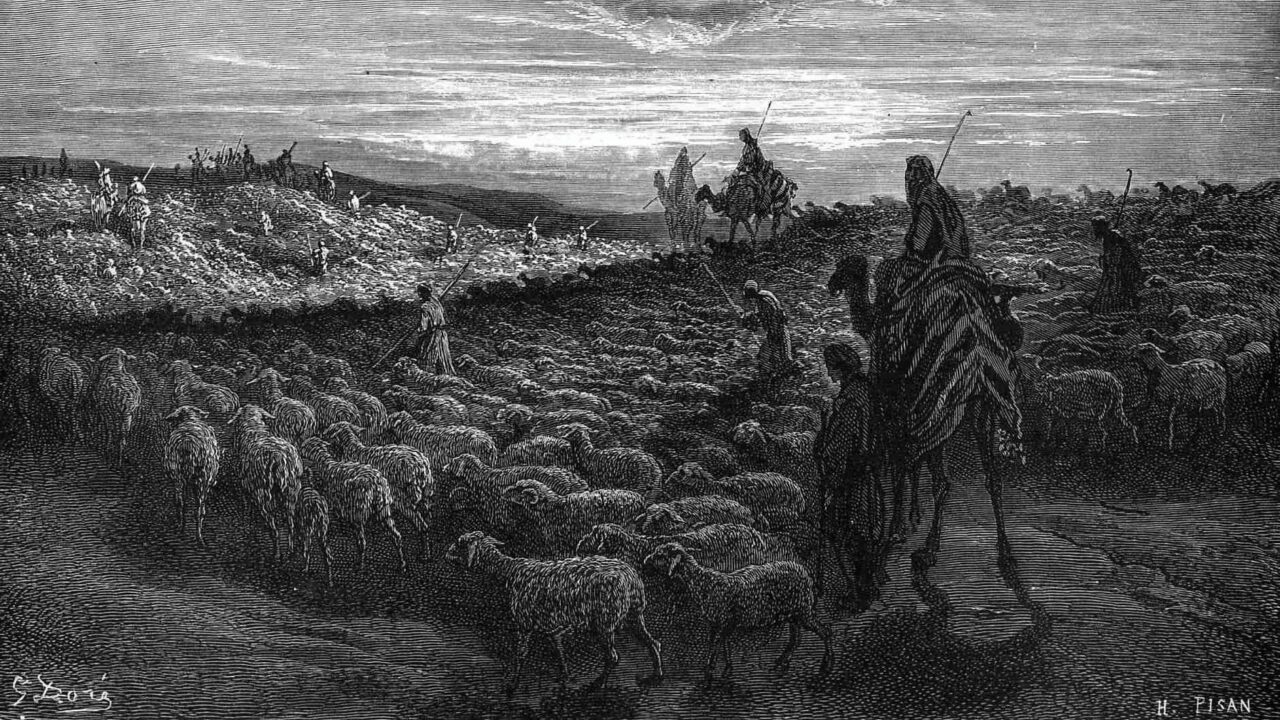
In this week’s Torah portion, Lech Lecha, God instructs Avram to leave all that he knows and begin a journey that will result in the covenant between God and the Israelites. “Lech lecha: Go to yourself,” God instructs Avram. Discover who you are and who you will be. Begin a journey to a new land and a new peoplehood.
In Chapter 17, God promises, “I will maintain my covenant between me and you and your descendants after you throughout their generations, as an everlasting covenant: to be God to you and to your descendants after you…. [And] I will give the land … as an everlasting heritage to you and to your descendants after you, and I will be God unto them.”
The future of Israel — the land and people — is born.
This year, on Kol Nidre, I talked about a modern definition of connection to our land and peoplehood. At this moment in history, we have arrived at a new “lech lecha” moment, when we are asked to look deep within ourselves and consider our identity and the future.
Rabbi Abraham Joshua Heschel wrote, “The tasks begun by the patriarchs and prophets, and carried out by countless Jews of the past, are now entrusted to us.” These words could have been written for this very moment. We look out across the desert toward Israel, just as Moses did. And like Moses, we stand at a moment of new beginning. Will there finally be a lasting peace in the Middle East? What does the future hold for us and the generations to come?
The Israelites wandered for 40 years toward a vision of the Promised Land that began in this week’s Torah portion. It was aspirational. It motivated our ancestors to wander toward a land that would be flowing with milk and honey. It led them to create a civil society based on laws that were given in the desert — before they ever got to the Promised Land.
The Torah’s message to our ancestors that we could build a society is still inspiring. But now we need to rethink what it means to be part of the land and people that God instructed Avram to imagine. We are living in a time of new possibility and a new paradigm. “Im tirzu ain zo agadah/ If you will it, it is no dream,” Theodor Herzl famously said. What will the future look like?
Just as God challenged Avram to leave behind what he knew and imagine what could be, we need a Zionism that doesn’t dwell on the past. One that finds partners to make peace with, as imperfect as they may be. It requires the vision of diaspora Jews who can dream a new dream for Israel with the benefit of a little distance. And it requires the vision of Israeli Jews to include us in a shared future with shared values. We must redouble our efforts to reconnect ourselves to each other and to teach our children about the fundamental importance of being part of the land and people of Israel, even in the diaspora.
“Lech lecha m’artzecha umimoladet’cha umibeit avicha el-ha’eretz asher areka,” God powerfully instructs Avram. Leave behind what has always been, what you’re comfortable with, the way you’ve always done things. And go to a land that I will show you — a land that you will dream about as you discover who you are.
How do we take these powerful words to heart nearly 3,000 years later, as we find ourselves dreaming about Israel? Seventy-eight years have passed since the founding of the modern State of Israel. And now, it is time for us to revisit the instructions God gave to Avram: Learn who you really are. Teach a sense of vision, peoplehood and belonging to the generations to come.
As we find ourselves in this moment of opportunity, we need to redefine what it is that the Jewish people stands for and what our shared peoplehood means in the world. Our living hostages have come home. It is time to think about rebuilding.
On Oct. 7, 2023, everything we knew broke. Our sense of identity was shaken to the core. Like Avram in this week’s parashah, we left all of our familiar places and relationships and were forced to redefine our surroundings. The soul-searching that has followed the horrible attack on our people has forced us to reimagine and redefine who we are and who we want to become. It is hard work. But like Avram, who built a strong relationship with God for himself and for future generations, we have the opportunity to go toward our true selves and to solidify our covenant with God for generations to come.