

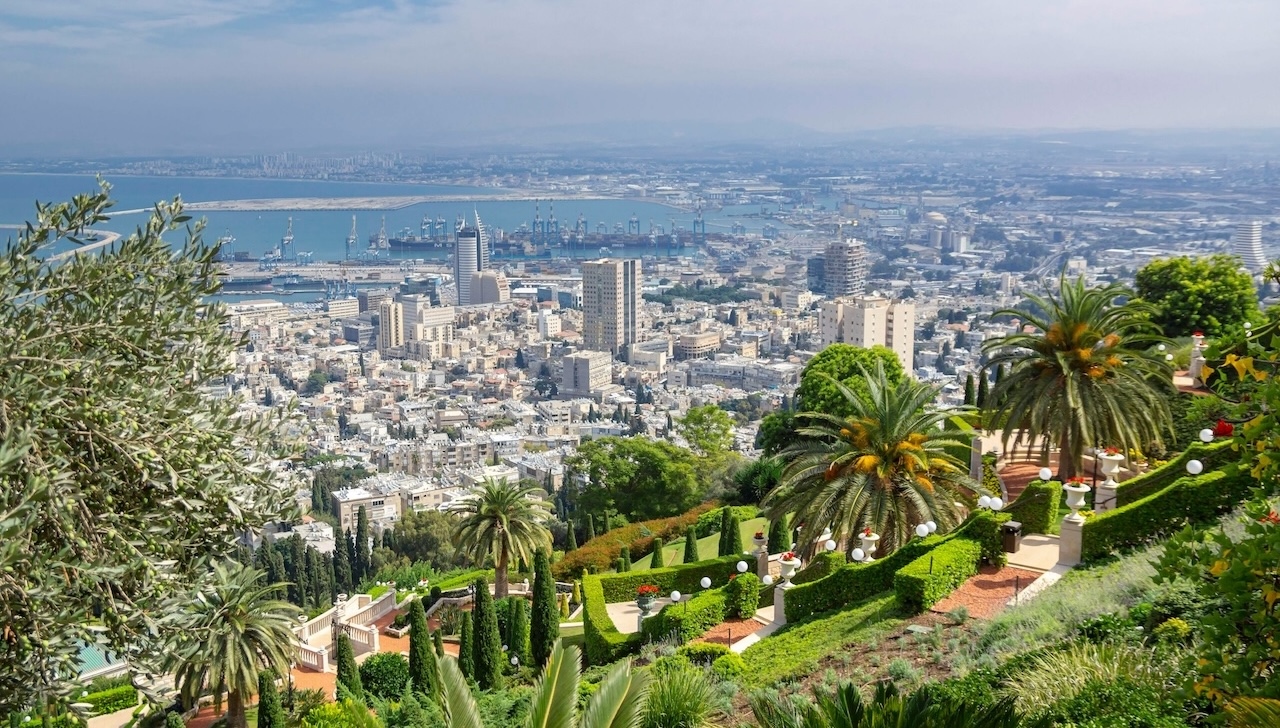
While often overshadowed by Tel Aviv’s reputation as Israel’s queer capital, Haifa has quietly nurtured a vibrant, complex LGBTQ+ legacy of its own. From its feminist history to its mixed Jewish-Arab communities, the port city has long been a site of intersectional activism and queer resilience.
Dotan Brom, a Ph.D. candidate at Tel Aviv University, is working to preserve this history. His doctoral research focuses on the queer history of Haifa from the British Mandate period up through the 1990s.

Through the Haifa Queer History Project, which he co-founded in 2015, Brom and his collaborators have collected oral histories, personal archives and artifacts documenting the lives and struggles of Haifa’s LGBTQ+ communities, both Jewish and Palestinian.
Brom presented some of his research at an event at Congregation Sha’ar Zahav on Oct. 23. The event was co-sponsored by Queers Against Antisemitism, a program of Jewish queer nonprofit A Wider Bridge and the San Francisco-Haifa Sister City Committee.
While in San Francisco, Brom spoke with J. about the importance of this work, Haifa’s unique place in Israel’s queer landscape and the surprising discoveries that continue to shape his research.
This interview has been edited for length and clarity.
What led you to this research?
The project actually grew out of my activist work over the past decade. Back in 2015, we founded the Haifa Queer History Project, a grassroots community archive and oral history initiative. Over the years, we’ve conducted around 30 interviews with elders from Haifa’s LGBTQ+ community — Jews and Palestinians, trans and cis, gay, lesbian, bi — everyone.
We’ve also collected physical materials people had tucked away in their attics or shoeboxes: flyers, party invitations, organizational papers, even two estates from individuals who passed away.
Why is collecting these kinds of personal materials so important?
Because queer history isn’t preserved in Israel’s official archives, the National Library or even the city archives. And the narrative that does exist is almost entirely centered on Tel Aviv. When people think about LGBTQ+ life in Israel, they think of Tel Aviv. For us, building an archive in Haifa was about reclaiming our own history as a community.
Even seemingly small items, like a party invitation, can tell us where people met, how they socialized and how they built community.
How would you describe Haifa’s place within Israel’s broader queer landscape?
Haifa is Israel’s third largest city, so naturally it’s had its own queer life and networks. It wasn’t as big a hub as Tel Aviv, but it’s a very particular place — a port city with strong feminist circles and a genuinely mixed population of Jews and Arabs. That creates a distinct social fabric and history that differs from both Tel Aviv and Jerusalem.
Did Haifa’s connection to San Francisco, its sister city, have any impact on its queer culture?
Honestly, not much. But there is an American influence, though. Because Haifa was a regular docking point for the U.S. Navy in the 1990s, sailors would often spend time in the city, and some naturally ended up in the cruising spots, like at Gan HaZikaron (Memorial Park).
Were there any discoveries in your research that particularly surprised you?
Many. I learned that some of Israel’s most important trans figures, like Nancy Schneider, Gila Goldstein and Zalman Shoshi, had major parts of their lives rooted in Haifa. Even the only known Palestinian trans woman of the 1960s, Mahmouda Riad, began her journey there.
And there’s the story of Marcia Freedman, an American immigrant to Haifa who founded Israel’s Women’s Liberation Movement in the early 1970s, became a Knesset member and later came out as a lesbian. She established the country’s first women’s shelter and played a huge role in feminist and lesbian-feminist organizing. These stories show how intertwined Haifa’s queer history is with broader feminist and political struggles.
A key focus of your academic work is analysis of the power dynamics between Jewish and Palestinian gay men during the 1990s. Can you elaborate?
In the 1990s, most LGBTQ+ organizations were predominantly Jewish and male, with very few Palestinian participants. That reflected both the social realities of who could safely come out, and deeper political dynamics. Within these spaces, Palestinian men were sometimes objectified or tokenized. Over time, especially as Israeli politics became more polarized, queer spaces themselves became more segregated.
Central to my study are two murder cases involving Jewish men and their younger Arab partners, sensationalized in the media as “homosexual murders.” These cases reveal how economic pressures, shifting sexual norms, power and the Israeli-Palestinian conflict intersected in Haifa’s queer scene.
How do you hope your work will impact the way people think about queer history in Israel?
I think one of the problems for people in Haifa is that we kind of live in the shadow of Tel Aviv. Like, when anything nice happens in the city, you say, ‘Oh, it’s like Tel Aviv.’ Or people say, in frustration, ‘You know, it will never be Tel Aviv.’ And I think it is OK, we don’t need to be Tel Aviv. We have our own thing going on, and the spirit of the city is unique to its own. Haifa has its own queer story, and it deserves to be told.