

The Torah column is supported by a generous donation from Eve Gordon-Ramek in memory of Kenneth Gordon.
Vayera
Genesis 18:1-22:24
There is a moment in this week’s Torah portion, Vayera, that seems simple, almost ordinary, yet it radiates with timeless beauty.
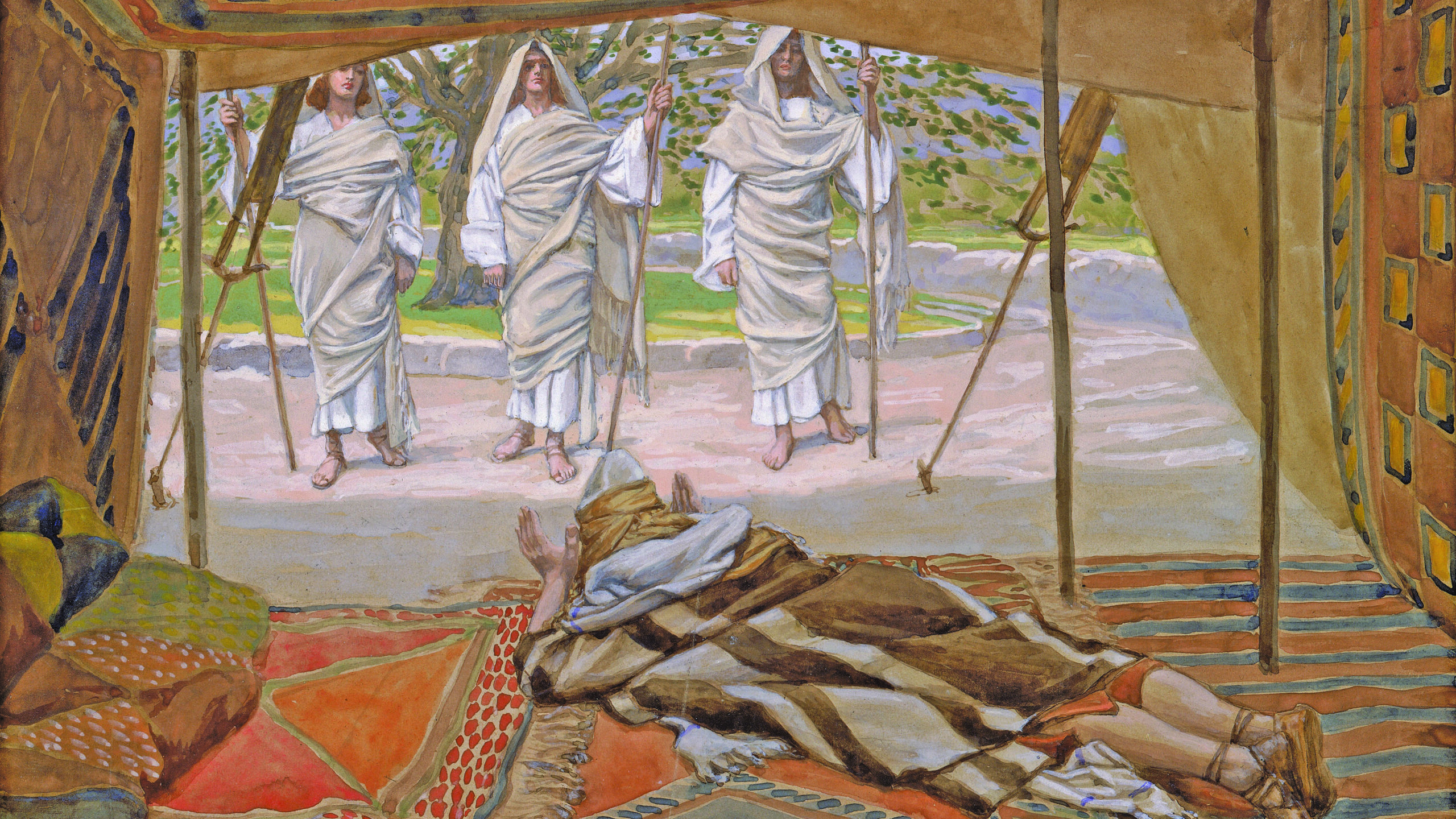
Abraham is sitting at the entrance to his tent, recovering from circumcision, kechom hayom — “in the heat of the day.”
The desert sun is merciless. The light shimmers on the horizon. Most of us, had we been in Abraham’s place, would have sought the shade, the comfort of rest. Yet Abraham sits at the doorway, scanning the empty landscape. He is looking for guests, for travelers to whom he can offer food, water and shelter.
He does not wait for them to come to him. He searches for them. And when he spots three figures in the distance, he does something astonishing for a man of his years and his pain: He runs to greet them. He bows low and says, “Let a little water be brought, wash your feet, rest under the tree, and I will fetch bread so you may refresh yourselves.”
Then he hurries to prepare a banquet. Sarah kneads the dough and bakes the bread. Abraham runs to the herd and selects a tender calf. Together, they serve their guests a meal of warmth and generosity.
The story seems straightforward. But at its beginning lies a phrase whose subtlety opens an entirely new dimension of meaning.
The Torah says that Abraham was sitting kechom hayom — usually translated as “in the heat of the day.” Yet if it merely meant “in,” the text should have said bechom hayom. Instead, it says kechom hayom — literally, “like the heat of the day.”
That single letter changes everything.
The verse is not only telling us when Abraham sat at the entrance of his tent. It is telling us who he was.
Abraham was like the warmth of the day itself. He sat there kechom hayom — like the sun, radiating warmth to a world grown cold. He was, to those travelers, what the sun is to the earth: a presence of light, of generosity, of hope.
The Torah is showing us the essence of Judaism before there was Sinai, before there was law, before there was nationhood: the call to be kechom hayom — to be like the warmth of day.
It is a call to see the pain of others, to bring light where there is darkness, warmth where there is loneliness, hope where there is despair.
But there is another layer.
The Torah emphasizes that Abraham was in pain, that he was recovering. That is not a passing detail — it’s the whole point. It is easy to be kind when life is comfortable. But to open your tent while you’re hurting, to reach out when your own heart is aching — that is divine.
In 1944, a young Jewish boy named Sol stood in the darkness of another world. The Nazis had stormed the city of Munkatch, herded its Jews into ghettos, then into the cattle cars bound for Auschwitz. When the doors opened, it was night.
Sol and hundreds of others were forced into the infamous line — left or right, life or death. He was 17, terrified, and alone. As he stood there, trembling and crying, a skeletal figure in striped rags stepped out from the shadows. The man asked softly, in Yiddish, “In what year were you born?”
“1927,” Sol whispered.
“No,” said the man urgently. “You were born in 1925. Remember that. What year were you born?”
“1925,” said Sol.
Moments later, Sol reached the front. “What year were you born?” asked the SS officer.
“1925.”
The officer nodded, pointing him to the right — toward forced labor, not the gas chamber. All those under 18 were sent to their deaths that night. The man who saved him vanished back into the darkness.
Sol Teichman survived. He went on to build a new life in Los Angeles — to found schools and synagogues, to support centers of learning and hospitality across the Jewish world. Yet every day, he remembered that moment — the whisper in the night, the stranger who reached beyond his own agony to save another life.
That man, standing in Auschwitz, was kechom hayom. He was Abraham at the tent, shining warmth into a world grown cold. He was Abraham in Auschwitz.
That is what it means to be a Jew: To feel another’s pain even when you are drowning in your own. To bring light when you yourself are surrounded by darkness. To choose empathy over apathy, compassion over despair.
We all carry the power to be kechom hayom — to be rays of sunlight in someone else’s storm.
The world has enough cynicism, enough indifference, enough coldness. What it needs are Abrahams and Sarahs, souls who will rise, even in pain, and ask: Who needs me right now? Whose world can I warm?
We may not always have answers. But like Abraham, we can open our tents. Like that nameless prisoner, we can hear the cry of another and whisper life into their darkness.
Even when the day feels hot, even when our own hearts ache, we can still be the warmth of the day. That is the legacy of Abraham. That is the soul of our people. And that is the light each of us was born to bring.