

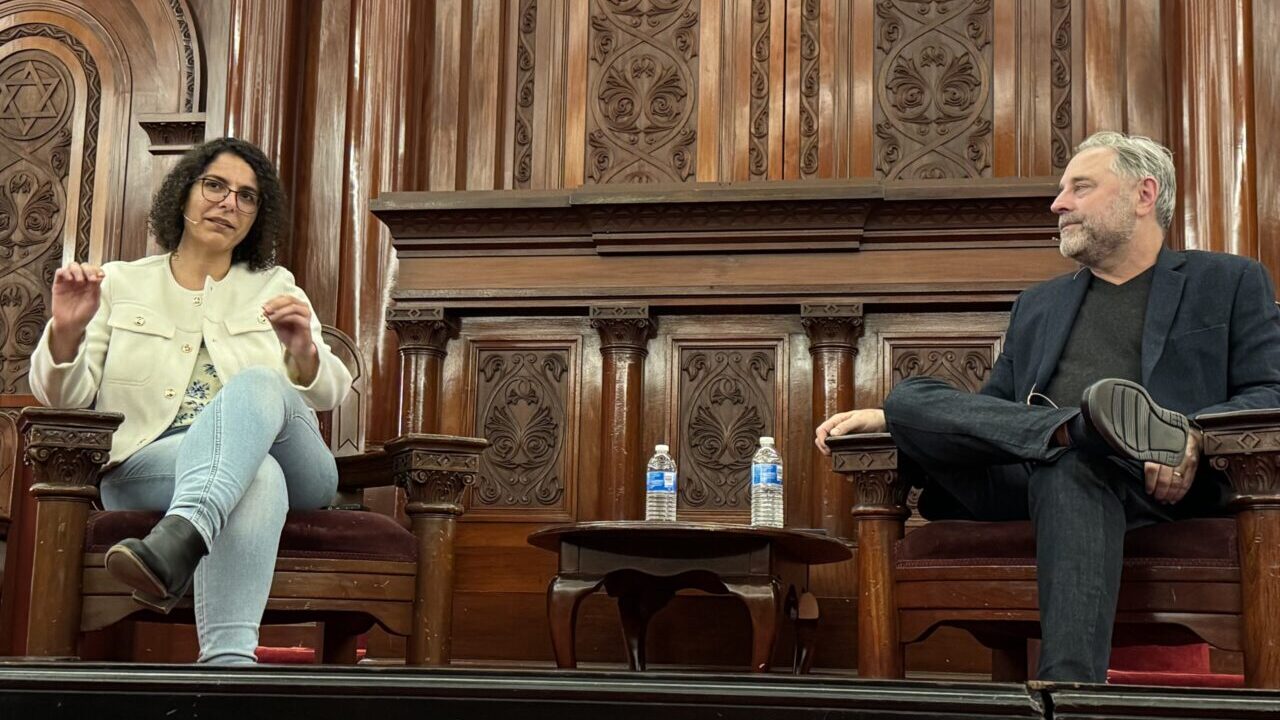
New Israel Fund CEO Daniel Sokatch smiled ruefully Tuesday night as he acknowledged Israel’s debt to President Donald Trump.
“There would be no cease-fire without Donald Trump imposing it on [Prime Minister Benjamin] Netanyahu,” Sokatch, a political progressive with no love for Trump, told some 150 people gathered at Congregation Sherith Israel in San Francisco.
The audience came to hear Sokatch in conversation with NIF board member Dr. Yasmeen Abu Fraiha about the future of the Israeli-Palestinian conflict.
“We have to give credit where credit is due,” Sokatch said. But, as both Sokatch and Abu Fraiha pointed out, the cease-fire is “very, very fragile,” and the future of Gaza remains unknown.
“The bombing has stopped, but it’s not like life in the West Bank and Gaza is better,” said Abu Fraiha, an Israeli Bedouin physician and longtime peace activist who is completing a clinical fellowship in critical care medicine at Beth Israel Deaconess Medical Center in Boston. “People are still hungry. Seventy percent of Gaza is destroyed.”
In a way, some things are worse, she said, noting that medical evacuations are more difficult because fewer countries are willing to accept Gazan patients as there is no longer a hot war taking place.
A native of Tel Sheva, a Bedouin town in the Negev, Fraiha spent 16 straight hours in the ER in Beersheva’s Soroka Hospital on Oct. 7, 2023, treating victims of the Hamas attacks. They were Mizrahi Jews from Sderot and Ofakim, Ashkenazim from border kibbutzim, Thai and Nepalese workers, as well as Israeli Bedouins, some from so-called “unrecognized” villages that are not provided with bomb shelters.
“I looked around and thought, not only are our patients from all these backgrounds, but my colleagues who rushed in to help from all over the Negev — religious Jews, settlers, left-wing kibbutz members and many, many Bedouins,” Abu Fraiha recalled. “I had an epiphany: It’s not about Jew or Arab. The dividing line is between people who believe violence is the answer to the conflict and people who believe in the sanctity of life.”
Sokatch, a San Francisco resident who has been with the New Israel Fund for 17 years, discussed the ways in which Oct. 7 changed the relationship between Israelis and their government. Because the government proved unable not only to protect its borders, but to provide needed social services in the days and weeks after the attacks, he said, civil society, mostly nonprofits, stepped in to do that work instead.
“Civil society pivoted on a dime,” he said. NIF financially supports many of those nonprofits, he said, describing them as “working for democracy and equality” in Israel. “Providing social services is supposed to be the job of the government, but in those weeks and months, we had to do it.”
Sokatch sees this shift as ongoing, both in Israel and in the United States, where he referenced the millions who protested Trump during “No Kings” demonstrations across America last month. “We live in an era of democratic recession,” he said. “We are the majority. We need to take to the streets to show we care.”
Asked by an audience member what has changed in Israel since the assassination of former Prime Minister Yitzhak Rabin exactly 30 years ago, Abu Fraiha said that while many on the left, including her, are “still grieving” his death, “things have really shifted in the past three years,” a period that began a year before Oct. 7 with the rise of the pro-democracy protest movement galvanized by Netanyahu’s proposed judicial reform.
“We are still far from his legacy,” she said, referring to Rabin’s dreams of peace between Israel and its Arab neighbors. “But his idea about the need for peace is gaining ground. With this war, people are realizing that you can’t ignore the situation with the Palestinians. It’s not something you can ‘manage.’”
“What Yasmeen just said is not to make us feel better,” Sokatch said. “In the last three years we have seen a civil society that is not giving those in power a minute’s rest. We have a civil society that is, in many ways, the envy of the world.”
Asked why they are not “in despair” over the situation in Gaza and inside Israel, both Sokatch and Abu Fraiha shook their heads.
“I don’t understand people who lose hope,” Abu Fraiha said. “We work with people who lost their homes, who lost family members, and they say, we are going to bring this government down and bring peace. How can you be in despair when you work with such people?”
“What chutzpah I’d have to have [in order] to lose hope,” said Sokatch. Quoting the great 20th-century rabbi and activist Abraham Joshua Heschel, Sokatch concluded, “Despair is a sin a Jew can’t afford.”