

Updated on Nov. 17
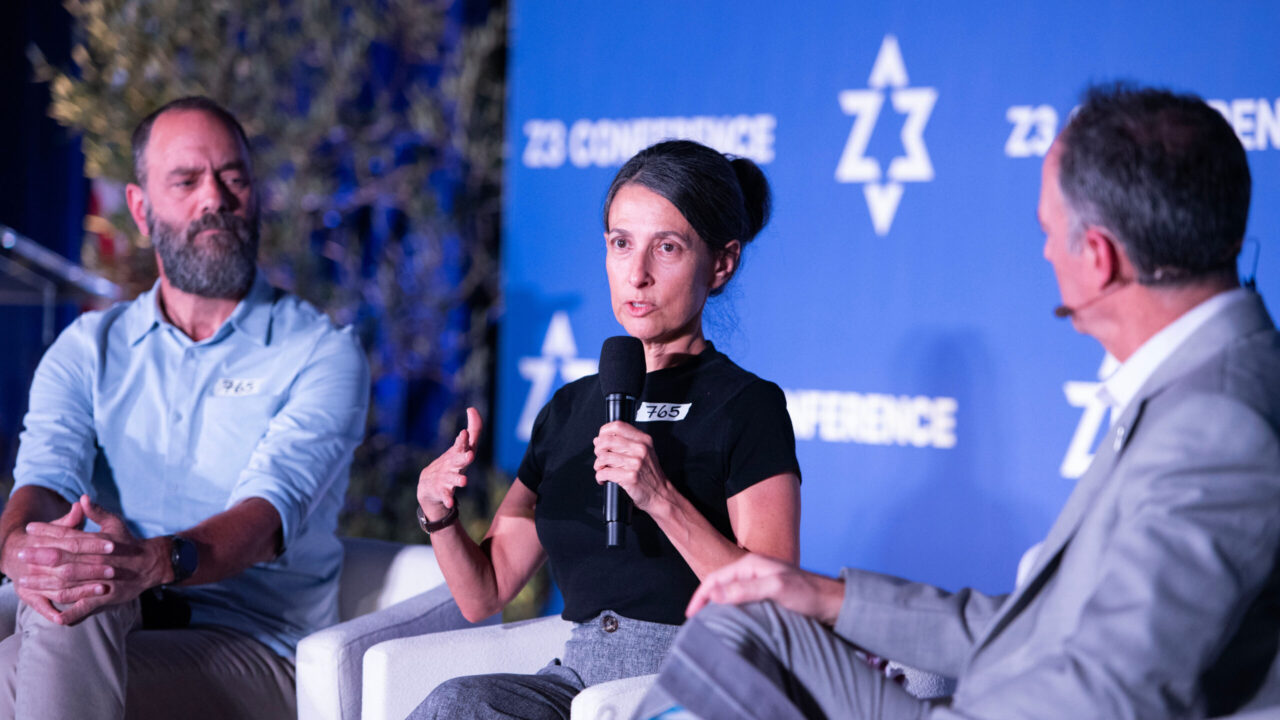
The 11th annual Z3 conference came to a close at the Oshman Family JCC in Palo Alto with a powerful plenary featuring Jon Polin and Rachel Goldberg-Polin, in conversation with JCC CEO Zack Bodner.
Speaking to some 2,200 attendees of all ages, the parents of fallen hostage Hersh Goldberg-Polin spoke about their evolving relationship with grief and God, and where they place their hope for the future.
Goldberg-Polin addressed some of the common assumptions — that she must be angry with God, or that her faith has been shaken — since her son was abducted on Oct. 7 and killed by Hamas in August 2024. But for her, the feelings are much more complicated.
“It’s very difficult to articulate in words what it feels like when your child is stolen,” she said. “Every day when I would wake up, even though I wanted to lay on the floor in despair, I would open my eyes and say ‘Modeh Ani,’” the daily morning prayer meant to thank God for “restoring one’s soul with mercy.”
Those words signified God’s faith in her, and her feeling of God’s presence during the toughest moments after Hersh was abducted.
“We’re always talking about whether we have faith in God. And here, the very first thing we say every morning is, you have faith in me. You gave me back my life, because I’m not done,” she said. “The closest I ever felt God in the room was when they came to tell me Hersh was killed. It was so obvious to me. I personally don’t know how I could go through this without that.”
Polin admitted his relationship with God is more of a struggle, but said he is leaning into it now more than ever. He said he channels some of his feelings toward thinking about Israeli society and what needs to happen next, in the postwar era.
One problem Polin points to is the tendency of government leaders in Israel to discount that the Jewish and Arab populations between the Jordan River and Mediterranean Sea are almost equal.
There are 7.7 million Jews and 2.1 million Arabs in Israel, according to the latest data from Israel’s Central Bureau of Statistics, but that does not take into account the roughly 3.2 million Palestinians in the West Bank and 2.1 million in the Gaza Strip, according to the CIA World Factbook.
“Few political leaders in Israel are willing to say we need to put this on the table and talk about it. I don’t think that there is a short-term solution, but I want leadership who acknowledges that this is a reality,” Polin said. “For the sake of our kids and our grandkids, we want to start to change it. We’re going to be strong, we’re never going to be invulnerable, but we are prepared to start talking about a different future with our neighbors.”

Z3 attendees said they were inspired by the programming at this year’s conference. San Rafael residents Anne and David Rosenfeld spoke with J. after a panel on compassion during a time of war, and said it was their first time attending Z3. It delivered exactly what Anne was hoping to see, she said.
Listening to people from different backgrounds, Israelis and Arabs included, was particularly inspiring to her and reminded her of the social work she and her husband do with underserved communities in Marin County. “We have the same feeling, that we’re all in this together,” she said.
Following the closing plenary, the Goldberg-Polins visited the teen summit tent to speak with Z3’s youngest attendees, whom Polin described as a source of great “energy and strength.”
Miri Kontorovsky, an eighth-grader at Gideon Hausner Jewish Day School, shared her best guess as to why her generation has that energizing influence.
“I think that they want to see the next generation owning up to being Zionists, and being happy to be Jewish, almost like how Hersh was very happy and enthusiastic, a good kid who was always truthful and honest,” she told J. during the evening reception. “Maybe they’re looking for that in us. So the way for them to do that is to be enthusiastic and joyous toward us, so that we can learn from them.”
Polin sees the same strength in young Israelis who came to Kibbutz Nir Oz on a post-high school program to assist in the community’s rebuilding efforts.
“Every one of those [teenagers] chose that program because they wanted to be part of rebuilding the battered south. I want that to be contagious among all of us, and among the young people,” he said. “We’re all reeling from all the big issues, Oct. 7, antisemitism, and we’re feeling weak and vulnerable. But there’s just so much to be proud of.”