

As Jewish communities face a cascade of overlapping crises, the question many donors are asking this season is not whether to give, but where their support is needed most.
From food insecurity and housing instability to mental health, antisemitism and the rising cost of Jewish life itself, the scope of need has grown so broad and complex that even leaders of major philanthropic organizations in the Bay Area point to different priorities. Behind the headlines, they report countless, quieter struggles that span every stage of life.
A 2021 community study found that roughly one in four Jewish households in the Bay Area felt financially insecure. Nonprofit leaders like Nancy Masters, associate executive director of S.F.-based Jewish Family and Children’s Services, now believe that number is significantly higher. As housing costs, food prices, health care expenses and child care rates continue to rise, she said, wages and job opportunities, particularly in the Bay Area, have failed to keep pace.

(Courtesy JFCS)
“We see more and more people who now can’t quite make it on what they have,” Masters said. “And it’s getting worse.”
JFCS is hearing daily from people who have lost jobs, are facing eviction or are experiencing a health or mental health crisis, Masters said. She describes a range of people who are facing financial burdens: Families with children, especially those with special needs, are struggling. Young adults in their 20s are finding it increasingly difficult to achieve financial independence. Adults in their 50s and 60s who are laid off often lack sufficient savings to weather long job searches. Seniors on fixed incomes face rent increases and rising medical costs with few options for relief.
Food insecurity is urgent
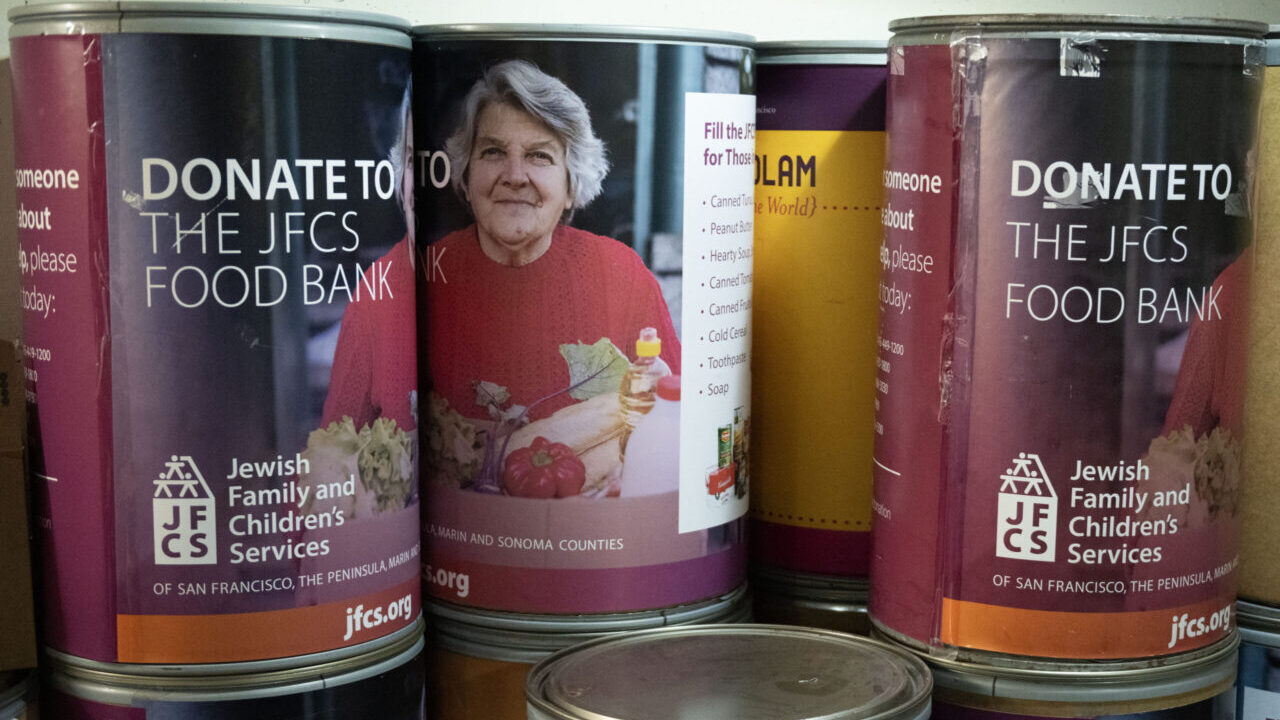
Food insecurity has become one of the most urgent manifestations of this strain. With the disruption of SNAP benefits during the 43-day federal government shutdown in October and November, many Jewish households that relied on the program had to turn to community organizations like JFCS for food assistance. JFCS operates the largest Jewish food bank in Northern California, and Masters said it has seen huge increases in demand as families try to recover from the SNAP disruption.
According to Dana Sheanin, CEO of S.F.-based Jewish
LearningWorks, Jewish educators are increasingly turning to food banks and social service agencies to make ends meet.
“There is a mythology that there’s no poverty in the Jewish community, but it’s actually not true,” she said, noting that Jewish educators in particular are “chronically underpaid.”
Joy Sisisky, CEO of the Jewish Federation Bay Area, said seniors represent another population whose needs often remain out of sight. Many face isolation, transportation barriers and difficulty accessing health care. Holocaust survivors and older immigrants are particularly vulnerable, often living on limited or fixed incomes while navigating complex service systems.
Domestic and gender-based violence is another critical but underrecognized issue, Sisisky said. Economic instability and heightened stress increase the risk of abuse, particularly for women. She pointed out that organizations like Shalom Bayit provide life-saving services, yet these needs rarely have the same visibility as other crises.

(Courtesy HFL)
At Hebrew Free Loan in S.F., executive director Cindy Rogoway sees a different side of the same story: middle-class and working-class families who appear stable but are quietly one emergency away from collapse. In the third quarter, she said, Hebrew Free Loan disbursed 20 percent more money in loans than it did in the same period in 2024.
“A big group of people that need loans from us are good, hard-working people trying to make ends meet and build a life for their families, but they can’t,” she said.
Many of the people who apply for loans with Hebrew Free Loan have jobs, degrees and steady incomes, Rogoway said, but they have high credit card debt — often from the Covid years — no emergency savings and no ability to absorb a sudden car repair, medical bill or move.
“People live so on the edge, through no fault of their own,” Rogoway said. “It’s really difficult to keep up with the cost of living.”
Interest-free loans are being used for everything from medical needs to debt consolidation, she said, and there has been a sharp rise in business and student loans, which echoes patterns seen after the 2008 recession, as people turn to entrepreneurship or higher education when employment is out of reach.
Rogoway described several common scenarios: Someone’s car dies and they can’t afford to buy a new one, but they need their car to get to work. Or a two-income family is going through fertility treatments, but one partner loses their job and now they can’t afford to continue. Some families aren’t able to pay for their children’s braces or cover all their education costs.
“Just today, we were considering [a loan application] for a single mother who wants to move her child to another school because there’s been a lot of antisemitism at the school the child attends,” said Rogoway.

(Courtesy Jewish LearningWorks)
She explained that the family was “just sort of making it” and couldn’t afford to relocate to another neighborhood so their child could attend the new school — an expense the mother feels is necessary for her child’s safety.
“There’s just a level of fear and anxiety in the community that is just pervasive, and it makes people feel less hopeful about the future and more worried and anxious,” Masters said.
The fear and anxiety aren’t just affecting adults. There is an emotional toll that is increasingly evident among children. Jewish LearningWorks reports rising anxiety, depression and loneliness among teens, elementary-age children and even preschoolers.
Children have been absorbing stress from many directions, Sheanin said: antisemitism, the Israel-Hamas war, climate anxiety, political instability and lingering post-pandemic disruption. She said even very young children are affected by what they overhear at home or experience through older siblings.
Rising cost of Jewish life
At the same time, the cost of participating in Jewish life — where historically people have turned for support, comfort and connection — continues to grow. Preschool, synagogue membership, day school and summer camp are increasingly out of reach for middle-income families, who often earn too much to qualify for full scholarships but not enough to comfortably afford tuition and fees. When budgets tighten, Jewish engagement can often be the first thing families cut.
Jewish organizations and institutions feel this strain acutely. Jewish LearningWorks has seen a 50 percent drop in individual giving over several years, along with steady declines in foundation support, as donors redirect dollars to causes that feel more urgent or immediate. One East Bay synagogue turned to Hebrew Free Loan to fill in the financial gaps when a major donor died, Rogoway said, leaving them without critical funds they were counting on.
“Congregants might have been able to support them more in the past, but right now they’re unemployed, or they have a lot of other costs,” said Rogoway. “People are having trouble, so they may not give as much.”

(Aaron Levy-Wolins/J. Staff)
The Jewish Federation Bay Area is seeing these challenges from a systems-wide perspective. Over the past fiscal year, the Federation granted approximately $4 million directly to Jewish health and human services agencies and about $25 million total to health and human services across the Bay Area.
Sisisky emphasized that the Federation’s work often happens behind the scenes: strengthening Jewish life and identity, caring for those in need, promoting justice and inclusion, combating antisemitism and responding to crises in Israel, Ukraine and beyond. Sisisky noted that the Federation is also the primary resource for Jewish security in the area, helping institutions prepare for and respond to rising threats amid a more than 344 percent increase in antisemitic incidents nationwide, according to the Anti-Defamation League.
Donor-advised funds have become a key tool in this landscape, Sisisky said, allowing individuals and families to give strategically. With tax changes in 2026 that may reduce charitable deduction benefits, she also said this is a particularly important moment for giving.
While major crises demand attention, countless individuals are living through quieter emergencies every day. Economic hardship, food insecurity, mental health struggles and isolation do not always make headlines, but they shape the fabric of communal life.
Leaders encourage donors to act with compassion and balance: to support immediate needs while also sustaining the educational, cultural and relational institutions that build long-term resilience. Volunteering time, giving what one can and staying engaged with organizations that personally matter all play a role.
A call to give — and receive
“Now is not the time to leave your synagogue. Or if you have a child in a day school and you’re struggling, talk to the school about scholarship. Don’t just pull away from it,” Sheanin said.
Equally important is asking for assistance.
“People feel very anxious and very burdened, and I think that contributes to a fear of asking for help,” said Sheanin. “If you have means, make an extra gift to something that might not originally have been on your list. And if you need help, ask for help. We’re so fortunate to have this amazing network of communal organizations that has been built over centuries.”
Added Masters, “Every dollar that’s given helps, every contribution, every $18 or $36 that an organization gets goes to help the bottom line of being able to provide the services. Whatever gift people can give, large or small, it’s always meaningful.”
Sisisky said that in addition to addressing immediate needs, the Federation is focused on supporting Jewish joy. Programs like PJ library, which sends free books to Jewish families about Judaism and Jewish holidays, and community events like Shabbat dinners and Hanukkah parties are crucial for morale during hard times.
“I hope people will think about supporting all of that as well,” she said, “because that’s what’s going to keep us here.”