

Updated Jan. 14
For many people, tarot cards belong to a vague realm of mystery, falling somewhere between magic and malarkey. Historians and practitioners have long argued over the origins of tarot and debated whether the cards have any enduring meaning at all.
Stav Appel never intended to enter that debate. He certainly didn’t think there was anything Jewish about it.
“I was never into tarot cards or fortune telling or astrology,” he told J. “That was another world from where I came from.”
By training, Appel is a Yale-educated data scientist. By devotion, he is a Torah scholar. He describes himself as a “bit of a hermit” and said he dedicates time each day to read Jewish texts in his New York home.
One day his wife came home with a tarot deck. As Appel flipped through the cards, he immediately recognized imagery he intimately knew: Biblical scenes, ritual objects and symbolic motifs that seemed to be drawn directly from Jewish tradition.

That moment drew Appel into a decade-long investigation, culminating in his book, “The Torah in the Tarot,” which he will discuss Thursday at a sold-out event at JCCSF and Saturday at Berkeley’s Congregation Netivot Shalom. The book, published in October by Ayin Press, sold out. A second printing is in the works.
In his book, Appel theorizes that one of the earliest and most influential tarot decks was not recreational or occult in origin, but Jewish. Appel believes Jewish artists encoded Hebrew letters, ritual symbols and sacred narratives into the imagery of tarot decks during eras when Jews were persecuted.
The oldest tarot decks are from 15th-century northern Italy. These decks, composed of 22 trump cards called the major arcana and 56 suit cards called the minor arcana, were originally used by nobility for a game called tarocchi, from which the word “tarot” is believed to derive.
Over the centuries, however, the striking imagery on the cards invited interpretation and speculation.
As Appel notes in his book, “numerous volumes have been written” claiming that the practice of using tarot cards for divination is a “secret vehicle for Egyptian mythology, Neoplatonism, Catharism, Catholic mysticism, Hermetic Qabalah, alchemy, astrology, all the above, and even more.”
In 1981, historian Frances Yates challenged the established scholarship of the time, pointing to a detail others had largely overlooked: The 22 cards of tarot’s major arcana correspond to the 22 letters of the Hebrew alphabet. That parallel, she wrote, at least opened the door to a Jewish interpretive framework.
Most tarot experts didn’t step through that door — but Appel did.
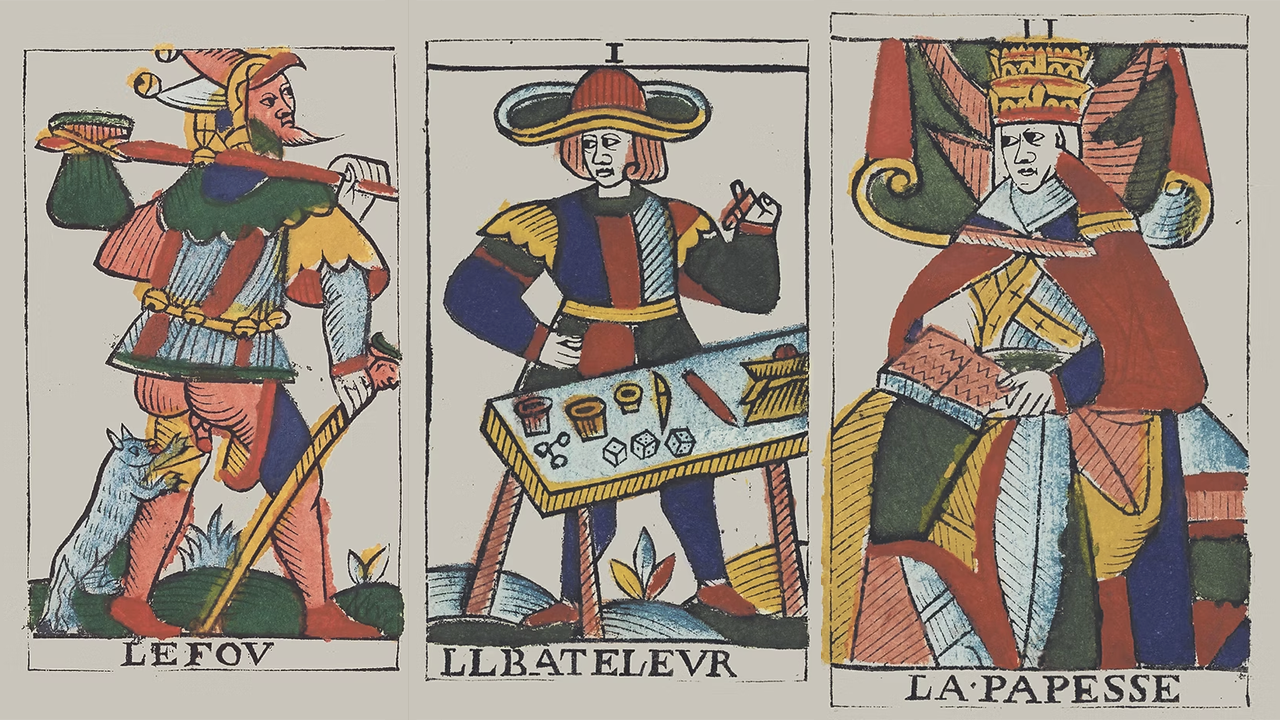
“The Torah in the Tarot” focuses on the Jean Noblet Tarot set, printed in Paris around 1650. It is one of the oldest complete decks in existence and a foundational model for later tarot traditions, including the Rider-Waite-Smith Tarot, which is considered the classic deck today.
Appel argues that the Noblet deck is a deliberately Jewish one, created by artists who hid Torah, Hebrew language and Jewish ritual in the images at a time when openly practicing Judaism was dangerous.
Other decks, he said, borrowed from Noblet. People with occult practices who used tarot cards noticed those patterns but didn’t interpret them as Jewish.
The historical context, Appel asserts, makes such an erasure unsurprising.
Jews had lived in France since the Roman era, but by the time the Noblet deck appeared Jews had been repeatedly persecuted across centuries: Talmudic manuscripts and other Jewish books were publicly burned, synagogues were converted to churches and Jews were dispossessed, expelled or slaughtered.
Jewish life persisted undercover. Appel contends that the tarot deck was part of a survival strategy. Playing cards were abundant and benign, and their structure made them ideal for encoding knowledge that would have appeared meaningless to non-Jewish eyes.
Like Yates, Appel focused on the idea that the major arcana corresponds to the 22 letters in the Hebrew alphabet. He decodes each image in the Noblet deck. Appel sees the forms of Hebrew letters in how people’s bodies are posed on the cards. He also points to Biblical scenes disguised as allegory, Jewish holidays embedded in landscapes and ritual objects hidden in plain sight.

Appel describes, for example, how “La Lune” (The Moon) contains a secret depiction of Passover, a holiday that always starts on a full moon. On the card, he writes, an image of a body of water and a lobster conceal the Hebrew letters “mem” and “tsadi,” the first two letters in the Hebrew words “Mitzrayim” (Egypt) and “matzah.”
The lobster appears to separate the water into two sides, referencing Moses parting the Red Sea. At the bottom of the image are three rounded objects, which Appel believes to be three pieces of matzah featured in a seder. Above the water are a dog and a lamb. The dog, Appel writes, refers to Exodus 11:7, which states that during the final plague, “not even a dog will bark at any Israelite, man or beast.” The lamb refers to the unblemished lamb sacrificed by Israelites during Passover to mark their homes for protection.
For Leslie Schaffer, a Jewish tarot reader and co-founder of the San Francisco Tarot Society, Appel’s theory initially sounded improbable.
“I didn’t think there was any connection between actual Judaism and Tarot,” she said. “I knew about Christian Qabalah, the sort of a bastardized version of Kabbalah present in the more esoteric decks. But I didn’t think there was any actual Jewish connection because I didn’t think of tarot and Judaism as being particularly compatible.”
Schaffer grew up immersed in Jewish life. She attended San Francisco’s Brandeis Day School, became a bat mitzvah, learned Hebrew and regularly attended Or Shalom Jewish Community in San Francisco. She began reading tarot cards at 13 and began a formal study of the practice as an adult.
She had used the Noblet deck before learning about Appel’s work, but nothing about it struck her as Jewish at the time.
“Once he pointed things out, all of a sudden I could look at that deck in a new way,” she said. “That was pretty exciting.”
Although Appel’s work has been embraced enthusiastically in Jewish spaces, the response from the tarot world has been less welcoming.
He said he was repeatedly told the connection was “impossible.” Tarot historians insist the cards are Catholic. Occultists embrace Hebrew letters while avoiding the word “Judaism.” Appel noticed the same reaction again and again.
“For some reason, no one would ever take that extra step to Judaism and Jews and connect tarot to the Hebrew alphabet,” he said. “It’s such a zany, embarrassing blind spot.”
Schaffer understands the hesitation. Tarot, and the practice of divination in general, thrives on mystery. Establishing an origin — especially one that contradicts the narratives taught within the tarot community — can feel threatening, she said. However, Schaffer rejects the idea that learning the history of the cards would drain them of their mystique.
“That only makes it more interesting to me,” she said. “It makes it a much richer experience because these are cultural objects, and if you remove them from their culture, they just don’t mean quite as much.”
For Appel, history and interpretation do not have to cancel each other out.
“Tarot card readers, in my mind, are primarily poets,” Appel said. “You can’t dictate to a poet how to interpret a particular symbol. They have creative freedom to do that.”
His work, he emphasizes, is not an attempt to police the meaning of the cards or strip them of their mystery, but to widen the story of that mystery’s origin.
“This isn’t about claiming tarot,” he said. “It’s about restoring a missing history.”