

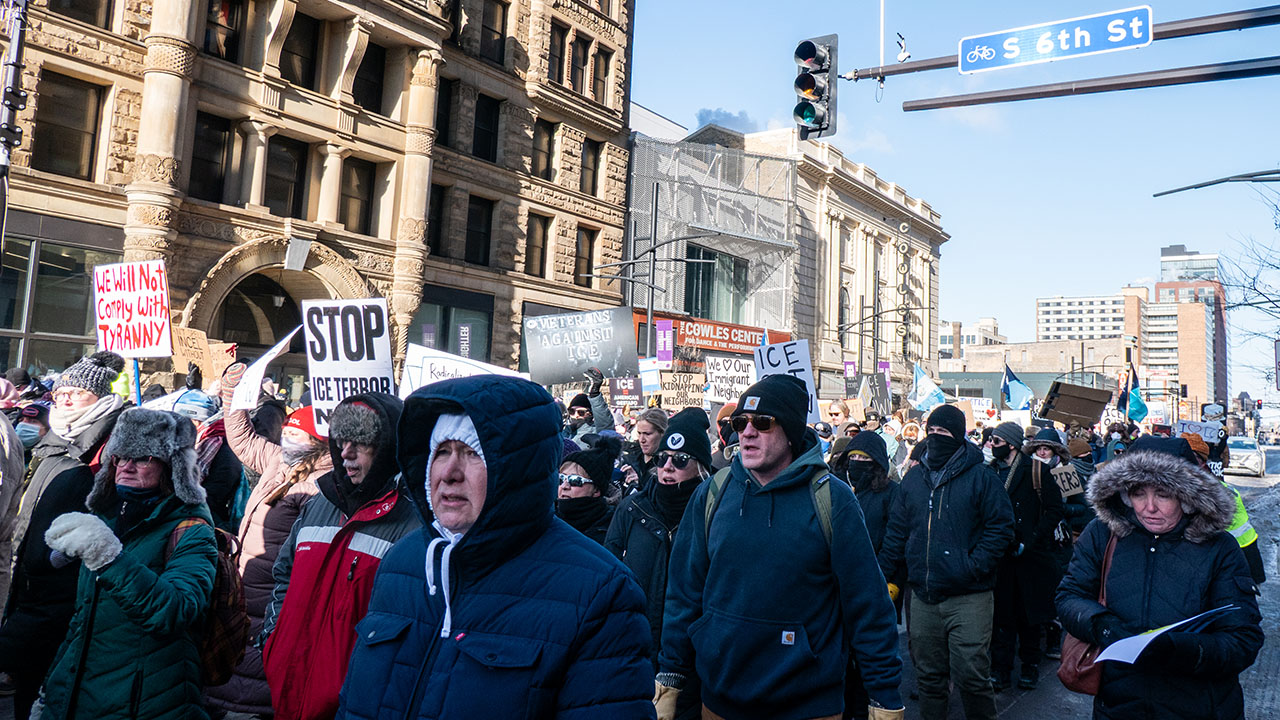
A group of Bay Area rabbis joined hundreds of other faith leaders last week in Minnesota, where they prayed and took action in the wake of accelerating violence by federal immigration agents. Many said they see what is happening there not as an isolated regional crisis, but as a warning.
At least 600 clergy members convened on Jan. 22 at Westminster Presbyterian Church for a meeting organized by Multifaith Antiracism, Change and Healing (MARCH). The event, kept secret until the night before due to fears of government interference, brought together Christian, Jewish, Muslim, Buddhist and other faith leaders to hear firsthand testimony and get guidance on actions that would best support the community’s efforts.
Rabbi Peretz Wolf-Prusan, formerly with San Francisco’s Congregation Emanu-El and Kehillah San Francisco, attended the event. He described it as both sobering and galvanizing and said it underscored the need to move past internal political divisions in order to unite in times of crisis.
“What we need to get ready to do, first and foremost, is give up the luxury of not working with coalition partners who you differ with on some single ideological issue,” Wolf-Prusan said. “Which, in the Bay Area, is just a pandemic. Zionism, non-Zionism, kaffiyehs or kippot –– ICE doesn’t care.”
Wolf-Prusan described ICE’s behavior in Minneapolis as “terrorizing,” with helicopters flying low over residential neighborhoods, armed federal agents patrolling streets, and people with legal documentation being detained over alleged false identification.
“They’re waving guns at people like I’ve never seen,” he said. “They are armed like they’re invading a country.”
Pervasive fear is creating tangible problems, Wolf-Prusan said. People who are afraid to leave their homes are not going to work and therefore are missing the paychecks they need to buy food and pay rent. Eviction in the subzero Minnesota winter, he said, “would be a death sentence.”

In response, concerned Minneapolis residents have built extensive, coordinated mutual-aid networks. Churches and neighborhood groups operate food pods, kitchens and delivery systems for families afraid to leave their homes. Others document ICE movements or warn residents when agents are nearby.
Rabbi David Cooper, emeritus rabbi of Piedmont’s Kehilla Community Synagogue, attended the MARCH gathering on Jan. 22, just two days before federal agents killed VA nurse Alex Pretti, and two weeks after an ICE officer shot and killed Renee Good, a mother of three.
Cooper echoed Wolf-Prusan’s sentiment. When people are in danger, he said, unity must take precedence over the differences that might otherwise divide a community.
“You have to drop the differences you might argue about at other times and come together to help people who are in jeopardy,” he said.
He said that Jewish history and Torah, more than politics, call on the community to act.
“We as Jews have a history that calls us to this work, and we have a religion that calls us to this work,” said Cooper. “We’re told you shall love your neighbor as yourself, which can be taken in many different ways. But we now need to be able to understand this as a universal call for all of our neighbors, not just our Jewish neighbors, to come out and help them.”
Other Bay Area Jewish clergy on the ground in Minneapolis included Rabbi Sydney Mintz, rabbinic scholar at Emanu-El; Rabbi Amy Eilberg, a Los Altos spiritual director and J. Torah columnist; and Rabbi Cat Zavis of Berkeley’s Beyt Tikkun.
For immigration attorneys in Northern California, the conditions described in Minneapolis are closer to home than many may realize.
Shawn Matloob, a San Francisco immigration attorney and member of Congregation Sha’ar Zahav, told J. in November that immigrants at every stage of legal status — from undocumented to green card applicants to lawful permanent residents — are getting caught up in enforcement actions. In some cases, including locally, citizen protesters reportedly have been detained.
According to Matloob, one of the biggest misconceptions is that the legal process guarantees any immigrant’s safety right now, no matter what the person’s status.
“In reality, people who are actively trying to legalize their status may be at higher risk,” he said. “Because they are the easiest to locate.”
Matloob described arrests taking place not only in the hallways outside of immigration courtrooms, but at U.S. processing offices and even at application support centers, where people go for fingerprinting as part of routine legal procedures.
“These are individuals with pending applications, work permits and Social Security. Many have U.S. citizen spouses and children,” he said.
The pattern, he said, has become unpredictable, resulting in a set of impossible decisions for immigrant families.
“If someone doesn’t show up to a court hearing, they risk a removal order in absentia,” Matloob said. “If they do show up, they risk being detained.”
He described accompanying a client to a green card interview based on marriage to a U.S. citizen. Historically, this would have been considered a low-risk case for deportation.
“Under normal circumstances, there would be no concern,” he said. “But I had to warn them there was a possibility of arrest. They were terrified.”
For Analucía Lopezrevoredo, founder and CEO of Bay Area-based Jewtina y Co. who was formerly undocumented, the crisis is not abstract for Jews, who are keenly aware of their own history of being targeted, with deadly consequences.
“We have to look honestly at the policies and conditions that made [the Holocaust] possible,” she said. “We are watching those conditions take shape right now in the United States.”
Lopezrevoredo emphasized that Jewish communities are not observers to this moment.
“This is already affecting Jewish communities,” she said. “We’re not just talking about immigrants that are Jewish, but also Jews with immigrant family members and Jews who really believe in defending our Constitution.”
Action, Lopezrevoredo stressed, takes many forms: donating, backing rapid response networks, learning one’s rights and creating emergency plans.
Matloob pointed to synagogues and nonprofits already mobilizing volunteers to accompany immigrants to hearings and appointments.
“This is something everyday people can do,” he said
Among faith leaders in Minneapolis, a phrase circulated repeatedly: “the theology of showing up.”
“Don’t wait for an elected official or a charismatic leader to tell you what to do. Just do something,” Wolf-Prusan said. “Find a food bank, find who’s organizing in your neighborhood and reach out and show up.”
Resources
These come from Jewtina y Co.’s list of groups working to support immigrants. If you choose to support any of these organizations, J. recommends vetting them independently.
Local groups
- Alameda County Immigration Legal and Education Partnership — 510- 241-4011
- Marin Rapid Response Network — 415-991-4545
- North Bay Rapid Response Network (Sonoma, Napa and Solano counties) — 707- 800-4544
- West Marin Rapid Response Network — 415-755-3622
- Stand Together Contra Costa — 925-900-5151
- San Francisco Rapid Response Network — 415-200-1548
- San Mateo County Rapid Response Network — 203-666-4472
National groups
Minnesota groups
- Immigrant Defense Network — Coalition of 90+ groups organizing rapid response.
- Impacted Neighbors Support Fund — Supports neighbors sheltering in place or fearing for their safety.
- ACLU Minnesota — Defends civil liberties and due process, including immigrant rights.
- COPAL — Advocacy, organizing and phone hotline with a focus on the Latino community.
- Immigrant Law Center of MN — Free legal representation for immigrants and refugees.
- Interfaith Coalition on Immigration — Advocacy, direct aid and community events.
- Minnesota Immigrant Rights Action Committee — Education and protest organizing.
- Monarca MN — Know-your-rights training and phone hotline.
- Unidos MN — Education, advocacy and protest organizing.