

We here at J. are proud that our paper goes back to 1895. We’re also grateful to UC Riverside’s California Newspaper Digital Collection and the National Library of Israel, both of which host our digitized archives.
J.’s archives at the National Library of Israel are part of the institution’s large Jewish press collection. Poking around to see what else of a similar vintage there is in English, I found a number of treasures. I was particularly interested in reading newspapers that were written not for Jews in big East Coast cities or the capitals of Europe, but at the margins of Jewish diaspora — as San Francisco was back then.
Even older than the Emanu-El, as our paper was first called, is the First Fruits of the West, a short-lived English-language Jewish journal published in Kingston, Jamaica, in 1844. Jews started coming in numbers to the island in the 18th century after it became an English territory, and Kingston at one point had several synagogues.
The inaugural issue of First Fruits consists of a lengthy opening statement (“We shall, on all occasions, be temperate in our remarks….”), a sermon, poetry, fiction and a history of the Jews of England.
However, proving that Jewish congregational life is pretty much the same everywhere at every time, they also published this note:
“We have received a letter signed ‘A Friend to Justice,’ in which the writer strongly animadverts on the mode in which one of the Kingston Congregations is governed… ‘A Friend to Justice’ had better address the President of the Congregation alluded to, as our pages cannot be made a vehicle for the expression of, what we conceive to be, uncalled for censure.”

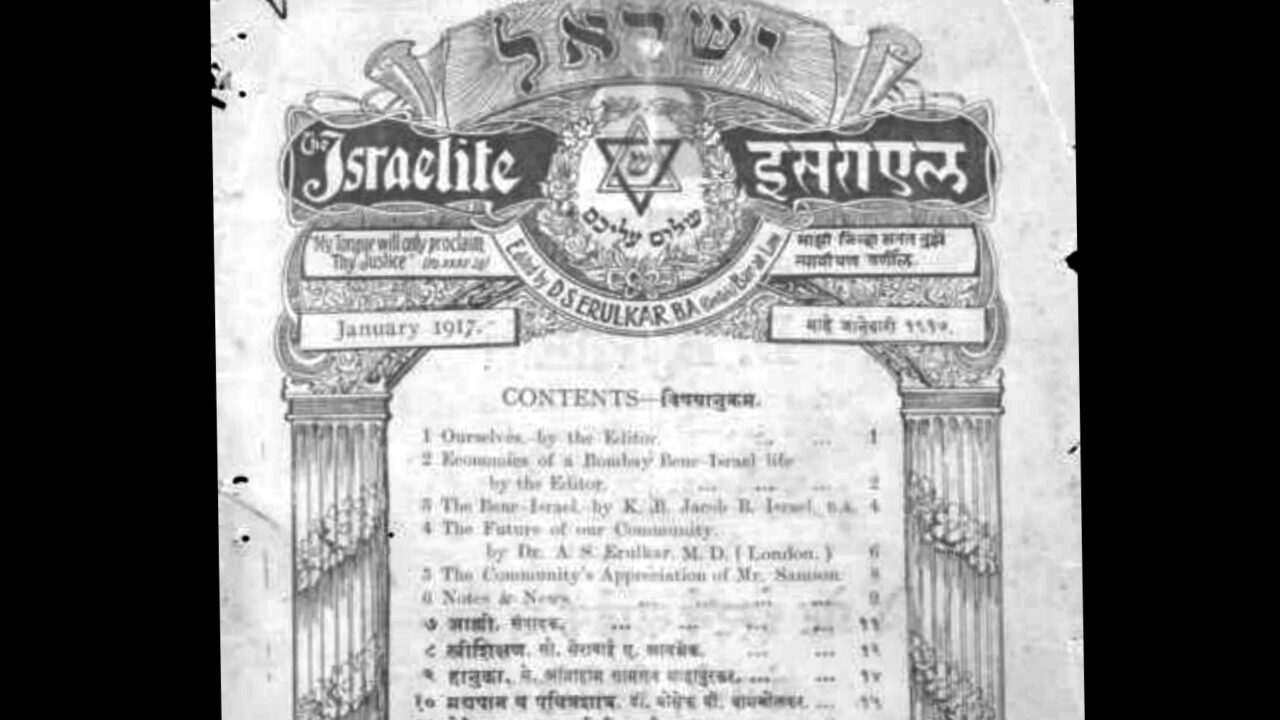
The Israelite, a publication in Mumbai, India, is another wonder. Founded in 1917 and published for about a decade, it was written bilingually in English and Marathi. The opening statement, written most likely by editor David Solomon Erulkar, reflects the tumultuous times:
“We are living in a most remarkable era, and in the midst of a great, yet bewildering civilization, when castes, communities and even nations are striving each for a particular ideal as the goal. From out of the unceasing agitation and perturbation, ‘progress’ of some kind or other, resounds as the watchword of the age. The whole creation seems astir…. Thus we are made the spectators of the greatest events the world has ever seen.”
The paper was written by and for the Bene Israel community, an originally rural group of Jewish Indians whose origins are hard to nail down. (They probably descended from Jews who came to India and intermarried. They are separate from both Cochin Jews and the Baghdadi Jews, both of whom have their own long histories in India.)
In an article in that first issue, the paper describes the Bene Israel as a “riddle.”
“In a land where the horizon seemed to them quite clear for the spread of their knowledge of Jesus Christ, [missionaries] were puzzled to find on the Western Coast, a poor, but industrious and well behaved class of people, calling themselves Bene-Israels (Sons of Israel or Jacob), observing Saturday as the Sabbath, performing circumcision of their male children on the 8th day after birth, and saying in Hebrew the most important prayer of Israel, which proclaims the unity of God.”
The National Library of Israel also has issues of the Jewish Guild Journal, a newspaper in what is now Zimbabwe, which was then the British colony of Rhodesia. It was launched in 1919 and published out of the city of Bulawayo until the 1930s.

“It is our aim to provide the Rhodesian and Congo Jewish community with interesting and, we hope, instructive reading matter, combined with as much news as possible of the doings of our friends in different parts of the country. We ask for the assistance of everyone to supply us with local news. The smallest event may prove interesting to a number of people.… We ask the community to accept our best Pesach wishes — in spite of the lack of Matzos.”
Most of the Rhodesian Jews had Eastern European roots and were quite Zionist. The paper carried news of Russia and the British Mandate for Palestine, but also social news from cities around the country where Jews lived. From Gwelo (now Gweru), it was “Mr. and Mrs. M. Sher have now moved into their fine new house,” while from Gatooma (now Kadoma) it was “Messrs. R. Fleishman and R. Ross have both opened butcheries at Eiffel Flats. We wish them luck.”
At the time the paper was published, Zimbabwean Jews were reeling amid the aftermath of WWI. In a long and impassioned treatise imploring for order and cooperation on the international stage, race is not mentioned at all or, if so, only obliquely: “We have heard of atomic energy, but what power is comparable to the emancipated soul of man? The sap of life is rising in the masses, they are determined to escape from servitude and to attain the fullest possible measure of self-realisation.”
These are only a few gems that can be found in the library. There are also the wonderful Israel’s Messenger out of Shanghai, the Australasian Hebrew and many more. Almost all are defunct — J. is one of only a few left standing.
Times change, but it’s interesting to reflect on this take from the Bene Israel newspaper:
“It can never be gainsaid that healthy journalism is the most necessary factor in the progress of any people; it is the best instrument for the interchange of ideas, for the introduction of all that is good and wanting in us; and for the abolition of all that is bad and present in us.”
Maybe that’s not how journalism is viewed today, but it’s a reminder that these Jewish publications held together fragile communities that were precariously placed at the far edges of the Jewish diaspora and reminded these Jews that they were part of a wider whole.