

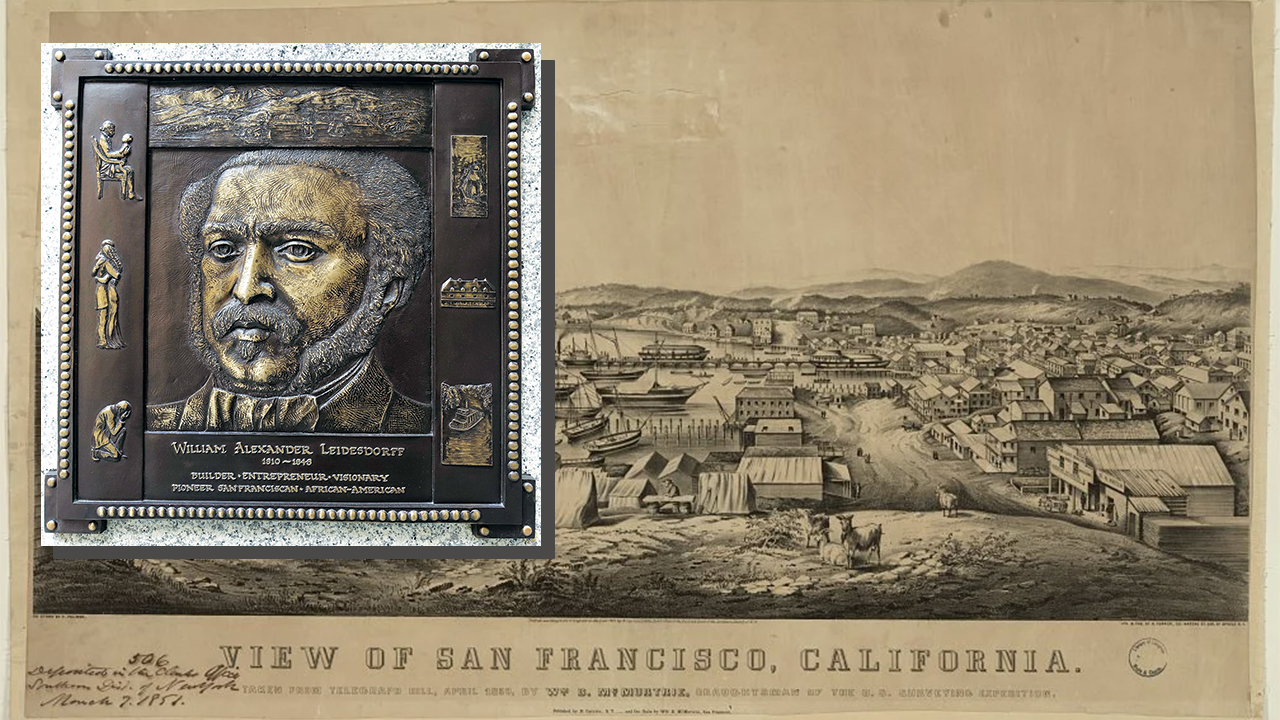
You should be skeptical of this article’s headline. The Jewish identity of William Leidesdorff, an entrepreneur who helped build San Francisco, is uncertain, given that he was buried in the Mission Dolores, a Catholic church. But his life story, marked by a series of firsts, reflects the wild diversity of early American Jews and the formative years of San Francisco.
This publication’s archives are replete with traces of the existence of Leidesdorff. His name lives on in the form of Leidesdorff Street, a three-block stretch between Pine and California Streets in the Financial District. Search “Leidesdorff” in our archives and one finds page upon page of ads and legal notices that refer to addresses on his eponymous street.
He could be considered San Francisco’s first Jew, depending on how one defines the term. His biography reads like an epic, and he is widely considered America’s first Black millionaire.
According to a 2005 book by Gary Mitchell Palgon, a descendant of Leidesdorff, he was born in the Virgin Islands to a Danish Jewish father and a Creole mother about whom little is known. Leidesdorff was not raised by his biological father. Sources cited by Paglon say his English adoptive father had him christened.
Leidesdorff broke off an engagement after his fiancee learned he was, in Liedesdorff’s words, “a mulatto,” a term used at the time to describe a person of both Black and white ancestry. He later sailed from New Orleans to San Francisco, then known as Yerba Buena, where he became a wealthy master of ships, later establishing the city’s first town council and serving as its treasurer. He is known to have launched the first steam ship to sail the San Francisco Bay. In a less savory footnote to that legacy, a hotel he owned hosted what is believed to be California’s first recorded minstrel show.
But in this paper, there has been just one telling of his life story, written in the distinct florid prose of our founding editor, Rabbi Jacob Voorsanger, in 1903.
Voorsanger seems sure of Leidesdorff’s Jewishness, although he admits “Captain Leidesdorff did not affiliate with the nascent Jewish community of San Francisco, for he lies buried in the Catholic graveyard at Mission Dolores.”

How did Voorsanger, writing in 1903, a half century after Leidesdorff’s death in 1848, even know of Liedesdorff’s Jewish descent? There is a tiny clue buried at the end of his brief write-up.
Leidesdorff died without leaving a will and his estate was contested. Voorsanger wrote that “his Jewish relatives, scattered throughout Austria and the Duchy of Posen [now roughly modern-day Poland], are somewhat late in their effort to recover [Leidesdorff’s estate].”
The San Francisco Chronicle also reported in 1904 that Hungarian descendants of Leidesdorff were seeking the state’s help in recovering his estate. One of them, Elias Haupt, made multiple visits to San Francisco attempting to get local lawyers interested in the case. It’s easy to imagine that Haupt or another of these distant Jewish relations made contact with Voorsanger, then the most prominent Jewish community leader in the city.
We Jews are always eager to claim even the most tenuously Jew-ish notables and celebrities as Jewish. Leidesdorff was raised in a Christian home and buried in a Catholic cemetery. Calling Leidesdorff a Jew flattens what must have been a complex personal identity. At the same time, claiming him as a Jew also complicates our contemporary understanding of who American Jews are and have been. And that, I think, is worthwhile.