

Some of my earliest concepts of war were shaped by a cassette tape.
On long road trips in the 1980s, my parents would play Paul Simon’s “Graceland” on the car stereo. The album opens with “The Boy in the Bubble,” which includes the line: “These are the days of lasers in the jungle, lasers in the jungle somewhere.”
I did not know what he meant exactly, but the line painted a vivid picture in my mind. War, as I imagined it, took place in jungles: dense green foliage, camouflage patterned in dark greens and blacks, helicopters hovering over tree canopies, soldiers moving through shadowy undergrowth.
Those imagined battlefields stayed with me throughout my childhood. They appeared in movies like “Rambo” and “Predator,” in video games like Contra and Metal Gear, and in the cultural afterimage of Vietnam that hung over the late Cold War years. Even when the stories were fictional, they always seemed to be set somewhere far away, deep in a jungle with lasers cutting through the night.
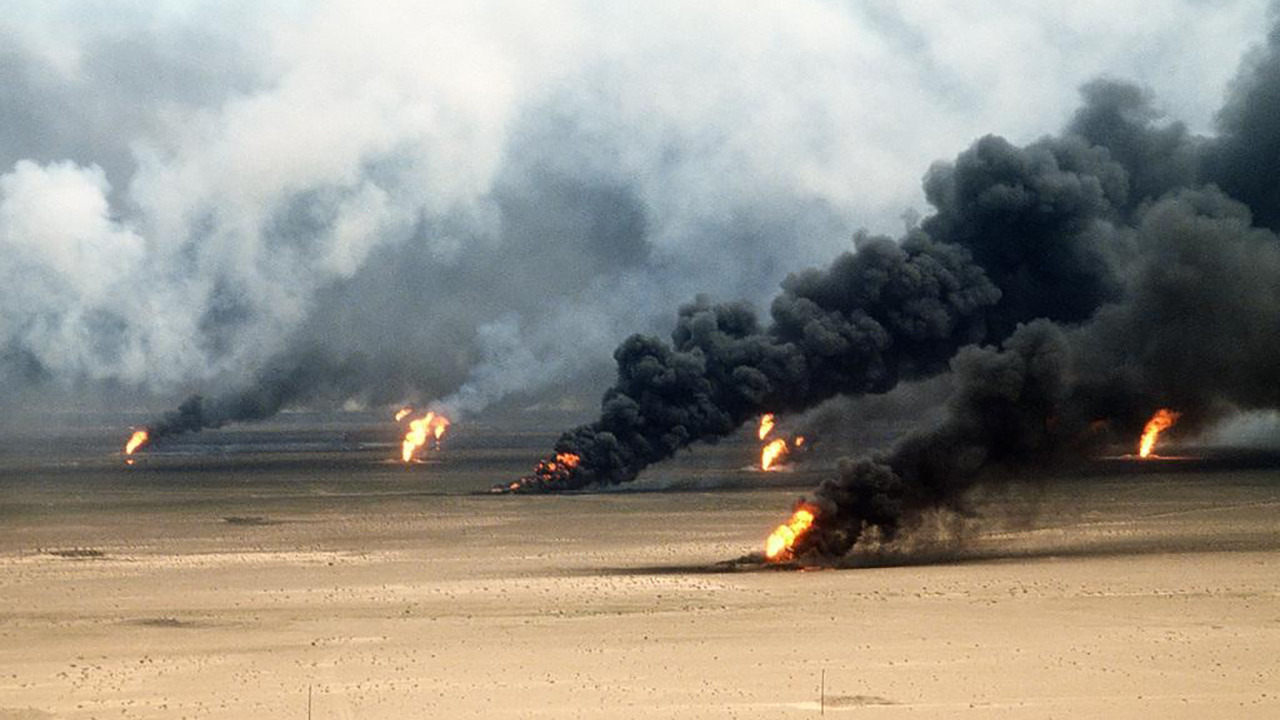
But the cultural imagery of war shifted as I grew up. By the time Operation Desert Storm began in 1991, the jungle had given way to the desert. The greens and blacks of camouflage were replaced by sand and khaki. War was now a hazy expanse of tan horizons and dust-filled skies, punctuated by armored vehicles crossing endless dunes and soldiers moving through cities half-buried in sand.
Today, as the United States and Israel find themselves in direct conflict with Iran, I am struck by how different the images of this war feel. What fills our screens now often looks abstract: gray radar displays, grainy videos of fighter jets shot down, satellite footage of explosions blooming in the night sky. War appears as streaks of light and flashes on distant horizons, graphics layered over maps.
It is the technological sublime: a spectacle of missiles, drones and interceptors. War is rendered as systems and signals rather than bodies and lives. With each layer, the human beings underneath slip further out of view.
For me, the war with Iran does not feel abstract at all. I think about friends and loved ones in Israel moving in and out of shelters as sirens sound. I think about families mourning those killed in missile strikes. I think about the quiet prayers that the Iron Dome will hold against the next barrage of ballistic missiles, and about the people who remain vulnerable — in Israel and across the region. I think about all those who feel powerless in the face of faceless weaponry.
At the Brandeis School of San Francisco, where I have been head of school for more than a decade, these events ripple through daily life in another way. For the past two years, we have managed, almost miraculously, to run our annual eighth-grade trip to Israel. Each spring, our students travel across the country, walking through layers of Jewish history they may have only encountered in prayer or in books. This year, once again, we wait.
My middle daughter is among the 50 students scheduled to go. We do not know whether the war will subside enough for the trip to happen. The uncertainty is a reminder that history is not something safely contained in textbooks. It is unfolding in real time, shaping the choices families and schools must make.
Perhaps this is why the timing of this war, arriving as the Jewish calendar turned toward Purim, felt strangely resonant. Purim reminds us that history often moves behind masks. The forces shaping our lives are not always visible, and the visions we are shown about power can obscure as much as they reveal. But Purim also reminds us to teach our children to step forward when history calls them, even when the full picture remains hidden.
Every generation constructs its own imagined battlefield, a landscape where war unfolds in the visual language of its time: jungles, deserts, and now skies and seas filled with “unmanned” drones and interceptors.
From thousands of miles away, it is easy to mistake the spectacle for reality. But beneath those images are people: children waiting in shelters, pilots, sailors, soldiers and their families, parents refreshing news feeds, hoping that the next siren will not come. Communities across the Middle East caught in the crossfire.
At the start of last week, I wrote to the Brandeis community about the letters that Esther and Mordecai send at the end of the Megillah, writing “words of peace and truth.” I will continue to pray that we all can learn to hold space in our hearts for the truth of the human lives behind the images on our screens — and for peace.