

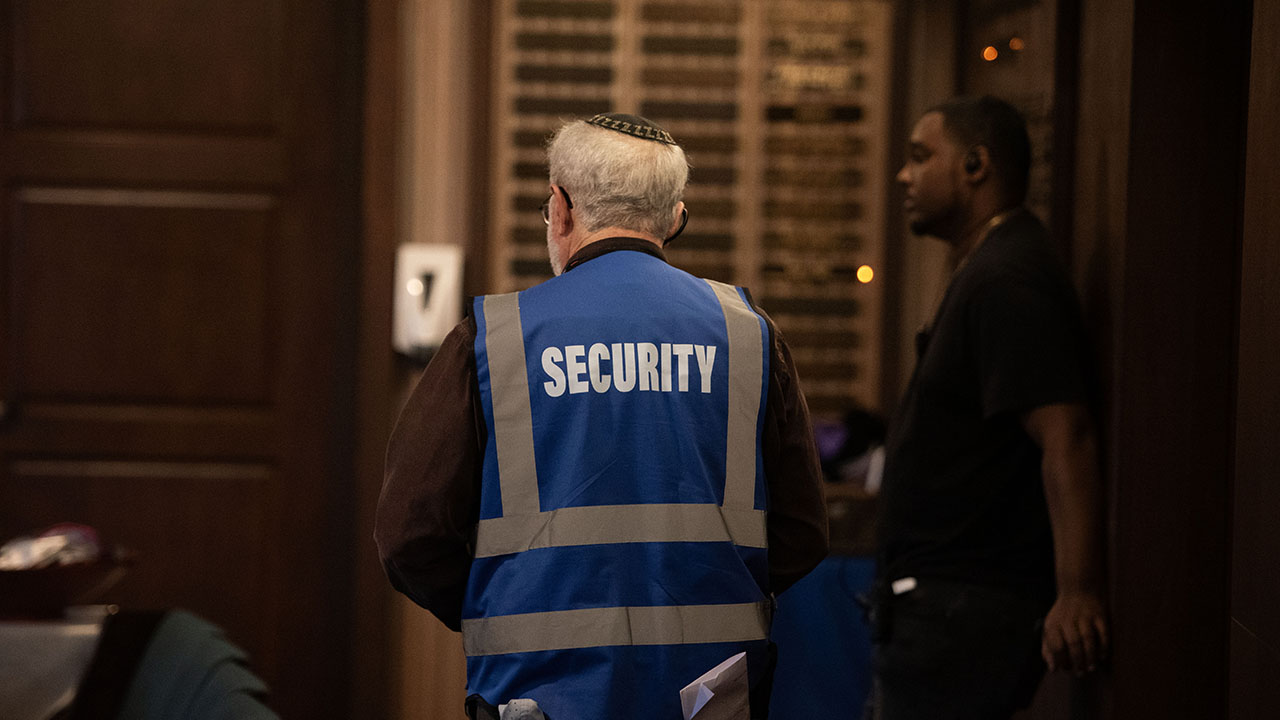
Jewish organizations and security experts in the Bay Area have reintensified their focus on community safety following the violent attack on a Detroit-area synagogue on Thursday.
Across North America, Jewish security officials are warning of the “most elevated and complex threat environment the Jewish community and this country has seen in modern history,” according to the Secure Community Network, a nonprofit that monitors threats to Jewish organizations.
The FBI identified the armed attacker as Ayman Mohamad Ghazali, a naturalized U.S. citizen from Lebanon.
Ghazali drove his pickup loaded with fireworks through the doors of Temple Israel in West Bloomfield, Michigan, and into a hallway before he was confronted by armed security guards, according to the FBI. His pickup got stuck in the hallway, and Ghazali shot himself to death after a gunfight with guards, the FBI reported. One security guard was hit by the pickup. None of the 140 children at the synagogue’s preschool were injured.
Tensions have already been high in the Bay Area Jewish community. The attack came days after a daytime assault on two Israeli American men outside an upscale restaurant in San Jose.
Bay Area Jewish community officials emphasized there is no immediate threat to the local Jewish community following the Michigan attack. The fact that the incident resulted in only the attacker’s death highlighted for many the importance of preparedness.
In an email to the community, Jewish Silicon Valley CEO Daniel Klein said Thursday that his organization was boosting security following the Michigan attack.
“While there have been no direct or active threats surrounding this incident to our building community,” Klein wrote, “out of an abundance of caution, we are elevating our security presence across our facility and increasing police presence across our Jewish ecosystem.”

Rabbi Jason Gwasdoff of Temple Israel in Stockton — a synagogue that shares a name with the one attacked in Michigan — told J. that his congregation doubled its security personnel after that incident. Gwasdoff also spoke to local police about increasing their presence around the synagogue, KCRA3 reported.
Synagogues and Jewish organizations have made similar security adjustments following violent attacks, such as the Bondi Beach massacre in Australia on the first night of Hanukkah in December. The specific methods used in the West Bloomfield attack, however, raise additional concerns about the potential car rammings.
“It’s really about — as security people say — expanding the perimeter,” said David Goldman, executive director of San Francisco’s Congregation Emanu-El. “Making sure that whatever threat level it is, you’re always constantly pushing it out, out, out.”
In the past five months, two other attacks on the Jewish community involved car rammings. In October, a man drove his car into a group of Yom Kippur worshippers outside an Orthodox synagogue in Manchester, England. In January, a man repeatedly drove his car into an entrance of the Chabad-Lubavitch world headquarters in Brooklyn.
Car rammings are a “very valid concern,” said San Francisco Police Department Commander Amy Hurwitz, the department’s liaison to the Jewish community. “These things are happening. They’re real. We are great as a community because we learn from what happens around us, and we take action.”

The best way for safety officials to determine how to fortify a building, Hurwitz said, is on a case-by-case basis. She encouraged organizations in San Francisco to take advantage of the free on-site surveys conducted by SFPD’s Neighborhood Safety Team. Surveys can be requested via email at [email protected].
The Jewish Federation Bay Area also offers vulnerability assessments, trainings and consultations to Jewish organizations.
“Vehicular attacks are one of the threats we consider when we conduct vulnerability assessments,” Rafi Brinner, Jewish Federation Bay Area’s senior director of community security, told J. via email. “Depending on the site, bollards, jersey barriers, planters, or decorative boulders can mitigate the threat from vehicular attacks.”

In 2024, California’s nonprofit security grant program awarded Congregation Kol Shofar in Tiburon a $250,000 grant, which the synagogue is using for projects such as additional lighting around its building’s exterior, according to executive director Gordon Gladstone.
Chochmat HaLev in Berkeley also received a state grant, which it will use to replace doors and gates on its building and install features to reduce visibility into the interior, according to a Friday email announcement. The congregation also asked for donations after notifying its congregants that increased security measures will strain its budget.
A shutdown at the Department of Homeland Security since mid-February has halted the review of millions of dollars in security funding for nonprofits, according to the Jewish Telegraphic Agency. The federal Nonprofit Security Grant Program, administered through DHS, helps nonprofits, including religious institutions, pay for security guards, cameras, reinforced doors and other protections.