

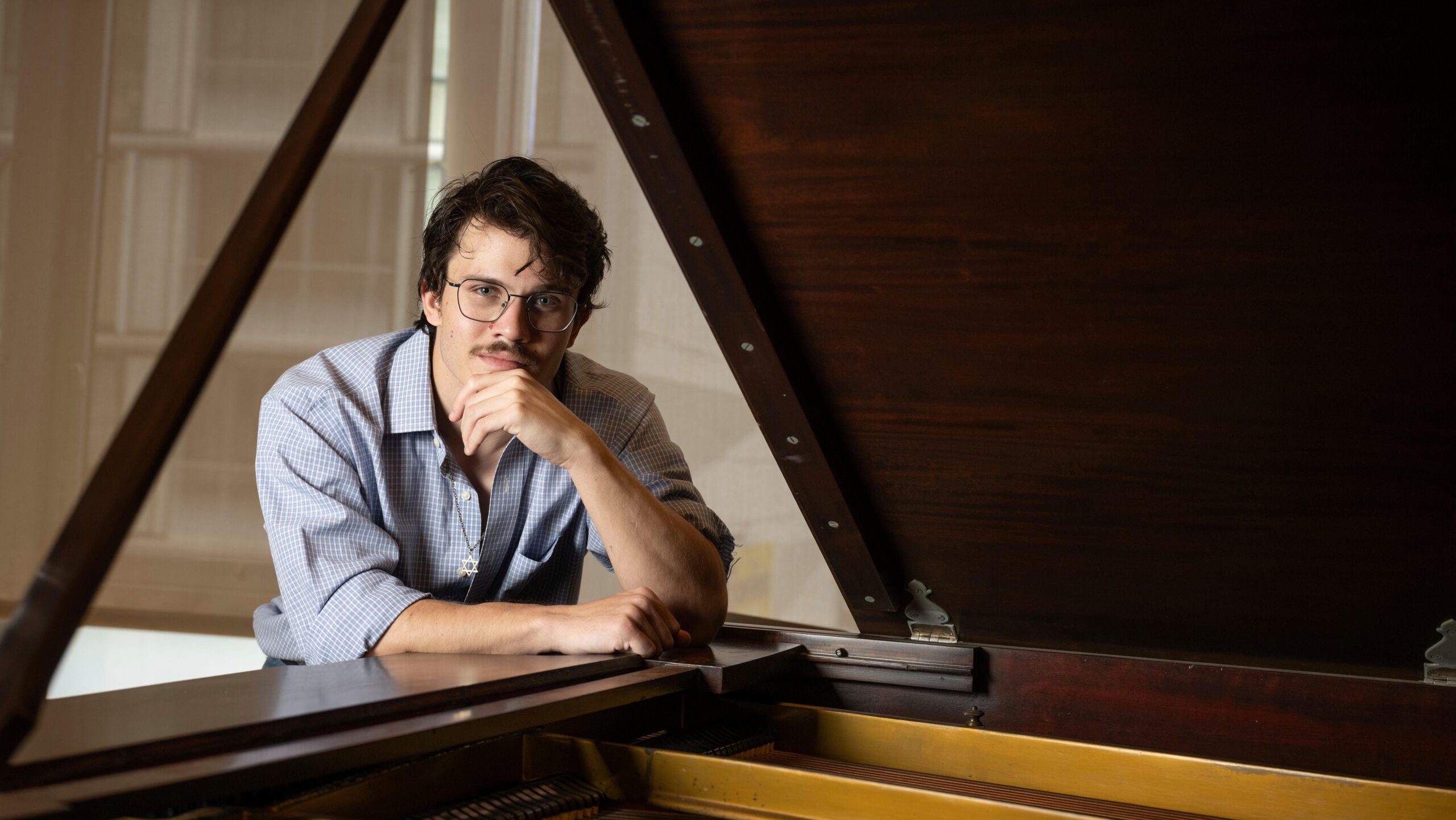
Alex Malinas was surprised to discover that Randy Weiss did not play oboe.
Two years ago, Malinas, 23, approached Weiss, 72, after Rosh Hashanah services to compliment his shofar blowing skills. Given his facility with the ritual horn, Malinas asked whether Weiss played woodwinds or brass.
“And I said, ‘No, I’m a violinist, which is why I really have to work hard!’” Weiss remembers telling him.
That meeting marked the beginning of a partnership between Weiss, a violinist whose career has included stops with the San Jose Symphony, San Francisco Ballet and San Francisco Opera, and Malinas, a pianist and composition student at the San Francisco Conservatory of Music.
Two years later, Weiss commissioned a new piano trio from Malinas. The piece had its world premiere April 12 at Congregation Sha’ar Zahav as part of the synagogue’s annual Music in the Mishkan series. The trio, which musically expresses a debate about the Torah portion Vayera, will be performed again on April 25 at a graduation recital that also features several other works by Malinas.
Though he began his piano training later than his peers, Malinas took to it quickly.
“I actually started piano at 13, which is pretty late, considering people usually start at the age of five,” he said. Just a few years later, at 17, he began composing.
“I felt playing just piano was very constricting, because you’re just playing other people’s works,” he said. “But being a composer, you’re really open to do anything, and also you’re creating.”
In addition to piano and composition, Malinas has at times picked up flute and cello, and currently plays accordion at gigs in the area — which is something of a bridge to one of his major influences: klezmer.
Though he composes for classical instruments, performed in concert hall and chamber music settings, his influences are eclectic. He’s heavily influenced by Russian classical music, but much of his work is inspired by klezmer, traditional Ashkenazi Jewish music and the Torah chanting he heard at his childhood synagogue, a Reform congregation. His mother’s Bulgarian folk dancing, and its accompanying music, has also influenced his work.
The Russian influences come from the land of Malinas’ birth. He was born in Russia and adopted at 16 months by an American family who raised him primarily in Reno, Nevada.
All these influences are baked into Malinas as a musician, but the piece Weiss commissioned for the Sha’ar Zahav chamber music series, called “VaYeira,” is his most explicitly Jewish composition yet.
“This was such a thrill,” Weiss said. “He’s just starting out, and how many opportunities do young composers get to write particular music and to be paid for it?”
The first movement, “Parsha,” is based on the musicality of the chanted trope for the Torah portion Vayera, specifically the section about Abraham sending his concubine Hagar and their son Ishmael out into the wilderness.

In the second movement, “Mavdil” (“Separation”), the music becomes a debate: “The violinist and the cellist [are] arguing with each other about their interpretation of the Torah portion,” Malinas said. “But also it can be seen as an argument about more general world politics … it goes really poorly, and the movement ends basically right as they’re about to kill each other.”
As tensions build, the third movement, “Hit’chabrut” (“Joining”), introduces a resolution. “It’s still dissonant and it’s uncomfortable, but they do live together and they’re able to coexist,” Malinas explained.
Music isn’t Malinas’ only way of expressing his Jewish identity. In 2021, he started a Jewish student group at the conservatory, the school’s first. It’s called the Jewish Music Collective.
After the Oct. 7 Hamas attacks in Israel, a pro-Palestinian student group reached out to Malinas, who said he considers himself pro-Palestinian, about working together. Though Malinas was amenable, “it turned bad pretty quickly,” he said.
The group circulated a petition demanding that the school issue a statement about the war and divest from companies doing business in Israel. They also hung posters saying “tell SFCM to stop supporting the Zionist occupation,” Malinas said. Worse, the posters also included statements about Israel and the conflict that Malinas said were inaccurate. Ultimately, though, Malinas said he and other Jewish students felt supported by SFCM administrators, who eventually reprimanded some members of the pro-Palestinian group.
“I used to consider myself like an anti-Zionist Jew because I didn’t know what that meant,” he said. “I used to think that it was just anti-Netanyahu and his government. But then … Oct. 7 happened, and the reaction I saw online and from people in school with me, where the sympathy of this giant terrorist attack that just happened just disappeared. It completely disappeared and completely flipped.”
Now, with his graduate recital coming up, Malinas is thinking about what comes next .
“There’s some people who are interested in commissioning me things, but commissions are difficult to make a stable living,” he said. “So I’m thinking maybe I’ll try to get a teaching job at a music school, because I could teach piano, flute, music theory — something that gives me a more stable income.”