
This story was originally published in the Forward. Click here to get the Forward’s free email newsletters delivered to your inbox.
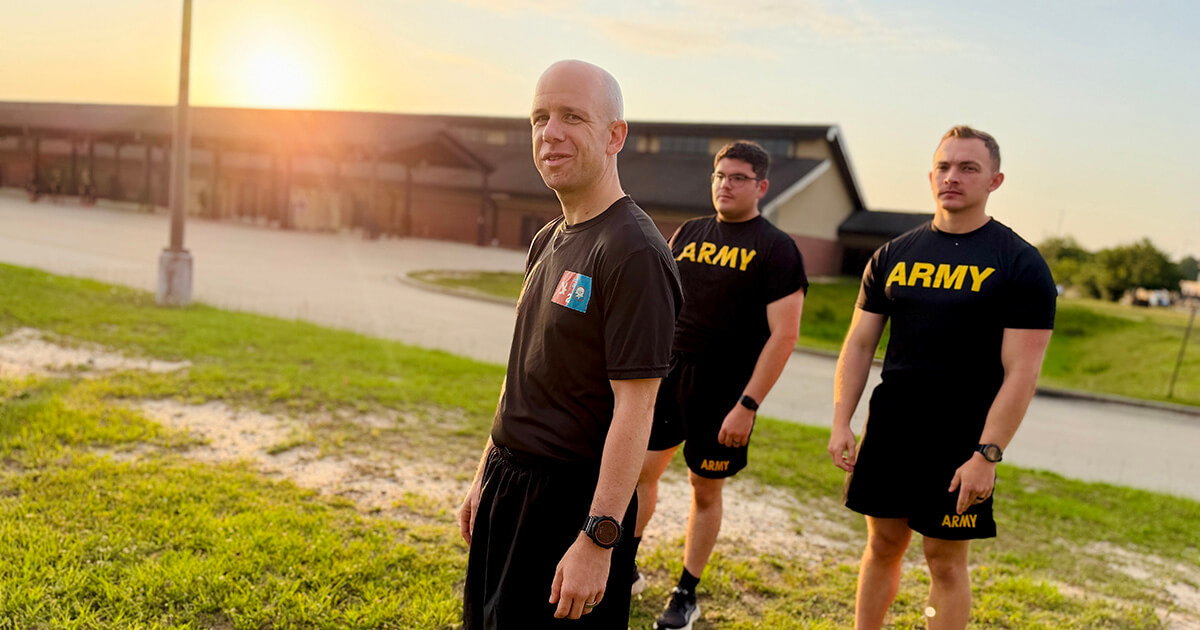
At dawn on Friday, two soldiers showed up for physical training. Their rabbi was already waiting.
Black T-shirts. Gold ARMY across the chest. Nothing to set them apart. They blended into the formation — hundreds of soldiers under the pine trees as reveille cut through the morning. The flag rose. They saluted, stretched, climbed ropes, ran into the dark.
For 30 minutes, they were indistinguishable. Then everything shifted.
The three men walked into a meeting room inside a battalion headquarters, their shirts still damp with sweat. One soldier held out his left arm. The other draped a camouflage tallit over his shoulders. Rabbi Scott Klein reached into his backpack, removed a pair of black leather tefillin, and began wrapping them around a soldier’s arm — seven times, the way it’s always done, the leather biting just enough to remind you it’s there.
At 36, Klein serves one of the most unusual pulpits in American Judaism. He is one of 140 chaplains at Fort Bragg, the world’s largest military base. And he is the Army’s only Jewish chaplain assigned to an airborne unit — which means that jumping out of an airplane, for him, is not a metaphor for faith. It’s a job requirement.

One of the men praying beside him that morning was Jacob Abrams, 24, a specialist from Manhattan, Kansas. He found out about Jewish life on the base by accident, in the commissary, on a flyer for a challah-baking workshop stapled near the cereal aisle.
“Scott instantly made me feel included in the community,” Abrams said.
On Friday mornings, the two wrap tefillin together after physical training. On Friday nights, they welcome Shabbat together. But the relationship doesn’t end at the chapel door. Klein joins field exercises. He sleeps in tents. He paratroops into combat zones.
“There are days — many days — where you just don’t want to be there,” Abrams said. “Having your chaplain out there, who’s also embracing the suckiness with you, it makes it a lot easier to get through.”
It is an old idea, dressed in new camouflage: that you do not minister from a distance. You jump first.
A congregation with no walls
Later that morning, Klein climbed into his car and began driving across Fort Bragg.
The base stretches for miles, a city unto itself — schools, supermarkets, banks, gas stations, a Chipotle, three Starbucks, all of it sitting inside roughly 250 square miles, a map Klein has long since stopped needing to consult.
As he drove, he pointed things out the way someone points out a childhood neighborhood: the headquarters of the 82nd Airborne Division, the parade fields, the training grounds where soldiers prepare to leave for places he has already been.

He grew up nearly 900 miles from here, in Skokie, Illinois, where his world, for a while, stayed small. After college, he joined his father’s accounting firm, dedicating himself to fostering local economic development and helping small businesses scale. The work paid the bills, but what he loved most was driving community entrepreneurship from the ground up — the Jewish networking events he organized for young professionals, the restaurant back rooms he’d reserve, the texts he’d send to make sure people showed up, and the strangers he introduced who became business partners, then friends.
“I realized that when you connect people, you aren’t just building networks—you’re building the infrastructure of a community,” he said.
Then, in his late 20s, an Army recruiter asked if he had ever considered serving. Klein had always thought of himself as deeply patriotic. He served on Skokie’s Fourth of July parade committee, loved civic life and believed, as an American Jew, that serving his country was a responsibility.
“If I have the opportunity to serve my country,” he recalled thinking, “I can’t let the door slam shut.”
The United States is marking this week its 250th birthday, what Klein called a “monumental” moment in the life of the “American experiment.”
He spoke of Francis Salvador, the first Jewish soldier killed in the Revolutionary War; Haym Solomon, who helped finance the Continental Army; the Civil War, which produced the country’s first official Jewish military chaplain, Rabbi Jacob Frankel, commissioned by Abraham Lincoln in 1862; the half a million American Jews who served in the two world wars that followed.
“We aren’t passive observers of this 250-year history,” he said. “We are foundational stakeholders.”

Klein commissioned into the Army Reserve. What followed reshaped his life.
During deployments across the Middle East, he became what the military calls a lay leader, the person responsible for holding Jewish life together in places where no chaplain existed to do it. On Friday nights, that meant leading Shabbat services in Jordan, Iraq, Syria, the United Arab Emirates, Bahrain, Saudi Arabia.
During one deployment, he led a Passover Seder in Egypt for soldiers and diplomats, retelling the story of the Exodus on the banks of the river where it happened. He led High Holiday services at Guantanamo Bay. In Iraq, he lit a Hanukkah menorah inside one of Saddam Hussein’s former offices — a small, stubborn flame in a room built for someone who would have extinguished it.
Eventually, the distinction between lay leader and rabbi stopped making sense to him. Klein enrolled in rabbinical school while still in uniform, attending classes online from bases scattered across the Middle East — studying the Talmud in the region where rabbis first argued over its pages, sometimes logging in from bunkers, sometimes losing the connection mid-lesson, the line between ancient text and unreliable internet blurring into one continuous feed.
He was ordained in 2024. Soon afterward, he joined the ranks of more than 100 Jewish chaplains serving across the U.S. armed forces, which have roughly 10,000 active-duty Jewish military personnel. (Out of that total force, Klein is one of only about 10 to 15 Jewish chaplains serving on active duty in the U.S. Army). The Army sent Klein to Fort Bragg. There, he began building something more permanent.
‘Never plateau’
Klein pulls into the parking lot of one of the base’s supermarkets.
Inside, it looked like a large grocery store anywhere in America — wide aisles, fluorescent light, shoppers pushing carts past the produce and the canned goods. Klein headed straight for the bakery.
“See this?” he said, pointing to a stack of challah. “We didn’t have this before.”
When he arrived at Fort Bragg, it wasn’t something easy to find on base. Klein worked with the store manager to bring it in. Today, it helps sustain Shabbat for the more than 200 Jewish soldiers and their families who are stationed here.
He walked a few aisles over to the meat department and pulled open the door to a large refrigerated case with a “Kosher” sign taped to it: brisket, ribeye, ground beef, stew meat for cholent. Before Klein, the options were thin. Now the case stays stocked. When the meat comes in, he posts to a WhatsApp group and a Signal chat, and Jewish soldiers from one end of Fort Bragg to the other know to come get it before it’s gone. It is a community built less on sermons than on supply chains.

None of that, on its own, is unusual for a chaplain. But for Klein, it is not enough.
For the past two years, he has also served as the interim rabbi at Beth Israel, a century-old congregation in Fayetteville, about 15 minutes off base. The synagogue has around 100 members and an active Sunday school. A permanent rabbi has been hired and will move into the parsonage on its 10-acre property in August.
Klein also volunteers his time as a chaplain for the Fayetteville Police Department. He teaches “Torah on tap” classes at a local brewery. He recently finished a two-year fellowship for rabbis serving small-town Jewish communities, the kind of program built for people without a colleague down the hall to ask for advice.

He travels to rabbinical schools to recruit students who assume the only pulpit worth having is a sanctuary, showing them that there’s another version of the job — one that jumps out of airplanes, sleeps in tents, and answers a 3 a.m. phone call that no synagogue board ever will.
He is already a qualified paratrooper and recently earned his Air Assault wings — rigorous tactical credentials rarely held by military chaplains. Later this summer, he takes that same drive to a special operations unit.
“I set a goal for myself a long time ago to never plateau,” he said. “I’m in the right organization, because the Army has that culture: ‘Great, you’ve achieved this. What’s next?’ Even at 36, I feel like I’m just getting started.”
And it isn’t only about rank or certifications. “I want to continue learning in Judaism, in Torah,” he said. “But also just as a human. I have this itch to keep doing more.”
From phone calls to a first meeting
In the afternoon, Klein returned home.
On base, the houses are nearly identical — modest homes lined up along quiet streets, indistinguishable from one another unless you know which door to knock on. Inside, the living room was sparsely decorated, the furniture simple and functional. Klein shares the house with his wife, Eli, who teaches special education at a school on base, and Buddy, their 11-year-old goldendoodle, who curled up on a chair.
On the couch sat Paul Kenul, a 69-year-old retired U.S. diplomat who had flown in from Europe. Raised Catholic, he was now studying to become a Jew.
Klein balanced a laptop on his knees, scrolling through a passage from “Pirkei Avot,” a tractate devoted to ethics and moral teachings. Kenul leaned forward, listening closely, a pen in one hand and a notepad in the other.

Kenul grew up on Long Island, in a neighborhood that was almost entirely Jewish, except for him. He spent a career bouncing between Alaska and Heidelberg and Addis Ababa before landing, almost by accident, in Tel Aviv, working at the U.S. embassy. “I felt like I was home,” he said.
He lives in Poland now, with his wife, in a house with an Israeli flag flying in the garden.
For the past year, every Sunday, on the phone, the two men have worked their way through the Torah cycle. The first few months, Kenul said, he was “high” learning with Klein, mesmerized by a tradition he wished he’d found as a teenager.
For Kenul, the lessons had begun to feel like something more. “When I study with the rabbi,” he said, “I feel like I’m feasting.”
This week, for the first time, he flew in to meet Klein in person. “We hugged, and we just kept talking,” Kenul said matter-of-factly.
He talks now about the Torah’s cast of men who failed and were forgiven and failed again the way other people talk about relatives. “They feel like my ancestors,” he said. “They made so many mistakes. I can relate to that.”
Borrowed space, sacred time
The Watters Family Life Center for Counseling and Resiliency does not look like a synagogue, because it isn’t one. It’s a building the Army built for chaplains of every faith to share, and on Friday nights, for about an hour, it becomes one.
Past the kitchen, a walk-in storage room held boxes of Streit’s potato kugel, bottles of grape juice, a stack of siddurs, and “Shabbat in a box” kits donated by a Connecticut nonprofit — a Kiddush cup, a havdalah candle, a challah cover, and, inexplicably, a deck of playing cards. In the corner, leaning against the wall, rests a blue pop-up sukkah.

Klein passed out camouflage kippahs at the door.
About 15 people sat in folding chairs, more arriving until someone had to grab extra seats. Klein stood behind a small pulpit, a menorah on the stage behind him between an American flag and the Army Chaplain Corps flag. He’d traded his fatigues for a gray suit, no tie. The service moved through Hebrew and English, everyone following along in camouflage-covered siddurs.
It was the Shabbat before the Fourth of July, and the week’s Torah reading happened to be Klein’s own bar mitzvah portion — a text that describes the sudden death of Miriam. For Klein, the connection was heartbreakingly close; his own sister, Miriam, had passed away suddenly just a month prior.
He shared with the room how the Torah handles the loss with a striking, quiet brevity, offering no drawn-out account of public mourning. Instead, Jewish tradition teaches that a miraculous well of water traveled with the Israelites through the dry wilderness for as long as Miriam lived — and vanished the moment she died.
Klein’s sister moved through the world with that same quiet, life-giving impact, he said. “She didn’t need the spotlight; she just brought sustenance and life to everyone around her,” he reflected. “She never would have wanted a loud, public display of grief. She would want us to keep moving forward through the desert.”
Then he recited the Mourner’s Kaddish.

A chaplain’s job, as the Army defines it, comes in three parts: nurture the living, care for the wounded, honor the fallen.
The first happens every day — soldiers walking in with money trouble, a marriage coming apart, the slow pressures that build until someone needs to talk to a person who won’t repeat what’s said.
The third comes without warning. When a soldier dies, in training or in combat, the call goes to the chaplain. Klein has stood with families the moment they find out. He has escorted remains across state lines, sometimes across continents, making sure both military protocol and Jewish tradition are followed at every step. At Dover Air Force Base, where the country’s dead return home first, chaplains are often the ones waiting on the tarmac.
“Escorting a fallen service member home is the most sacred, heavy duty we have,” he said. “It is the ultimate expression of our promise never to leave a fallen comrade.”
After the prayer for peace and a prayer for the country’s soldiers, the room sang “Shalom Aleichem” and Klein poured Kiddush into plastic cups. There was babka, black and white cookies, and fresh challah baked by a soldier’s wife, still warm when it reached the table.
There was also cake: carrot cake left over from his shloshim service for Klein’s sister, and a cookie cake for the country’s 250th — grief and birthday cake sharing a tablecloth. It was the whole evening in miniature: whatever needed holding, the room found a way to hold it.