

When I was 7, I was in love with Arlo Guthrie.
The curly-locked son of Woody Guthrie, the 20th century’s most famous folk singer and the author of “This Land is Your Land,” seemed, to my kid’s mind, both fun and familiar.
Maybe it was because Arlo Guthrie was Jewish. His father, the famous troubadour from Oklahoma, was not. Yet a new documentary film by San Francisco filmmaker Steven Pressman makes a case for Woody Guthrie’s own Yiddishkeit through his deep connection to Aliza Greenblatt, a poet, a lyricist and his mother-in-law.
“He was so not Jewish, but there’s still a great Jewish story to tell about Woody,” Pressman said.
The film “Dust Bowls and Jewish Souls: Another Side of Woody Guthrie” will be presented twice during the upcoming San Francisco Jewish Film Festival, where it will screen as part of a day of “Local Spotlight” films at the Castro Theatre in S.F. on July 18 and Piedmont Theatre in Oakland on July 28.
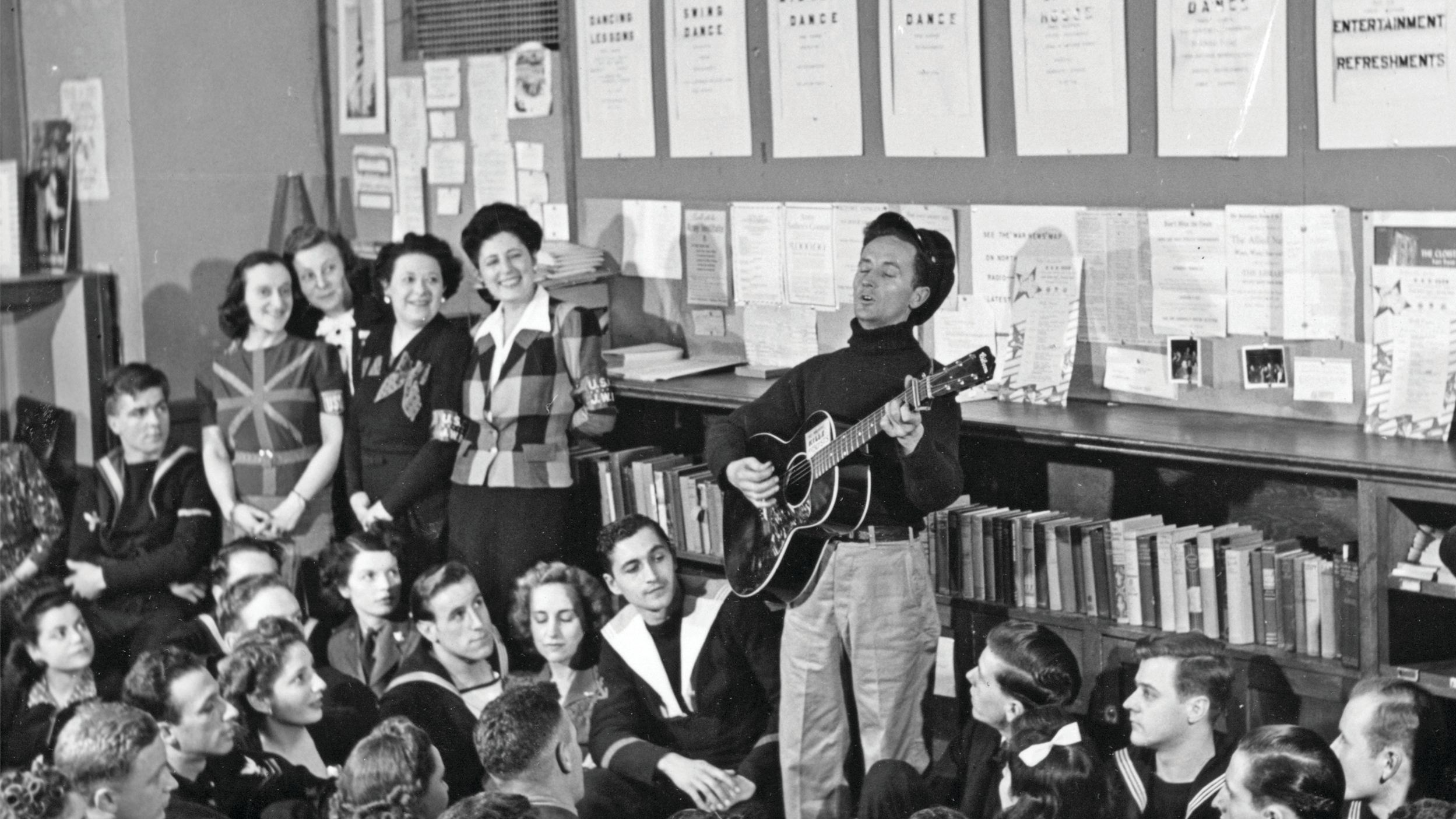
Woody Guthrie’s origins in small-town Oklahoma are well known, as are his Dust Bowl songs, his rise to fame and his guitar emblazoned with the motto: “This machine kills fascists.” People still sing his songs nearly 60 years after his death.
But Aliza Greenblatt has almost been forgotten.

Greenblatt, born in the 1880s, became a known figure in Yiddish literature in America and a published author whose words were often set to music.
“This is a woman who published four or five books of poetry, all in Yiddish,” Pressman said.
As a girl, she left Russia and settled in the U.S., where she married Isidor Greenblatt in her early 20s. She became a socialist, a poet immersed in the cultural Yiddish life of New York and an ardent believer in the possibility of a state of Israel.
Guthrie, by contrast, grew up in a small town watching his family descend into illness, tragedy and poverty, before he rose to fame as a radio personality and then lost all work once he was blacklisted for his socialist views.
The film interweaves their story, partly to show a little-explored part of Guthrie’s life and partly to bring Greenblatt to greater prominence.
“Also to show how they influenced each other’s lives, which they absolutely did,” Pressman said. “And that turned out to be the real fun part of this whole project.”
That the two met at all is due to the fact that Guthrie happened to fall in love with Aliza and Isador’s daughter Marjorie, who was a dancer in the company of modern dance icon Martha Graham. Both were married at the time, but it was love at first sight when they met in New York, Marjorie explains in archival recordings used in the film.
She broke all the Jewish rules, says their daughter, Nora Guthrie: She got divorced, had a child out of wedlock and married a gentile. But the marriage marked Guthrie’s entry into a Jewish family’s world that, by all accounts, he loved and cherished. That extended to his mother-in-law.
They made an odd pair.
“Some people aren’t Jewish,” Aaron Lansky, founder of the Yiddish Book Center, says in the film. “And some people really aren’t Jewish. That was Woody Guthrie.”
But, Lansky says, Marjorie felt the lanky Oklahoman had a Jewish soul. “And that I think was mostly centered around his relationship with Marjorie’s mother, Aliza Greenblatt,” Lansky said.
The Guthrie family moved two blocks away from Marjorie’s parents in a heavily Jewish, Yiddish-speaking area of Coney Island. Woody and Marjorie’s first child, Cathy, died at 4 years old in a fire, a tragic echo of Woody’s own sister, who also died in a fire when he was young. The couple had three more children: Arlo, Joady and Nora.

Woody Guthrie’s children say he was close to Greenblatt: He illustrated a book of her poems and gave feedback on her lyrics. Partially inspired by Greenblatt, he wrote songs on Jewish themes — about Hanukkah, Purim, borscht, halvah and pickles.
As Guthrie wasted away from Huntington’s disease, a hereditary neurological condition that meant he had to be hospitalized most of the time, Greenblatt stepped in to help Marjorie raise the kids, which included lighting Shabbat candles with them every Friday night.
Arlo Guthrie, in the film, speaks lovingly of being sung to by her and of celebrating the Jewish holidays in their own inimitable Guthrie way.
One anecdote from the film is too strange to omit. At some point, Marjorie hired a tutor to help the kids get a bit more of a Jewish education, but the tutor was too strict for the kids and the plan didn’t last. The family was amazed to find out later that the tutor was none other than Rabbi Meir Kahane, an anti-Arab extremist who was convicted of terrorism in both the United States and Israel.
“He was a very nice man,” jokes Arlo Guthrie. “Except, when he was done with us, he went a little crazy.”

The film also deals with some of the other Jewish influences in Woody Guthrie’s life, including his manager and the man who owned the recording studio he used.
Looking for a Jewish angle on a beloved non-Jewish figure means that sometimes the film casts too wide a net. The more poignant moments come when Woody’s children talk of their delight in realizing that their beloved grandmother was a respected poet with fans of her own.
“What convinced Arlo to sit down with us was because we were also focusing on his bubbe, who he was very close with,” Pressman said. “Both Nora and Arlo just really savored that opportunity.”
Pressman said the film was funded through grants from foundations and Jewish Story Partners, which supports Jewish-themed documentaries. Pressman, who is a journalist as well as a filmmaker, was also a 2019 filmmaker in residence at the Jewish Film Institute, which produces the SFJFF. Pressman said the film’s concept started with a chance discovery that Woody Guthrie had written a Hanukkah song, but Pressman feels the film has taken on a greater, and more timely, relevance as it touches on themes such as the treatment of refugees and those who give a voice to the voiceless.
“I hope that audiences come away from the film thinking about those issues as well,” he said. “But I also want them thinking, ‘Wow, who knew that Woody Guthrie had a Jewish story?’”