

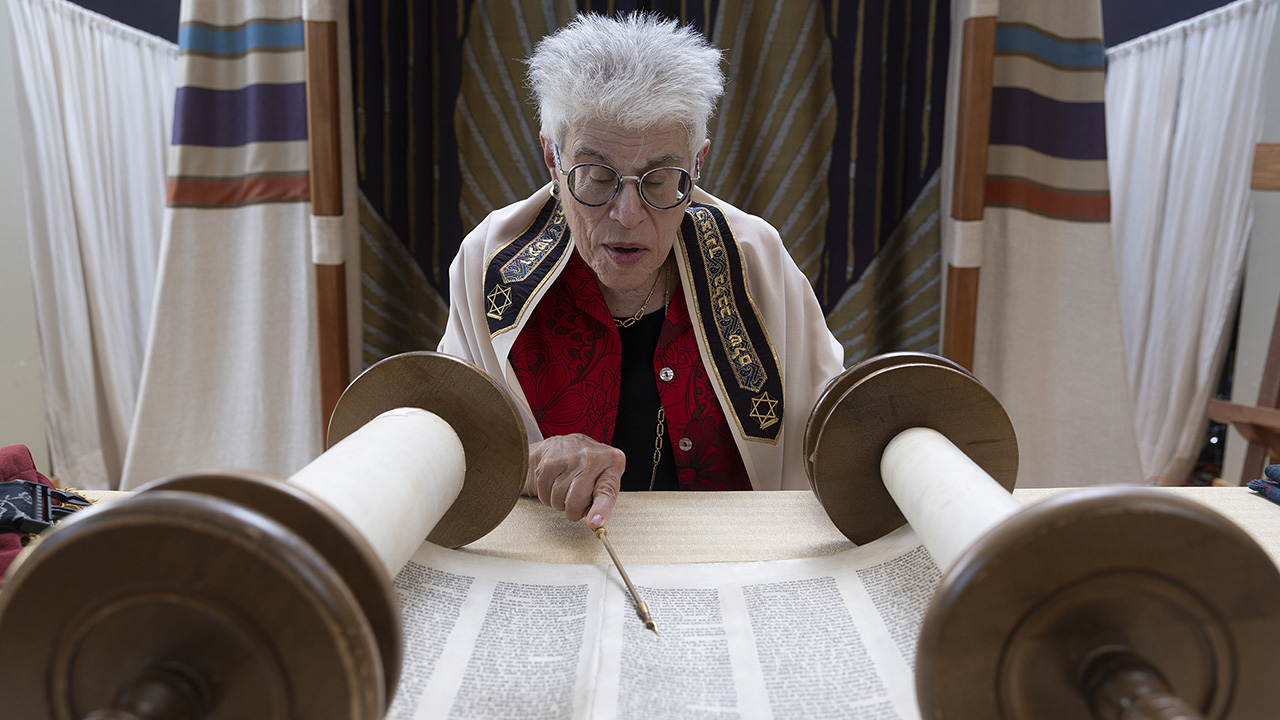
I celebrated my bat mitzvah on June 20 at Congregation Netivot Shalom in Berkeley at the age of 83. Since I had not publicly celebrated becoming a bat mitzvah when I turned 13 back in 1956, one might reasonably ask: What sense does it make to do it now?
There was no need for me to promise to be a good Jew; I spent the 70 years between ages 13 and 83 “doing Jewish.” Until my retirement, I was a professor of Talmud at the Jewish Theological Seminary in New York. A bat mitzvah at 83, or at all, might seem redundant.
But over the course of my lifetime, American Judaism underwent seismic change. Until the 1970s, women’s voices were not welcome on the bimah and were even banned in yeshivahs, the traditional venues of Talmud study. That began to shift in 1972 when Ezrat Nashim, a group of feminist women, cogently argued for equality of opportunity and obligation for Jewish women.
My role in that group was to provide the Talmudic basis for these changes. After many heated discussions, I was able to advance the claim that even though the Talmudic rabbis significantly upgraded women’s status in a wide variety of areas, they left the implementation of full equality to future generations.
As a result of Ezrat Nashim going public with its feminist critique of Judaism and campaign for change, many synagogues recognized the merit of our arguments and began to offer ritual opportunities — such as reading from the Torah — that had been unavailable to women in the past. Egalitarian Judaism rapidly became the norm in the Conservative and Reform movements. Birth-related ceremonies and bat mitzvahs for girls became standard practice.
But all of these changes came too late for me to have a bat mitzvah. By then, I was well past the standard bat mitzvah age.
When Rabbi Stuart Kelman, of blessed memory, the first rabbi of Congregation Netivot Shalom, celebrated a second bar mitzvah in 2025 at the age of 83, I began to consider marking my own first bat mitzvah in 2026, when I too would turn 83.
For me, there was a simple and compelling rationale: gathering my family. To have my sons, daughters‑in‑law and grandchildren all in one place at the same time is a rare gift. As one grows older, time spent with children and grandchildren becomes one of life’s great joys. That alone seemed reason enough.

As the day approached, the celebration began to ripple outward. I asked each of my three sons to read an aliyah of Torah. A 14-year-old granddaughter, who celebrated her bat mitzvah last year, volunteered to read an aliyah as well. So did one of my daughters-in-law. An 8‑year‑old granddaughter asked to read an English prayer for the United States and Israel. And all five grandchildren were assigned the delightful task of showering me with candy after my own aliyah.
These developments transformed the event into a profoundly Jewish moment not only for me but for my entire family. And because I moved to Berkeley only two and a half years ago, my synagogue community did not yet know my children or grandchildren. My kids did not grow up here. The bat mitzvah celebration therefore became an opportunity for my community to meet my family — and for my family to meet my community.
Celebrating at 83 also meant that my grandchildren would see their grandmother reading Torah and delivering a drash in her synagogue, surrounded by a community that celebrated with her and took pride in her. That image may inspire them not only to mark their own coming‑of‑age Jewishly, but to live their lives more Jewishly, embraced by a synagogue community.
More broadly, if increasing numbers of 83‑year‑olds celebrate a first or second bar or bat mitzvah, it may alter the outlook of synagogue boards. Boards often emphasize the need to attract “young people,” implying that older Jews are less central to the community’s future. But one of the things we “old Jews” do exceptionally well is inspire younger Jews to imagine themselves growing old like us: living Jewish lives in the context of community. I saw this repeatedly while serving on admission committees at the JTS Rabbinical School: Applicants often credited a grandparent with influencing them to live Jewishly. I used to be surprised by this, but I now understand that this is precisely what grandparents often do.
Flaunting our Jewish accomplishments publicly at 83 (which cannot be done at 13) is therefore beneficial to ourselves, to our families and to the broader Jewish community. And since most b’nai mitzvah conclude with a good kiddush, who needs further justification for such a celebration.
I dedicate this to the memory of my husband, professor Milton B. Adesnik, who passed away four years ago.