

(JTA) — JERUSALEM — Jerusalem’s premier soccer team made an unusual announcement last week: It would give a new cafe free advertising on players’ uniforms for the coming season.
Cafe Basimta was facing harassment from haredi Orthodox protesters who wanted it to close on Shabbat, and Hapoel Jerusalem said it wanted to send the message that Jerusalem is “an open and diverse city, where there is room for everyone.”
But on Tuesday, Hapoel Jerusalem reversed course and retracted the offer, after learning via an inquiry from the Jewish Telegraphic Agency that Cafe Basimta is an official project of Jews for Jesus.
“Our original intention was simply to support a small business that was being denied its freedom of operation, and we still believe in that principle,” club spokesperson Matan Avrina told JTA. “However, we also realized that this specific story is more complex than we initially knew.”
For the secular Israelis who have flocked to Cafe Basimta in response to the protests, too, the revelation of the cafe’s ties to a Christian missionary organization is complicating what had seemed like a simple skirmish in the city’s culture war over businesses open on the Jewish day of rest.
“I don’t know if it changes my desire to drink their coffee, but it definitely complicates things,” Gabriel, an American studying in Jerusalem for the year, told JTA on Saturday from the cafe’s long line after learning about the Jews for Jesus connection, as protesters yelled. “It’s one layer deeper than I thought.”

Others say the cafe’s Christian character is irrelevant to their defense of Cafe Basimta.
“I understand they hate Jews for Jesus, and I understand what they hate them for,” said Jerusalem’s deputy mayor Adir Schwartz, who is a prominent defender of the city’s secular sector, in an interview. “My father was a rabbi abroad, and I get that they feel they are protecting Jewish continuity.But this is about belonging in our shared city.”
Yoel Ben David, the cafe’s operator as well as Jews for Jesus’ top official in Jerusalem, says the twin culture wars have been good for business.
“Even though financially, it’s great, me and the staff, we don’t love it,” he told JTA from his cafe on Saturday. “We’d all love it to just chill out.”
At first, the tensions over Cafe Basimta seemed straightforward: In a city where 46% of Jews are haredi, or ultra-Orthodox, and only 13% identify as secular, the inverse of Israel as a whole, here was a rare cafe willing to flout religious authorities and open on Shabbat. A handful of such cafes dot the city, but others have given up on Shabbat hours in the past over pressure from religious authorities.
Cafe Basimta, which means “cafe in the alley,” opened at the end of May in the Nahlaot neighborhood of central Jerusalem. The name refers to the neighborhood’s 19th century stone dwellings toppling into one another along tiny streets. Decades ago a center of the city’s bohemian culture, Nahlaot is now increasingly haredi and there are few if any establishments open on Shabbat.

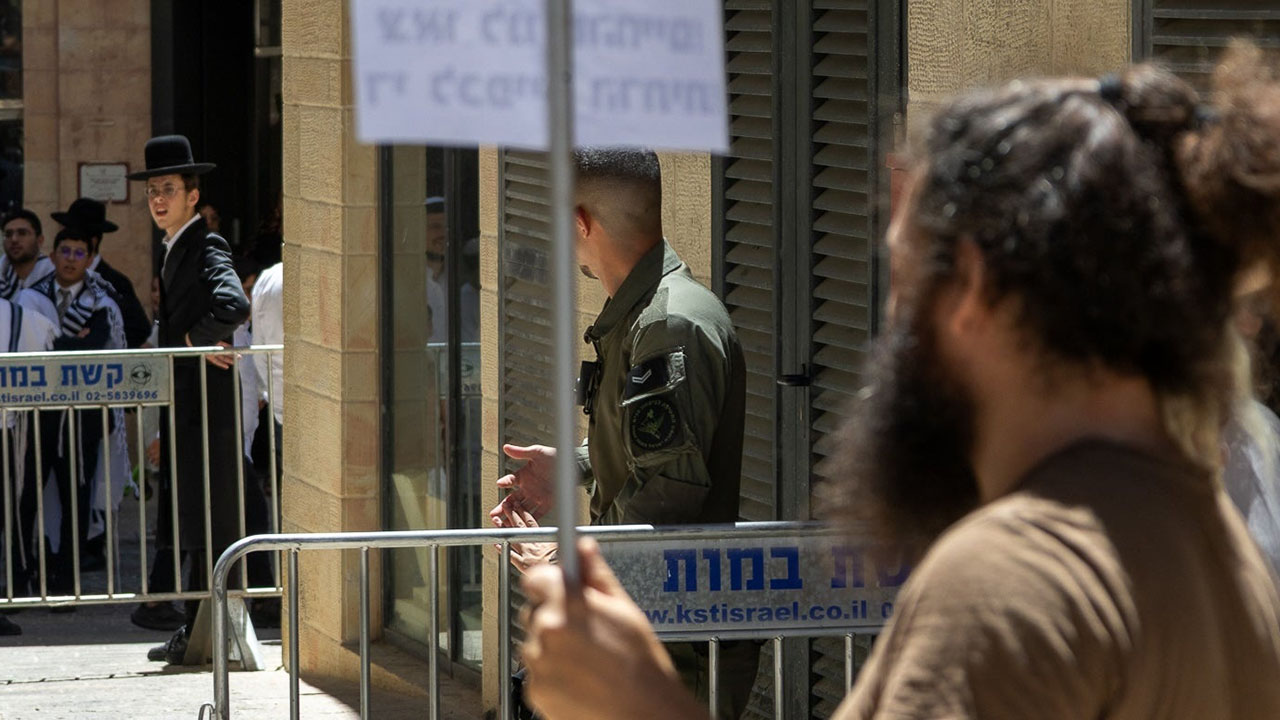
On July 4, the first Saturday it drew protesters, dozens of haredi demonstrators, many of them reportedly minors, descended on the cafe in four separate waves, surrounding it, banging on its windows and overturning tables, according to cafe staff and footage circulated online.
At the time, the cafe’s ties to Jews for Jesus were not public. That changed in early July, when Or LeAchim, a haredi anti-missionary organization that helps Jews leave missionary groups and cults, exposed the connections and began organizing protests against Cafe Basimta.
The group has placed pashkevils, or public billboards, denouncing the cafe in the neighborhood. “The missionary-messianic influence operates all the more forcefully by winning over hearts through food and drink,” the placards say in Hebrew. “And as if that were not enough, they added sin upon crime and began operating the place on the holy Sabbath, with disgraceful Sabbath desecration in the heart of the holy city.”
The revelations surprised and deterred some who had been inclined to support the cafe. But they did not change the tenor of the demonstrations, which remain focused on Basimta’s Shabbat operations.
“People went to demonstrate because it was open on Shabbos. They did not know that it was a missionary place. The demonstration was not useful for us,” said Binyamin Klugger, who works with Or LeAchim as well as other anti-missionary groups, and who was concerned the aggression of the Haredi protesters would undercut his message about the cafe’s evangelizing mission. He added, “People that continue to demonstrate are really not knowing that it is a missionary place.”
During Saturday’s demonstration, cries of “Shabbos!” echoed off the stone alleyways as the line of Israelis waiting for cold coffees stretched into the courtyard.
Israeli police stepped in to cordon off the protesters, preventing them from approaching the cafe. Some secular Israelis yelled back, with a handful at one point breaking into “Shalom Aleichem,” the hymn traditionally sung at the Shabbat table.
Residents stared down at the altercations from their balconies, the screams shattering an otherwise quiet Shabbat morning. Yael Levy, who moved to Israel from California and lives in the building directly beside Cafe Basimta, was handing out cookies to build goodwill.
“It’s very sad, especially during the Three Weeks,” she said, referring to the mourning period between the 17th of Tammuz and Tisha B’Av, when Jews commemorate the destruction of both Temples, a destruction rabbinic tradition attributes to baseless hatred among Jews. “This is just bad energy during a time that calls for positive energy.”

Outside, a long line of coffee fiends waited their turn to choose from an extensive drinks menu, as Ben David greeted customers and monitored the demonstration.
There were no visible signs of the cafe’s affiliation with Jews for Jesus. But Ben David confirmed that the organization owns the building and the cafe, which joins a growing network of similar outposts across the country. He said he is aiming to strike a balance between missionary work and just offering a pleasant place to work or meet.
“Everyone accuses us of that,” Ben David said about proselytizing. “The Jesus goal is not completely out, but it’s not front and center.”
Jews for Jesus is a flagship organization of the diffuse movement of Messianic Judaism, which believes in the divinity of Jesus while claiming to practice Judaism — an overlap that no denomination across the Jewish world accepts as compatible. While hard numbers about how many Israelis hold Messianic beliefs are scarce, both Messianic leaders and their critics believe the number is growing. Last year, one of the two Israeli embassy workers killed in an attack outside the Capital Jewish Museum in Washington, D.C., came from an Israeli Messianic family.
In 2024, Jews for Jesus appointed a member with an Israeli background as its CEO for the first time, and the Israeli branch of the global organization took in roughly $6 million in revenue that year, supporting a local staff of 60. On its website, it solicits donations for its Israel work, including, in one December 2025 appeal, $225,000 to launch a coffee shop and ministry center in Haifa, which it called a “welcoming space where Israelis can encounter the hope of Yeshua,” the Hebrew name for Jesus.
Ben David has worked with Jews for Jesus for more than two decades. He was born in Israel and came to believe in the divinity of Jesus as a young adult, together with his wife, around the time of his stint in the army, where he served as an Orthodox rabbi. He has a master’s degree from a Messianic seminary and once helmed training for missionary staff in Israel, according to Jews for Jesus’ website, which says he “now leads our work in Jerusalem, bringing the gospel back to the city where he first believed.”
Missionary activity is not illegal in Israel, with the exception of proselytizing to minors without their parents’ consent and offering religious conversions in exchange for a material gift. But many Israelis believe that it is, in a reflection of the deep cultural norms in Jewish communities.
Or LeAchim says it is planning a future protest that will focus more squarely on Cafe Basimta’s missionary ambitions.
“We are planning to hold a massive protest there soon — involving thousands of people — on a weekday,” said Rabbi Binyamin Vulcan, the group’s head of counter-missionary activities. “In the meantime, we are trying to get the place shut down through the municipality.”
Ben David said Jews for Jesus, anticipating such a response, bought Basimta’s building instead of renting it from a landlord who could be susceptible to a pressure campaign. At the same time, he insisted he didn’t understand the uproar.
“If Jesus is the Jewish Messiah,” Ben David said, “what could be more Jewish than believing in Jesus?” As for the missionary label, he insists the cafe is about more than just theology: “We don’t put crosses in our espresso,” he said.
Klugger said he is mystified about why the same secular Jerusalemites who are uncomfortable with the growing haredi character of the city are willing to buy coffee from someone who wants them to stop being Jewish altogether.
“If you don’t want haredim influencing your children,” he said, “you also can’t want missionaries influencing your children.”
Some Shabbat customers, meanwhile, say they have heard the warnings and aren’t swayed — for them, who owns the cafe is beside the point.
“I’m not going to convert because of the coffee, unless it’s really good coffee, then maybe,” said Lior Stern, who drove from the Tel Aviv area to support the cafe after hearing about the protests. “It could be Buddhist, it could be Muslim, it could be Jewish, it could be Christian. That’s not the point. The point is freedom.”