
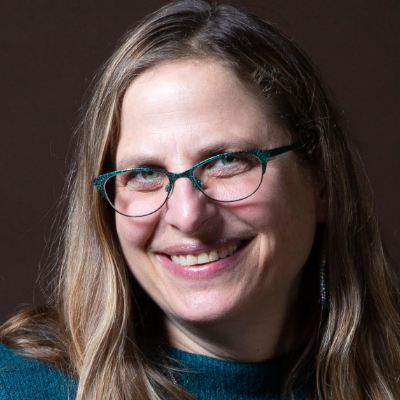
About 30 years ago, Pam Frydman Baugh had become so disillusioned with Judaism that she almost gave up on it completely. But it took just one talk to turn her life around.
Little did she know that one lecture would put her on a path that would lead to her ordination as a rabbi, or that 24 years later she would become president of the 4-year-old Ohalah, the Association of Rabbis for Jewish Renewal.
In 1973, she went to a lecture to hand out brochures on behalf of an organization she was part of, promoting Arab-Jewish reconciliation.
“I expected to tolerate the talk,” she said.
Raised a mix of Orthodox and Conservative, she had stopped practicing Judaism. She had begun exploring other spiritual traditions, specifically Sufism, a mystical movement that grew out of Islam, and Buddhism.
But the lecture, on tarot, astrology and the Kabbalah, given by Zalman Schachter-Shalomi, or “Reb Zalman” to those who know him, blew her away.
“I became completely swept away from what he was teaching,” she said. “I was very surprised to learn that Jewish mystical texts carried the answers to many of the questions I was asking, and I thought didn’t exist in Judaism.”
Now the spiritual leader of San Francisco’s Or Shalom Jewish Community, Baugh was elected president of Ohalah on Dec. 4 in Boulder, Colo.
She joins a number of local Jewish leaders who have taken the helm of national organizations recently. Among them are Rabbi Martin Weiner of San Francisco’s Congregation Sherith Israel and Rabbi Janet Marder of Los Altos Hills’ Congregation Beth Am, president and vice president respectively of the Reform rabbis’ association, the Central Conference of American Rabbis, and Amy Friedkin, the president-elect of AIPAC, the America Israel Public Affairs Committee.
Ohalah is an acronym for Agudat HaRabbanim L’Hitchadshut HaYahadut, Hebrew for the name of the association in English, but it also means “her tent.”
The rabbis who chose the name “wanted to pick a word that had a sense of warmth and openness, in relationship to our work,” said Baugh.
The Jewish Renewal movement evolved out of the teachings of Schachter-Shalomi, a Lubavitch-trained rabbi who sought to “find new ways to practice Judaism and breathe new life into Jewish ritual,” said Baugh.
Paraphrasing Reconstructionist movement founder Rabbi Mordecai Kaplan, Baugh said Renewal rabbis believe “tradition has a vote but not a veto.” They look for guidance in the Talmud and from the other Jewish movements, and then “feel free to be influenced by that without being bound by it.”
The Bay Area is home to several Renewal congregations in addition to Or Shalom, including Kehilla Community Synagogue in Berkeley and Aquarian Minyan, based in Oakland.
There are several others that call themselves Renewal but are not affiliated with the national organization, including Beyt Tikkun and Keneset HaLev in San Francisco. Berkeley’s Chochmat HaLev also uses utilizes Renewal practices.
According to the Jewish Renewal movement’s official Web site, there are 40-plus congregations and chavurot, or informal organizations, worldwide.
“The Bay Area is one of the places where Jewish Renewal originally blossomed and flourished,” said Baugh, who lives in Daly City with her husband and 14-year-old son. She also has a 23-year-old stepson. Her husband is a psychotherapist who is also the musical director of Or Shalom.
Baugh’s path to the rabbinate was a circuitous one. She drifted from Orthodoxy because as a woman she was discouraged from singing and participating as loudly and fully as she wanted to. She attended Tel Aviv University for her entire undergraduate education, and an experience while she was a student there propelled her to get involved in Jewish-Arab reconciliation.
A close friend of hers had been called to reserve duty in the Gaza Strip. He stood by as a group of his fellow soldiers took the lamb of a Palestinian family for no reason other than because they could.
“They just took it and slaughtered it and roasted it. He was very upset about this, and as he was telling us the story, my view of Israel just shattered before me. I started to see the inhumanity of the situation.”
Her work in this area led her to become friendly with a Sufi.
“I joined them and also started to meditate and dance with them and participate in their spiritual practices,” she said, “but in the Sufi community I was always viewed as a Jew.”
What appealed to her, she said, was that “the Sufis I was involved with were very universal, chanting phrases from all the major traditions, including Judaism.”
At the same time, Baugh attended lectures by Schachter-Shalomi whenever he came to the Bay Area, which was several times a year. In 1974, he led High Holy Day services at Glide Memorial Church, and invited a Sufi choir to sing, asking Baugh to serve as the conduit between him and the choir.
“I would go over the Jewish liturgy and explain it to them in Sufi terms so the choir director would know what kind of music to prepare for the different parts of the service,” she said. “So this put me in a working relationship with Reb Zalman, talking through the liturgy of High Holidays and seeing it in a completely deeper way than I ever had before. I found myself using the teachings I had been using with the Sufis, to be able to translate from one tradition to the other and something opened in me.”
After those services, a group began meeting for Shabbat in Berkeley. That group developed into the Aquarian Minyan, in which Baugh was active. By that point, her Jewish practice deepened, and she began davening daily.
Then, when Schachter-Shalomi was about to found a “seminary without walls” to ordain Jewish Renewal rabbis, he called Baugh, inviting her to study.
Baugh said she’d have to think about it. And in so doing, she went home to visit her parents.
Her father, who was born and raised Orthodox in Poland, lost almost his entire family to the Holocaust. When Baugh’s grandmother died, her father did not allow her to shovel dirt on the coffin because she was a woman. Her exploration of other faiths deeply pained him.
Yet when she told him of this opportunity, “he smiled and clearly was very proud, and he said, ‘Do it.’ He felt he could support it and did so until he died.”
Baugh’s father died a year and half before she was ordained. The seminary never really materialized; instead, Schachter-Shalomi directed Baugh’s studies himself, or through rabbis whom he recommended. Her ordination took 11 years.
In 1991, she began teaching a few kids whose parents were largely unaffiliated, many of them in intermarried families. That soon evolved into Or Shalom in Noe Valley, which began with about 22 families. Now there are close to 200.
Or Shalom has a rule that only kids who show initiative and want to be there are allowed to come to religious school. Nobody is forced to attend.
Ed Koplowitz, one of the synagogue’s founders, said that Baugh has made it a welcoming place for those who might not feel comfortable at more mainstream synagogues.
“My wife is Jewish, but we were in the minority at that time,” he said. “Or Shalom was as comfortable a setting as there was for people to have a service that was accessible.”
Baugh’s background in other traditions gives her a certain “openness and eclecticism, and that “makes people feel comfortable and included,” said Koplowitz.
As president of Ohalah, Baugh will not be the first woman to become the head of a rabbinical organization (Rabbi Nancy Fuchs Kreimer is president of the Reconstructionist Rabbinical Association). But in her two years as president, she will make her mark in shaping the young organization.
One of the reasons for its founding in 1998 was to give Renewal rabbis more legitimacy among their peers in other movements. A number of rabbis throughout the country have questioned the ordination of Renewal rabbis because many have not graduated from a seminary.
Baugh, who studied years more than most seminary graduates, said she did not face that problem here. The Board of Rabbis of Northern California has accepted her, as it has Michael Lerner of Beyt Tikkun, who has also received ordination from Aleph, the Alliance for Jewish Renewal.
“For many years, I have felt very accepted among the rabbis of the Bay Area, and more than that, I am friends and colleagues with them,” she said. “Rabbis have referred congregants to me, and I refer others to them.”
What makes Ohalah different from the other professional rabbinic organizations is that graduation from a seminary usually qualifies that rabbi for entrance into the professional organization of the same movement. Since Renewal is not a denomination, Ohalah’s members have been ordained in every seminary from Reform to Orthodox, and some, such as Baugh, have studied personally with Schachter-Shalomi.
But they must be voted in by the other members. “What we’re looking for are rabbis who are open to a diversity of views,” she explained. Rabbis can belong to Ohalah regardless of whether they officiate at interfaith marriages or gay or lesbian commitment ceremonies.
Also, Ohalah is a division of Aleph. The other rabbinic associations are separate from their movements’ congregational arms.
“We decided to create ourselves that way intentionally, in order to put our energies in our early years, into fostering rabbinical development and creating rubrics of a new organization.”
According to Baugh, there are 62 members. “But my guess is that there are hundreds of rabbis who would call themselves Renewal.”
Baugh said she was hoping the visibility of the organization would increase under her leadership.
Rabbi David Zaslow, of Ashland, Ore., is Ohalah’s current secretary. He has known Baugh for eight years.
“Some people have a narrow view of the world, and she has a broad view,” he said. “She empowers people and brings them to their highest potential rather than using the old hierarchical model of ‘I’m the boss.’ She’ll also lead by example.”
Baugh believes that Renewal is taking hold not only in its own congregations but that its influence is being felt in synagogues of the other movements as well.
“Renewal is not the exclusive pursuit of our movement,” she said. “If it disappeared tomorrow, the renewal of Judaism would continue. It’s happening in every movement, certainly in every congregation in the Bay Area.”