
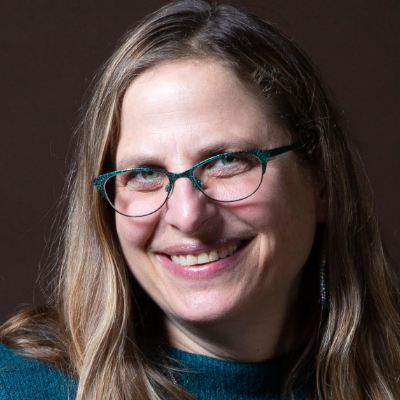
Shortly after Amy Errett moved to the Bay Area, a friend invited her to attend services at Glide Memorial Church.
Errett was a non-practicing Jew who hadn’t been to synagogue in ages. Nevertheless, the thought of going to church held no appeal.
“Why would I go to church?” she thought. “I don’t go to synagogue, I have a hard enough time with that. But kicking and screaming, I went.”
While the mention of Jesus now and then did bother her a bit, on the whole, the experience was overwhelmingly positive. Errett, 44, CEO of Olivia, a travel company that caters to the lesbian market, found the eclectic service — called a “celebration” in Glide parlance — more spiritual than anything she had ever experienced.
“Clearly there was something going on there bigger than just songs about Jesus,” she said. “I’m not a Christian. I don’t identify with the Methodist Church from the perspective of ‘This is my belief system.’ But I identify with the spirituality.”
Errett identifies so strongly, that she is president of the board of Glide. While a handful of Jews are among the leadership of the church, many more go regularly to services and volunteer with the church’s social service programs. In fact, an estimated 10 to 20 percent of the membership is Jewish.
More than the services though, the social action component of Glide resonated with Errett. Founded in 1929, Glide has a history of activism that began in the 1960s, when the Rev. Cecil Williams became spiritual leader. In 1967, he decided to take down the cross from the sanctuary, in an effort to gain wider appeal. Almost immediately under Williams’ leadership, Glide began offering a number of social service programs. It continues to take a leadership role in the city, providing food to the homeless, and programs for people in recovery and teens at risk.
“I don’t go and serve food and serve on the board or raise money for Glide because I believe that Methodists should rule the world,” said Errett. “I do it because I believe people should get fed.”
Glide is also known for its open-door policy to gays and lesbians, as well as to everyone.
While the church calls itself Methodist, Errett said that to her, it seems nondenominational. “It’s about liberation theology and freedom, self-expression and accepting people for who they are.”
Additionally, she said, “A lot of the people are similar to myself. For whatever reason, the religion they were brought up in didn’t do it for them. This grabs you in a way other places don’t.”
While Errett is somewhat involved in the Jewish community — an involvement that began when a local Jewish community coalition selected her as an Israel Fellow in 2001 — other members of Glide who are active in the Jewish community don’t feel any conflict in their spiritual pursuits.
“I’m not going to Glide because of the religious side; I have my own path and I know what it is,” said Zev Zaidman, 35, a Berkeley entrepreneur who is a regular at the Jewish meditation center Chochmat HaLev.
Zaidman, who attends Shabbat services almost every week, also attends Glide on Sunday mornings about once a month. “I’m not going there to become a Christian or because I’m not happy with Judaism,” he said. “I’m just complementing it.”
When Phyllis Kaplan, who heads the special education department at Cal State Hayward, first attended Glide in the late ’60s, she immediately became hooked. Kaplan, 62, has served on the board ever since, except for when she has been on sabbatical.
She described her father as the kind of man who brought alcoholics home from New York City’s Bowery and helped them get cleaned up. “My Jewish father did the kind of work Glide does and I was raised to do what Glide does,” she said.
Kaplan, who has adopted 10 children of different races and disabilities over the years, said Glide is the perfect place that welcomes her nonconventional family.
Calling Glide her “sane asylum,” she said the first time she went, as well as in subsequent visits, “I knew that was the way the world needed to be, it just worked for me.”
Kaplan attends High Holy Day services every year, and has logged many hours of volunteer work in Israel. But she has found no Jewish organization that can compare to what Glide does.
“I don’t think there is another organization doing exactly this,” she said. “There is not another one that I’ve found in the world that as openly and as compassionately and unconditionally loves and accepts people as much as Glide.”
Jason Ollander-Krane went from volunteering for Jewish organizations to almost exclusively volunteering at Glide — “doing about everything a volunteer can do there.”
While he attends Shabbat services once a month, the 47-year-old management consultant goes to Glide every Sunday.
Ollander-Krane said he was taught to value diversity and can’t help escape the feeling that at Shabbat services, everyone is the same. Additionally, he said, “I feel there’s a real sensitivity to all spiritual paths at Glide, especially the important heritage that Jews bring.”
Though he has volunteered in the Jewish community, he gets more satisfaction from his efforts with Glide.
“My contribution at federation was always seen in terms of how much money I could donate,” he said. “I’m not a rich person, but I’m a very able person. People valued the expertise I brought, but it always paled in comparison to the monetary contribution. I wish the Jewish community would understand that people my age and younger are interested in giving their energy and effort, that that kind of involvement is more important and gets them farther faster rather than someone who shows up to a meeting every once in awhile.”
Errett believes that social service programs with a spiritual component work better than those without, which is why Glide’s programs are so effective.”I would love to find that in terms of comprehensive social service programs in a Jewish setting,” said Errett, “but in my opinion, it doesn’t exist in the same way in San Francisco.”