
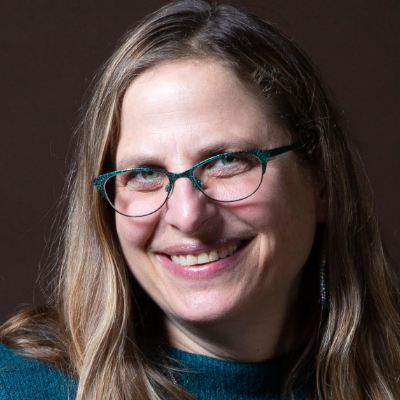
Luke “Noach” Dzmura dreamed of furthering his studies in Israel but couldn’t go without financial assistance. So the graduate student at Berkeley’s Graduate Theological Union applied for the Haas Koshland Memorial Award — despite thinking, “There’s no way in hell I’ll get it.”
The 43-year-old Dzmura is different than the more than 20 previous winners — usually recent college graduates — not only for being almost twice their age.
He is a transgender man, formerly a woman, who converted to Judaism.
But he had nothing to lose, he thought, so he applied. In his essay, he described his field of interest: rabbinics, gender and sexuality, as well as his master’s thesis on what the rabbis thought about gender variance. He said the rabbis recognized more than two genders, which “has at least one message for us today who are so stuck in our binaries.”
The award he won, given annually from the Jewish Community Endowment Fund in honor of Walter Haas and Daniel Koshland, will provide him with $15,000 to study in Israel next year. He hopes to do so at the Pardes Institute of Jewish Studies.
Koshland’s daughter, Frances Geballe, said of Dzmura, “He’s met many challenges in his life and was so warm and natural and poised and anxious to take part in life. We keep thinking when we meet these young people that maybe the world will be saved after all.”
The award-winner, whose grandfather was a priest, grew up Byzantine Catholic in West Virginia, and throughout high school dreamed of becoming a priest. Byzantine Catholicism evolved out of Eastern Orthodox, he explained, and was differentiated by allowing priests to marry. Seventy years ago, it joined the Roman Catholic Church.
Although she couldn’t exactly articulate it then, somewhere along the way, she realized that girls could not become priests.
By the time she reached college, she was not practicing Catholicism anymore.
While in graduate school, she got toxic shock syndrome and almost died. The brush with death got her wondering about the mark she would have made on the world. She began volunteering with AIDS patients in Dallas, where, at this time, the word AIDS was not uttered; it was called “an infectious disease.”
Though Dzmura had unsuccessfully dated men, until she began working with AIDS patients she had never met a gay person. She didn’t even know such a possibility existed, but meeting gay men made her realize she must be a lesbian.
Soon after, she went to a leadership conference for the lesbian, gay, bisexual and transgender community, and met a transgender man for the first time.
“I had never known of that possibility before — that a man who had been female, through hormones and surgery had become male. That was a profound experience, but it was too much for me to handle, so I buried it and forgot about it for 10 years.”
At the same time, she saw that spirituality played a very important role in the lives of the AIDS patients with whom she was working.
“They were spiritual in a way I never had encountered before. They were using the tools and techniques of religion outside of religious contexts to help themselves, to improve their thinking about themselves and to improve their health, and to change their behavior in positive ways. I really liked that kind of spirituality but didn’t know what to call it.”
Through them, Dzmura began exploring paganism and Wicca, which she practiced for about 10 years. But after some time, “It became too much work to create everything new. And it felt like there was no link to tradition. It felt too piecemeal, not a system.”
Through involvement in that community, she began attending a Unitarian Universalist Church. She liked it because it was free of dogma.
Dzmura, who had shortly before that point begun the hormonal transition to becoming a man, found her new church to be open and welcoming to people like her — so much so that her childhood dream of becoming a priest returned, and she consulted her minister.
The minister definitively told her, “You must first define your own ideology.”
That sent Dzmura on a search, visiting many different spiritual communities — as a man. He was living in Pittsburgh, Pa., at the time, and after visiting Bet Tikvah, Pittsburgh’s LGBT congregation, he kept going back.
At Bet Tikvah, which was largely lay-led, he saw a man doing the candlelighting. He saw a woman giving a sermon. He saw a transgender woman have a naming ceremony.
Dzmura had begun divinity school in Pittsburgh but it wasn’t liberal enough for him, so he applied to come to GTU. He was still planning on becoming a Unitarian Universalist minister, but once he got to the Bay Area, he began “shul-hopping” and “from that moment, I felt ‘I’m converting.’ I found so much wonderful Judaism here, such incredible diversity of Judaisms.”
When asked to describe further what he liked about the faith, he said, “I began to feel in a million ways something that would connect to me and that I could connect to. I fell in love with Judaism, from the service, to the holidays, to the people and their welcome and sense of familiarity-with-outsider status. And I felt like with Judaism there were tools for a person like me to navigate the world in a better, more connected way.”
There was just one problem. “I realized it would shoot my career plans in the foot.”
In the year leading up to his conversion two and a half years ago, Dzmura took Jewish studies classes at GTU, and “began a lifetime romance with Jewish texts.” He also studied with Rabbi Benay Lappe, who has begun Svara, a “queer yeshiva.” Dzmura said Svara “is made for people like me to traditionally study the texts but to come at it with a queer and trans sensibility, and bring the many voices forward, and not just the one overpowering and sometimes condemnatory voice.”
Dzmura has been accepted as a Ph.D. candidate at GTU. He doesn’t rule out going to rabbinical school, or he may decide to become an academic.
His unique perspective has him thinking about things that most Jews wouldn’t even consider, such as what it means for transgender bodies to participate in gendered religious ritual, like the mikvah, or what it means for a transgender to say the morning prayer that Orthodox men say, “Thank you, God, for not making me a woman.”
“How do I approach that when I consider myself male, but I don’t want to write another prayer?” he asked.
Whatever he does, it will involve futhering the discussion on a topic that to most people is not well understood.
“I want to explore issues of Judaism and its marginalized people, and the new Judaisms that emerge on the fringe, where new things come together.”