

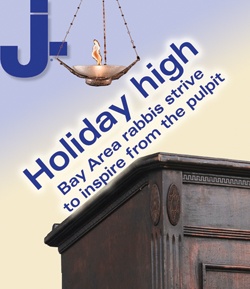
 When June rolls around, school’s out and surf’s up. Once the lazy days of summer begin, for most people it’s time for a little coconut-scented R&R.
But for rabbis, June can be a time of growing tension. Like migratory birds sensing the urge to fly south, by June rabbis can’t help but ponder a great task looming: writing their High Holy Day sermons.
With the entire congregation seated before them (the first day of Rosh Hashanah is Sept. 19 this year), rabbis use the bully pulpit of the High Holy Days to reflect on key spiritual and social issues.
Their sermons (most rabbis deliver two or more) might address the environment, the economy or the efficacy of prayer. Whatever the topic, rabbis focus all their learning, training and powers of elocution on this moment, and they always hope to hit a home run.
For rabbis, it takes work to keep up the batting average. And usually the writing process begins long before actually sitting down at the computer to compose. It often starts with wandering lonely as a cloud.
“I have to do more walking, exercising, reading texts and focusing my prayers on what I want to bring up,” says Rabbi Mark Melamut of Congregation B’nai Emunah in San Francisco. “It’s writing down ideas in notebooks and letting it form. It’s far from a linear process.”
Rabbi Camille Angel of San Francisco’s Congregation Sha’ar Zahav, the daughter of a rabbi, prepares by spending some quality time with her extensive library, reading texts and re-reading her dad’s old sermons.
“I have these memories of my father working on his sermons from my childhood,” she says. “It’s a daunting task to be surrounded by so many well-crafted messages. So many of them have perennial impact. I try not to be intimidated by that.”
She also spends time listening to members of her predominantly LGBT membership and discerning their wishes, hopes and prayers.
“If I want my congregation to really come away with something,” she says, “I have to identify what they want.”
 Rabbi Avi Schulman of Temple Beth Torah in Fremont similarly considers the congregation as a whole before he sits down to write. In addition to polling his congregants, he stuffs newspaper clippings, blog entries and his own handwritten notes into a file folder labeled “High Holy Day sermons.”
“I set aside time in my calendar to think, reflect and give myself a vision of what I want to accomplish,” he says. “I find it helpful to wander through the books in my library. Different authors will speak to me in different ways. I also find going for walks is very helpful.”
Rabbi Ari Cartun of Congregation Etz Chayim in Palo Alto doesn’t start writing his sermons until July or August — even though he, too, keeps a year-round file folder. By now, the veteran rabbi trusts the organic writing process.
“If I push and nothing happens, I figure it’s not right,” Cartun says. “If I’m angry or writing out of frustration, I throw it out. I don’t want to scold. I try to inspire. You’ve got everybody there, the largest congregation of the year. You want to make sure you don’t waste it.”
Rabbi Menachem Creditor of Berkeley’s Netivot Shalom takes the whole “organic” thing and pushes it to the limit. He does not contemplate his sermons early on, preferring instead to wait. And wait.
“I let the idea come to me the week before Rosh Hashanah and Yom Kippur,” he says. “The process itself is [about] being a resonant leader. Listening well to the pulse of the community is the best way to pick a message.”
That’s the MO of Rabbi George Gittleman of Congregation Shomrei Torah in Santa Rosa. Though he says he starts worrying about his next High Holy Day sermons “the day after Yom Kippur,” he puts all ideas on a low simmer through the summer, holding off on writing.
“I like to see where my heart is and also what’s happening in the world. Then by mid-August I feel I have to get something down on paper — the theme or the story that won’t let go. Sometimes I end up with one [sermon] that goes nowhere, but it’s for my neshama,” he says, using the Hebrew term for “soul.”
Most rabbis deliver sermons for Rosh Hashanah and Yom Kippur, but some write several more — for Yizkor, youth services and other settings. It’s a lot to keep track of.
Some strike a balance between themes of social action and those of a more reflective, spiritual nature. This year Rabbi Stephen Pearce of San Francisco’s Congregation Emanu-El will give a contemplative homily for the Yizkor service on Yom Kippur. For Rosh Hashanah, his sermon will examine the economic implosion, with an emphasis on the greed of criminals like Bernard Madoff.
“It’s on people’s minds,” Pearce says of his sermon on the economy. “If someone wasn’t directly impacted by Madoff, then they’ve been impacted by the lax SEC and totally unregulated banking. I want every sermon to have a point of advocacy.”
Rabbi Mark Bloom of Oakland’s Temple Beth Abraham will similarly sermonize on the economy, with the current health care reform debate factored in as well. He says the topic was solidified for him after a recent national conference call between religious leaders and President Barack Obama.
“It was amazing to hear [Obama] quoting the U’Netaneh Tokef,” says Bloom, referring to the great prayer of the High Holy Days. “I’m not the kind of rabbi to give the sermon he asked for: ‘Go support health care reform.’ But what can we do? We can visit the sick.”
Another of Bloom’s planned sermons will describe his tour of Poland earlier this year, focusing on several newly reopened synagogues of Krakow.
Unlike many rabbis who script their sermons word for word, Bloom — a former high school debater — prefers to memorize bullet points and speak extemporaneously. He says what he may lose in content he will “more than make up for in eye contact and personal connection.”
Rabbi David Booth of Palo Alto’s Congregation Kol Emeth will inject a running theme throughout his five sermons this High Holy Day season: How fear and hope can be two sides of the same coin.
“Especially in these anxiety-provoking times, we’re realizing how paralyzing fear can be and how important it is to bring hope into the lives of others,” Booth says. “I’m also going to tell a lot more stories, some Chassidic tales, some rabbinic tales.”
While Booth has been head rabbi of his congregation for more than three years, Rabbi Elon Sunshine will be delivering his first High Holy Day sermons to Congregation B’nai Shalom in Walnut Creek.
He says Rosh Hashanah provides an opportunity to present to the assembled congregation his vision for their shared future.
“That’s part of what drives my discussion on the first day,” he says. “What is community about and why is being part of community is important. I also take the opportunity to introduce myself.”
Part of that introduction included e-mailing synagogue members with abstracts of his High Holy Day sermons, plus suggested reading.
One of those sermons explores the Conservative movement and where it’s headed. This is part of a yearlong initiative that Sunshine calls “a conversation.”
“We want to explore what it means to be part of the Conservative movement and what it means to belong to a community,” Sunshine says. “The hope is these two conversations will somehow intersect and help shape the future.”
Temple Beth Torah’s Schulman plans on addressing the financial meltdown, something he expects congregants from his hard-hit East Bay town of Fremont will understand personally.
“I feel called upon to acknowledge the last year,” he says. “I don’t want it to be a recitation of grim figures, but there’s a desire on my part to acknowledge it. I know what it’s been like.”
B’nai Emunah’s Melamut prefers to write sermons that avoid overt political pronouncements, saying “That’s not necessarily what people come to shul for.”
One of his sermons this year is based on the old Chassidic story about having two notes, one for each coat pocket. The first reads “The world was created for me”; the other, “I am but dust and ashes.” Says Melamut, “It teaches about balance. We use it to build spiritual capital.”
For one of his five High Holy Days sermons, Cartun will tackle an unusual topic: why Jews seem to be over-represented in American humor. And it goes way beyond quoting choice moments from “Seinfeld” episodes.
He says when he meets with grieving families in preparation for a funeral, one of the most common refrains is that the deceased had a great sense of humor.
“For writing eulogies, about seven out of 10 tell me it’s most important thing they want me to know,” he says. “Jews find it to be a very important characteristic.”
Gittleman, now in his 14th year at Shomrei Torah, has a few choice topics of his own on tap. One, on the theme of life hanging in the balance, is inspired by the life and untimely death last year of San Francisco Rabbi Alan Lew. Another centers on the concept of lashon hara, the Hebrew term for malicious gossip. And yet another will talk about the Mamaloshen.
“The loss of Yiddish language and culture is so much bigger and more profound than we can imagine,” Gittleman says. “I’ll talk about that and what it means to remember a language that’s basically dead to us.”
Just in case any rabbis develop a case of writer’s block, the Northern California Board of Rabbis sponsors an annual sermon seminar. Guest speakers — usually rabbis who have been around the block a few times — offer tips and strategies for crystallizing sermon themes.
Similarly, rabbis access Web sites devoted to sermon writing, as well as archives of countless sermons delivered over the years.
This comes on top of classes on homiletics rabbis take in seminary. So they should come to the task well prepared. But like so much else in life, nothing teaches better than experience.
“I have a word of caution to rabbis in general,” says Pearce, now in his 18th year as senior rabbi at Emanu-El. “There are a lot of sermons from American rabbis. Most are awful. We live in a society in which the written word is no longer one in which we receive in-depth training, so we get a lot of light stuff.”
Ideally, this problem won’t affect local rabbis, especially given the elevated spirituality prevalent this time of year. It’s the perfect setting for a passionate — and passionately delivered — sermon.
“The energy is so exquisite,” says Netivot Shalom’s Creditor. “There’s so much yearning in the room. Yom Kippur is an adrenaline rush for 25 hours. If you can step into it, it is so inescapable. I find it to be the most exhilarating experience of ritual in the community that there is.”
While the rabbis agree the sermon remains an important aspect of the High Holy Day experience, they insist it is only part of a much larger whole.
“The dynamic of [the holidays] is unlike any other time of year,” says Schulman. “The liturgy, the prayers, the choir: All are part of heightening the joy and the deep emotion that are the High Holy Days.”
For Gittleman, standing at the pulpit leading services and delivering his sermons, the emotions of the holidays move him just as much as any of his congregants.
“When I stand and look out,” he says, “the human yearning, need, hurt, pain and excitement — all those feelings can be overwhelming. It’s humbling and beautiful.”
Cover photo illustration by Cathleen Maclearie