

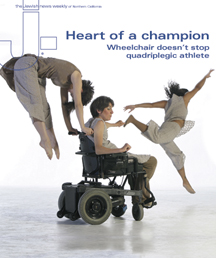
If it’s Saturday, Bonnie Lewkowicz is playing murderball.
If it’s Sunday, she’s hiking a Bay Area wilderness trail.
 Midweek, she’s likely dancing for a school assembly or singing with the East Bay Jewish Folk Chorus.
Try to keep up with her. You’d just be spinning your wheels.
Lewkowicz, 53, is quadriplegic, in a wheelchair since age 15 when she was injured in an accident on an all-terrain vehicle. That never stopped her from pursuing her passions. All of them.
Now, the Berkeley resident’s pioneering efforts in dance for the disabled and in murderball (also called quad rugby) are being recognized by the Jewish Sports Hall of Fame of Northern California. The induction ceremony will take place at a gala Sunday, June 13 at San Francisco’s Four Seasons Hotel.
Lewkowicz is the first quad athlete inducted into the Bay Area institution. “She overcame adversity, and that’s part of our cause,” says Executive Director Gary Wiener. “She’s a good representative of the Jewish community. I think her perseverance is admirable.”
She first heard about the Hall of Fame honor when a friend who helped out with her old quad rugby team called to say he planned to nominate her. “He asked if I would be interested,” Lewkowicz remembers, “and I said, ‘what’s not to be interested?’”
The award honors her involvement in both dance and murderball, a sport popularized in the 2005 Oscar-nominated documentary of the same name. In 1988, Lewkowicz founded both the California Quad Rugby League and her championship team, Quadzilla, a co-ed squad still talked about with reverence among fans.
But quad rugby isn’t her only way to play.

For more than 20 years, Lewkowicz has also been a principal dancer with Axis, a company she helped found that features disabled and able-bodied dancers performing together in original modern dance pieces.
Lewkowicz soon will launch a website detailing disabled access at state beaches, parks and trails. That’s on top of her “Wheelchair Rider’s Guide: San Francisco Bay and Nearby Coast,” published in 2006, and “Access San Francisco,” a city guide for disabled visitors.
All of Lewkowicz’s activities can be filed under her lifelong adherence to Jewish ethics, which led her to pursue projects that help others.
“I would have a hard time thinking of myself as anything other than Jewish,” she says. “Jewish values and culture are very important to my life, not just food to eat, but to share.”

Though paralyzed from the neck down with limited use of her hands, Lewkowicz epitomizes a hands-on attitude, especially when it comes to sports. Her love for quad rugby was ignited in the mid-1980s after attending a national wheelchair exhibition game in Texas.
Lewkowicz had been active in swimming and quad track events, but she longed for the camaraderie of a team sport like quad rugby. So she brought the game home with her to California.
Invented in Canada in the late 1970s, quad rugby is played on a hardwood indoor court with four on a side, the object being to carry the ball (usually a volleyball) across a goal line. As in basketball, players are required to pass and dribble the ball.
Like rugby, it gets rough.
Physical contact is part of the game, and players do get hurt. Lewkowicz has been knocked over more times than she can count. But the excitement of a murderball contest never lets up.
“It was the first sport I felt like I could really participate in,” she says. “I didn’t do basketball because I didn’t have the muscles.”
Once she formed her team, Quadzilla went on a tear. For years she and her teammates traveled the country, leading Quadzilla to the quad rugby national championship in 1990 against Tampa, then losing the title in 1993 in double overtime — a game fans consider the greatest finals match in league history (according to murderball blogs).
To the uninitiated, a quad rugby match looks a bit chaotic. But as with any sport, the pleasure is in the finer points.
“Not all quads are created equal,” Lewkowicz says. “It was originally for people with spinal cord injury, so it was easier to classify people. Now we have people with other disabilities, like polio, or one side [of their bodies] not affected. You need a classification to compete in sanctioned games. So how do we classify them?”
Each player is rated on a four-point scale, four being the highest level of physical function. A team can field players totaling only 12 points on the court at a time.
“I was the lowest you go, .5,” she says. “If you’re a woman you get docked half a point, and if you’re over age 50 you get docked half a point. So now I’m negative .05.”
She wasn’t the only .5 on her team. Insisting on having more women participate in the co-ed sport, she recruited an acquaintance, Ann Cupalo Freeman of Berkeley, to join Quadzilla.

Freeman was born with a form of dwarfism that makes walking difficult. At first she balked at the idea of playing so challenging a game. Not previously an athlete, she says she didn’t even know the difference between offense and defense.
“I remember I went out to practice and got frustrated being so short,” Freeman recalls. “I couldn’t throw the ball or carry the ball. I called Bonnie and said this isn’t going to work. She said it’s a team sport and everyone plays a part, so come try again. I’m so grateful to her that she encouraged me.”
Freeman was on Quadzilla’s 1990 championship team. “It was unbelievable,” she says of that final game. “We were so happy, banging each other on the back, all that male sports stuff, and feeling like, oh my God, this is what it feels like to have a sports victory.”
Quadzilla folded seven years ago. Since then, Lewkowicz has continued to play quad rugby purely for recreation. Much of her time since has centered on her dance career with Axis (Axisdance.org).
Founded in 1987, Axis brings together dancers with and without disabilities to create performance pieces. Starting in 1997, Axis began commissioning outside choreographers like Bill T. Jones, Joe Goode and Victoria Marks.
“We don’t see our wheelchairs as props but as extensions of our bodies,” Lewkowicz says, adding that dancing “gave me a creative outlet to express myself in a physical way I was doing prior to my injury.”
Over the years, Lewkowicz has toured with Axis across the United States, as well as Germany, Russia and parts of Europe. The company also appears at school assemblies and accepts other teaching opportunities.
“Bonnie is a rock,” says Axis artistic director Judith Smith, who is also quadriplegic. “She is a beautiful dancer, with a very steady presence on stage. She brings a charisma and a sense of purpose.”
“Anyone can dance,” Lewkowicz adds. “Our message is anyone should be able to dance. Dance doesn’t have to be a narrowly defined elite activity.”
Lewkowicz, raised in an observant Jewish home, is the daughter of an Auschwitz survivor father and a mother she describes as the “matriarch.”
She has been seeking to break down barriers for disabled people ever since that bright, awful April day in 1972 back in her hometown of Detroit.
Lewkowicz was an active girl who loved ballet, tap and jazz dance, as well as other sports. So when she had the chance to take a ride down the street on a six-wheel all-terrain vehicle, she jumped at it.
The vehicle hit a pothole, flipped and threw the four riders. Three walked away. Bonnie just laid there.
“A friend had the foresight not to move me,” she remembers, “which could have caused further injury. I was in shock. It didn’t really sink in until a few weeks later.”
“It” being the fact that she would never walk or have much use of her arms. She was laid out for nearly five months after the accident, with doctors doubtful she would ever be able to do anything for herself again.
“It was hard,” she remembers. “It sucked. There was definitely a time I didn’t want to live this way. I don’t know if I consciously knew this, but my dad was a survivor. Knowing what he went through, I thought nothing could be worse than that.”
By the beginning of the next school year, Lewkowicz was back on her high school campus, outfitted in her first wheelchair. Over time she decided she wouldn’t allow herself to despair.
Eventually she found she liked to swim, not only for physical therapy but also as a form of liberation. “Sports really helped me in my day-to-day life. I got stronger and learned body mechanics to learn how to do things.”
Once she was of college age, Lewkowicz decided to move to California for one primary reason: “Snow, baby, snow,” she says. “Wheelchairs and snow don’t mix.”
In 1975 she relocated to Southern California, then moved to Sonoma County for eight years before finally settling in Berkeley, where she attended Cal.
She found work as a travel agent specializing in trips for people with disabilities. She also worked for the Bay Area Outreach and Recreation Program, a Berkeley nonprofit that fosters social integration for the disabled.
That’s where she met her husband-to-be, Paul Church, who had come to BORP to get information about classes in wheelchair tennis. Lewkowicz at the time was organizing the first all-wheelchair centipede team for Bay to Breakers. He signed up, and love soon followed. The two married in 1992.
Today, Church works for the city of Berkeley, supervising compliance with the Americans with Disabilities Act.
As for the Yiddish chorus, Lewkowicz loves singing with the group, even though she insists she’s no Beverly Sills. “Jewish music resonates in my body,” she says. “I can’t talk music; I more feel music. Singing is just a wonderful, universal thing.”
Lewkowicz and Church live on a quiet North Berkeley street. There’s a cactus garden in the back, skylights and azure tile counters inside. There’s little Lewkowicz cannot do as a homeowner and homemaker. She’s hosted seders, she travels, she lives a full life.
A lot of that is due to one key lesson. When asked the main thing she had to learn how to do after the accident, Lewkowicz says: “Ask for help.”
That explains Access Northern California (accessnca.org), a nonprofit she founded in 1997, with the mission of improving access to local travel and recreation for people with disabilities.
“It grew up out of my experience as a travel agent specializing in accessible travel, and the lack of good information out there,” she says. “I decided to become a resource for people traveling here or people local who need this information. It’s been just me on a shoestring budget, project to project.”
Shoestring or not, she researched and wrote several books and publications distributed by the San Francisco Convention & Visitors Bureau and the Coastal Conservancy. Her next project, due later this year, is Wheelingcalscoast.com, devoted to statewide access information.
Like her local guidebooks, this website required her to research every beach, bluff and bay along the California coast. Where there’s a wheel, there’s a way.
And that’s how Bonnie Lewkowicz lives her life every day.
“I hope what I put out there is to follow your passions and to not let ‘no’ be an answer to things,” she says. “Disability was the mother of invention. It’s enabled me to think outside the box.”
Five inductees to join Hall of Fame
The Jewish Sports Hall of Fame of Northern California will honor this year’s five inductees at a banquet Sunday, June 13 in San Francisco.
Inductees are quadriplegic athlete and dancer Bonnie Lewkowicz, former S.F. Giants owner Bob Lurie, former Oakland Raider Ron Mix, tennis ace Bob Sockolov and Olympic swimming gold medalist Ben Wildman-Tobriner.
Baseball great Shawn Green will receive the first Hank Greenberg Award.
Noteworthy Jewish student athletes from the Bay Area also will be honored.
Presenters include Art Agnos, Fred Biletnikoff, Phil Bronstein, Orlano Cepeda and Chris Cook.
The event this weekend starts with a celebrity reception and silent auction at 4:30 p.m., followed by the dinner and awards ceremony at 6 p.m. at the Four Seasons Hotel, 757 Market St., S.F. Tickets are $175. For information, call (408) 374-1600, e-mail [email protected] or visit www.jshofnc.org.
RELATED: Student athlete surmounts obstacles on and off the field