

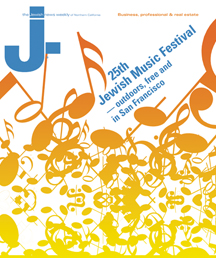
The annual Jewish Music Festival is coming, and for the first time in 25 years it’s mostly outdoors, mostly free and entirely in San Francisco.
A lineup of musical performances will take place on consecutive Sundays, July 11 and 18, at Yerba Buena Gardens, with multiple stages going all day on the 11th.
“I’ve wanted to do a free outdoor festival for years,” says longtime Jewish Music Festival director Ellie Shapiro. “The biggest exposure people get to Jewish music is when it’s free and you get a wide audience of various backgrounds.”
 Despite the tough economic times, Shapiro says she has been able to find the funding needed to stage free music. In the past, festivalgoers had to pay admission for most concerts. The first part of the event, which has been an annual affair since 1986, was in March at several East Bay locations.
The outdoor Jewish music festival concept surely predates King Solomon, but more contemporary Jewish incarnations, such as the Jewish Culture Festival in Krakow, Poland, and the Ashkenaz Festival in Toronto, inspired Shapiro to take the Bay Area edition al fresco.
“The Ashkenaz is a free outdoor music festival at the harbor front in downtown Toronto,” she says. “They get 15,000 people, many of whom have no idea about Jewish culture. They come because they’re walking along the lake front.”
How about the Yerba Buena Gardens instead?
This being the silver anniversary of the Jewish Music Festival, Shapiro decided to keep things local. Almost every band and solo performer lives in the Bay Area and has local ties.

Performers include klezmer bands Kugelplex, the Red Hot Chachkas and Glenn Hartman and the Klezmer Playboys. The all-female a cappella vocal ensemble Vocolot will be there, as will Santa Cruz percussionist Dror Sinai and Ladino salsa singer Kat Parra.
Children will have their own special entertainers, including Berkeley singer Ira Levin and Yiddish singers Gerry Tenney and Elana Jagoda. There’s even a hip-hop contingent with local rappers Eprhyme and Joshua Walters laying down some beats.
All of it is designed to be easy on the ears. “This [outdoor] format changed the kind of music we programmed,” Shapiro adds. “Sometimes we do avant-garde music geared towards niche audiences. The music we picked for this event is easily accessible.”
That’s true even as this year’s headliners bring a musically adventurous spirit to the event.
In years past, Shapiro has commissioned new works for the festival. This year’s beneficiary is composer Dan Plonsey, who will premiere his latest opus, “Dan Plonsey’s Bar Mitzvah,” on July 11 with fellow performers the Dandelion Dancetheater, presented in association with the Contemporary Jewish Museum. This event, at the museum, has an admission fee.

The French quartet Watcha Clan also will bring its blend of electronica-filtered North African Jewish melodies to a July 18 ticketed concert at the Yerba Buena Center for the Arts. Together for 10 years, the band features lead singer Sistah K, who performs in French, English, Hebrew and Arabic. The drummer’s name is Soupa Ju.
Jewlia Eisenberg will front her punk Balkan band Charming Hostess, and then some. A week before playing with Watcha Clan on July 18, the Bay Area composer will premiere her new sonic conceptual piece, the Bowls Project, on July 11 at Yerba Buena Gardens.
Eisenberg describes it as an “immersive music performance that takes place in a dome … based on inscriptions of sex and magic from Babylonian amulets” and bowls.
Somehow that all gets connected to Talmud and meditation. And it all takes place in a newly constructed masonry dome. Don’t ask; just go.
At the instrument “petting zoo,” it’s man versus oud, in which anyone can pick, pluck and bow his or her way through a roomful of Jewish instruments.
Shapiro partnered with the Community Music Center and the Zambaleta world music institute, two respected music education complexes based in San Francisco. Not only are they contributing instruments to the zoo –– which encourages hands-on experimentation –– but faculty from both institutions also will be there to show visitors how to “pet the wild violins,” as Shapiro puts it.
On display will be more than the fiddles, clarinets and accordions normally associated with Jewish music. Because the Community Music Center has a large Chinese clientele, many of the instruments will be Chinese.

Meaning someone just might attempt to play a hora on the pipa.
“We really hope people will bring their own instruments,” Shapiro says of the instrument zoo. “It will be a success if people play with each other, and if a kid plays a clarinet for the first time and says, ‘This is cool. I want to take lessons.’”
And just maybe that kid will put that clarinet through a few klezmer paces.
“The festival’s mission has always been to present music that both celebrates Jewish experience in innovative ways and engages the broader community,” Shapiro says, adding the upcoming festival “really explores what it means to be Jewish in the multicultural world and embrace what the Bay Area is about, as a hub of multicultural life.”
RELATED STORY:
Music goes ‘bowling’: Unique ‘Bowls Project’ gives voice to women of ancient Babylonia