

Just a week after Arin Fishkin trekked back to San Francisco from Burning Man festival last year, festival officials wanted her back.
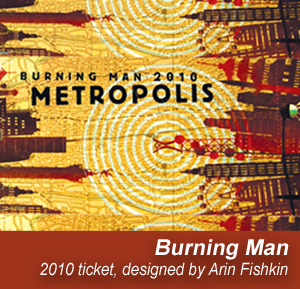
Fishkin, a graphic designer for several local startups, sustainable businesses and nonprofits, was one of about 20 artists invited to submit a design for the ticket and poster for the 2010 Burning Man, “Metropolis,” which runs Monday, Aug. 30 to Sept. 6.
Her winning entry — myriad red buildings set in front of a light blue and taupe sky — is printed on approximately 70,000 Burning Man tickets. She received the good news this past October, giving organizers time to capitalize on ticket sales during the 2009 holiday season. She also gets to attend Burning Man for free.

“It’s the biggest honor of my career,” said the 41-year-old, a graduate of University of Michigan’s School of Art and Design. “Burning Man has been an inspiration to me. The [color] palette is darker, somber and intense to reflect what happens at the event after dark. When day turns to night, things become more surreal.”
Since its inception on San Francisco’s Baker Beach in the 1980s, the annual festival has grown into a mass phenomenon. More than 40,000 people, known as “burners,” now come each year to Black Rock Desert and its postapocalyptic landscape in the Nevada wilderness.
Attendees experiment with creating temporary community and radical self-sufficiency in a city — complete with departments of public works, planning and “mutant vehicles” — that is created and then dismantled on the playa, the ancient lakebed where Burning Man unfolds. The event culminates with the burning of “The Man,” a massive man-shaped structure that looms over the playa.
Fishkin, who is Jewish and occasionally attends Congregation Sha’ar Zahav in San Francisco with her 5-year-old daughter, has been a “burner” since 1996.
“It’s a really important part of my life because it’s an opportunity to leave inhibitions behind,” she said. “I am inspired by the art in that environment. You have giant metal or wood sculptures in this featureless desert that everyone is encouraged to interact and play with.”
In 2009 Fishkin was selected to design the Burning Man calendar, the lone souvenir handed out to festival officials and special guests. The calendar is also one of the few items sold at Burning Man. Five years earlier she helped create the now-defunct Burning Man newsletter, the Black Rock Journal.
When she’s not surviving the 100-plus temperatures at Black Rock, Fishkin is creating art inspired by wallpaper, Japanese woodblock prints and 1920s posters.

She also enjoys cooking and previously worked at the JCCSF café, where she learned about the laws of kashrut.
When Fishkin visited her family in Jerusalem, “it paid off tremendously,” she said. “Knowing what was OK to cook and eat definitely helped.”
She pointed out that Judaism and her spirituality play a significant role in the type of projects she takes on — Fishkin tries to collaborate, as much as possible, with clients whose work is for the greater good.
Fishkin’s graphic designs have graced the packaging, banners, brochures and websites of a long list of clients, including Bi-Rite Market, the California Safe Schools Coalition and the Gay-Straight Alliance Network. She recently designed a weight loss and weight training application for the iPhone.
“I like to think my work is transparent enough to bend to the needs of my clients,” Fishkin said. “I have a clear way of presenting ideas that is very inclusive.”