
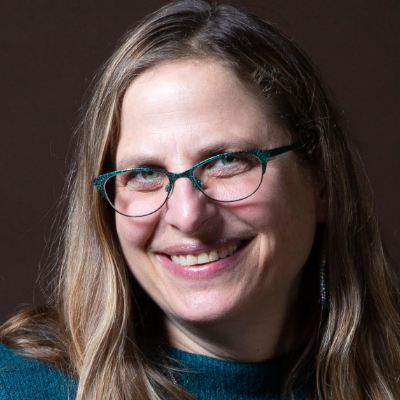
Congregants of Berkeley’s Netivot Shalom know that their rabbi, Stuart Kelman, never intended to lead a pulpit.
“I wanted my focus to be in education, particularly with teenagers,” said Kelman, who for nine years directed the former Agency for Jewish Education in Oakland.
Nonetheless, those same congregants honored Kelman Sunday on his 60th birthday — which also marked the Conservative shul’s bar mitzvah year and his ninth year as its full-time rabbi — at a festive celebration at Scott’s Restaurant in Oakland. Kelman even took the stage to play a few numbers on his clarinet.
A founding member of the congregation himself, Kelman first served for four years as a part-time rabbinic consultant, on top of his full-time job at the agency.
The congregation, which bills itself as both egalitarian and participatory, began with an ad in the Jewish Bulletin that said “What? Conservatives in Berkeley?” and grew faster than anyone expected. When it reached 200 households, the number of lifecycle events Kelman was required to do made him feel too stretched. “I was actually moonlighting, I couldn’t do it anymore,” the rabbi said. “It wasn’t fair. They needed more than I could possibly give.”
The fact that Kelman was run ragged by his responsibilities caused him to broach the topic with the board, suggesting he become the congregation’s full-time rabbi.
But Netivot being the participatory congregation that it is, at first board members pondered whether having a full-time rabbi would change things.
Kelman convinced them that it wouldn’t, and they offered him the job.
“We didn’t interview anyone else,” said Art Braufman, a founding member of the congregation.
Since the very beginning, Netivot has placed an emphasis on congregants playing a large role in synagogue — leading services, reading Torah and offering their own commentaries.
Kelman takes empowering his congregants seriously, and described his leadership this way: “I’m not in the mold of the central person, as are many of my colleagues.” At Netivot, “The power of religious leadership does not always lie in the hands of the rabbi.”
Braufman believes “one of the beauties of Rabbi Kelman is that he can be a congregational rabbi and encourage participation and maintain that all these years. This is his great uniqueness.”
But this kind of leadership can be challenging, Kelman conceded, in that he feels he is constantly trying to maintain a balancing act.
“Sometimes I feel I need to step in, but have to remember not to.”
Then there are what Kelman referred to as “hot-button topics,” which are sure to arise at any congregation.
Generally, “we try and engage in a period of study about them and come to some conclusions which are both rabbinically sound and take into account the voices of the congregation,” he said. Years ago, it was the role of gays and lesbians in the synagogue. Currently up for discussion is the role of the non-Jew in the congregation.
Highlights from Kelman’s tenure are as recent as last week.
The synagogue has approximately 50 families with children under the age of 5, and last week they came to synagogue to walk around with the Torah.
Although they do this every year, it “was astounding just seeing these little children and their participation as part of this larger community that we have,” said Kelman.
Seeing members become b’nai mitzvah as adults is another, as is presiding over the many conversions of both children and adults over the years.
And then there was the woman in Cuba, who, with Kelman’s help, donned tefillin for the first time.
Through congregant June Safran, Netivot has become very involved in helping the Jews of Cuba. Kelman has been to the country three times.
“One Sunday morning while we were there, we had a minyan, and I was showing them how to put on tefillin. As I helped a woman put it on, I realized this is the first woman in the land of Cuba ever to do it.”
Closer to home, Kelman takes pride not only in his synagogue, but in the community that has blossomed from it. “We’ve created a chevra kadishah that now has about 60 people involved, who help families at times of crisis,” he said. “That has extended to the areas of visiting the sick and welcoming guests.”
The congregation remains in the throes of fund-raising for its new building and hopes to break ground after the High Holy Days. If all goes as planned, High Holy Days services will be held in the new building in 2003.
“We have now raised close to $3.2 million in one-and-a-half-years,” said Kelman, adding that he is excited about the new facility not only for the obvious reasons, but because “we can begin to do much more in terms of mitzvot than we can not having our own place.”
Clearly, the rabbi has made his mark on the congregation.
Celia Concus, the first president of Netivot, called him “a treasure.”
Said Braufman: “He steps back and instead of being a strong, dominating rabbi, he allows the congregants to grow and learn and participate. He ignites that spark in each of us.”