

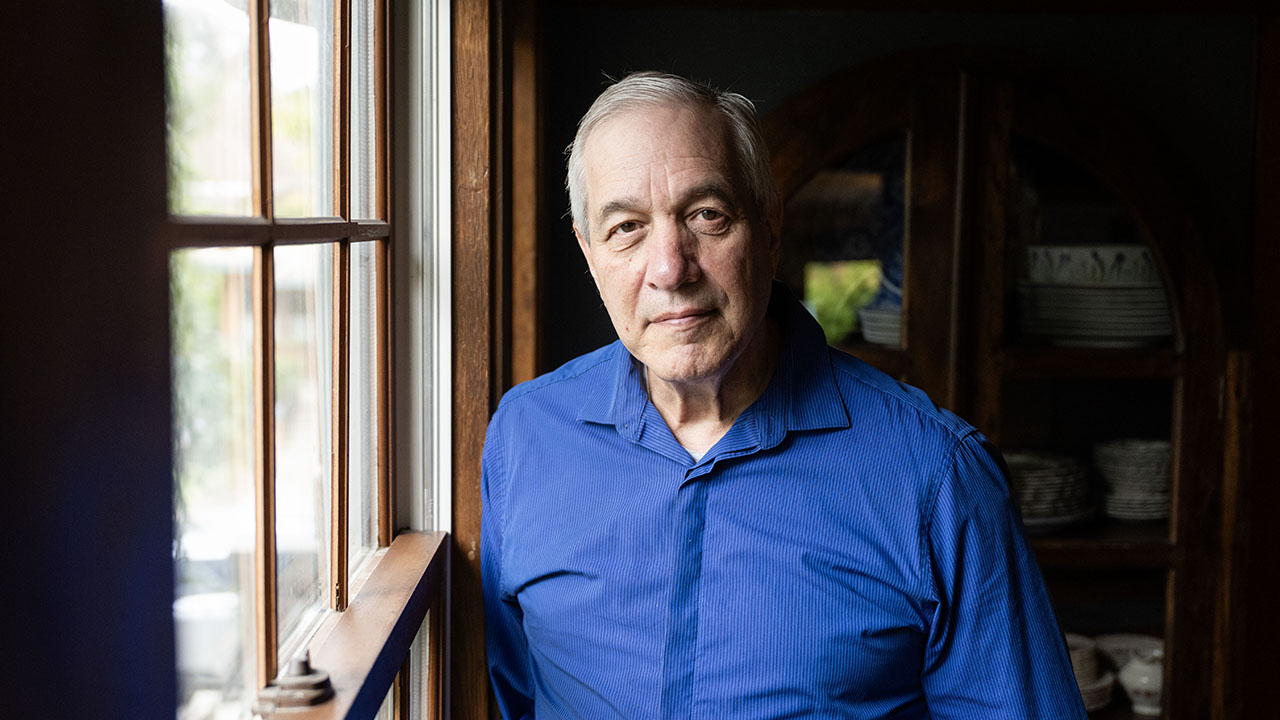
Rabbi Yoel Kahn was told he would never be admitted to rabbinical school if he was openly gay. So he hid his identity. When people began to find out, he was told he would never be ordained. And when he got a job at Congregation Sha’ar Zahav, San Francisco’s LGBTQ synagogue, he was told he’d never get another job after that.
But he did get another job. In fact, he’s had a surprisingly varied rabbinic career, almost entirely in Northern California, since his ordination in 1985.
Born in Oakland and raised in San Jose, he was one of the first openly gay rabbis and the first full-time rabbi of Sha’ar Zahav, which he led through the AIDS crisis. He also served as the first director of the Taube Center for Jewish Peoplehood at the JCC of San Francisco, director of Stanford University Hillel, rabbi of Congregation Shir Shalom in Sonoma and, finally, rabbi of Congregation Beth El in Berkeley, where he served for 14 years.
Somewhere in the middle of all that, he made time to earn a Ph.D. through the Center for Jewish Studies at the Graduate Theological Union in Berkeley. His dissertation became a book in 2010, “The Three Blessings: Boundaries, Censorship, and Identity in Jewish Liturgy.”
Although he officially retired from Beth El in 2021, Kahn has remained busy. He has served as an interim or seasonal rabbi for multiple communities, including one in Florence, Italy, and he continues to speak, teach, write and research.
Kahn, 67, lives in Berkeley with his husband of 45 years, poet Dan Bellm. They are the parents of an adult son, Adam.
We spoke about the future of the rabbinate, the joy and pain of leading a gay synagogue through the AIDS epidemic and his interest in Jewish liturgy.
This interview has been edited for length and clarity.
What was Sha’ar Zahav like in the ’80s? Was it the only Jewish place in the Bay Area where folks could be fully out?
We were the only place I would have to say.
People would come to sort of like drop in or visit — I won’t say surreptitiously, but it was a place of refuge, as it were, especially for out-of-town visitors. Locally, I just want to mention, of course, that when Sha’ar Zahav was founded, in ’76 I believe, the Jewish Bulletin [this publication’s former name] refused to publish announcements and turned down advertising as well.
I believe there also was a transitional period where we’d take the ad money, but wouldn’t print the service times with the rest of the listings. What was your rabbinate about at Sha’ar Zahav?
Well, there was the generic rabbinate, which means people being born, sick, dying — things that every rabbi is dealing with. But overwhelmingly, Sha’ar Zahav was also about making a place that was safe for people who felt they were marginalized. So a lot of liturgy subtly but significantly emphasized the idea that God loves you, or you have a place.
As Jews, many felt still marginalized out in the wider community and so they wanted a safe Jewish place — but other Jewish places weren’t necessarily safe for them either. And so for people who felt double-marginalized, the synagogue was the place of community and belonging.
Another big part was, of course, the epidemic.
You mentioned normal rabbinic duties like visiting sick people, but I assume that was an outsized part of your rabbinate at the height of the AIDS crisis.
That was a big part of the rabbinate. That was a big part of the life of the congregation. But it wasn’t the only part of the life of the congregation. During the bad years, probably ’88, ’89 until ’95, ’96, we were constantly losing people.
So one is people who are members of the congregation who are sick. Two is all the rest of the congregation who are either taking care of them or otherwise just impacted by them. Then there are the resources of the congregation — the people. They’re not available to volunteer or be engaged or to financially support the congregation because they’re busy dying or taking care of others.
And then we still had the rest of the life of the congregation. We had Shabbat every week. And our school was started during this period. This was the period of our baby boom — mostly lesbians, but not exclusively. My husband and I became parents in 1991, and we started the school in 1988.
You weren’t the first out gay rabbi, but you were very early. When did you come out?
Fred Gottschalk, who was then the president of Hebrew Union College [the Reform movement’s rabbinical school], had explicitly said he would not knowingly ordain a gay or lesbian person. He, of course, was later himself found to have been a serial sexual harasser.
The placement director met with the graduating class and went down the list of all the students and all the jobs that were available back then — and gets down to Sha’ar Zahav, which was looking for a rabbi, looks up and says, “Nu kinderlach, you should know that anyone who takes this job will have the schmutz of homosexuality on his resume and will never get another job.”
That was the message — only for me to discover that I couldn’t get a different job because even though I thought I was closeted, apparently lots of people knew. So I took the job that was offered to me, which was Sha’ar Zahav.
So essentially, your official coming out and your arrival at Sha’ar Zahav were simultaneous.
Pretty much overlapped.

How has the rabbinate changed since you entered the field? What challenges do you see younger rabbis facing that are new or things that you didn’t have to deal with?
One is that denominational affiliation has gone down, down, down. That institutional sense of belonging, affiliation, knowing what you’re part of, has changed radically. And that has meant that people are less grounded in knowing where their community is. And the field’s just broader and wider.
Two is Israel. Those of us who have been critical of Israeli policies for a long time still felt that there was a certain consensus cross-community that is no longer possible. It doesn’t feel like anyone can say anything. Whatever we may feel about the present government and its leadership or the direction that Israel has taken or 70 years of occupation — it feels like there’s nothing safe. The shared consensus has eroded greatly as well as the institutional places have gotten much more rigid.
You’ve been doing some part-time interim work at Beth Am in Los Altos Hills.
I just stepped down from that. I was the coach to the clergy team. There was one rabbi who’s there in her first position and one rabbi is stepping up to be the senior rabbi, another person who’s mid-career, and I sort of helped each person develop where they were.
Their new senior rabbi starts on July 1, which is part of the reason why I’m done.
You’ve had a seasonal gig at a synagogue in Florence? Do I have that right?
I did for three years, once I retired from my congregational position. I was the visiting fall rabbi for Shir Hadash, the liberal synagogue of Florence, Italy. So I was there for 10 weeks in the fall, High Holidays through till Hanukkah.
That sounds like fun.
It was a great gig. We are very privileged to live in places with large, robust, well-resourced Jewish communities. In Europe, Jewish communities struggle because of just sheer numbers. And then if you’re in the liberal Jewish community in Europe, you’re struggling even more because you don’t get [government] resources, you aren’t recognized. So it’s a small group of very faithful people.
You took a little break from your pulpit rabbinic work at one point and earned a Ph.D. from the Graduate Theological Union in Berkeley. What was your dissertation about?
No, I started my Ph.D. a long time ago, back when I was at Sha’ar Zahav. I got it actually around 1999 from GTU. My book, which was my dissertation about the history of liturgy, came out in 2010. And now that I’m retired, one of my retirement gigs is writing and teaching about the history of liturgy.
For example, one thing I’m working on right now is the origins of Mah Tovu, which we say when we walk in the door of a synagogue. But like, when did we first start saying it and how did it come to be? And why these verses? It’s not entirely clear, but let’s just say that it wasn’t always done the way we do it now. And then there’s another custom of walking in the door and bowing 13 times to the Ark while reciting 13 verses that all have the word mishtachavim in them, which I hypothesize is a bit of a competition to the Stations of the Cross. But I don’t know that that is correct.
It’s a great theory, though.