

Yes, the goats still fly and the fiddler’s still on the roof. But there’s much more waiting in the wings at “Chagall and the Artists of the Russian Jewish Theater,” a new exhibit at the Contemporary Jewish Museum.
Consisting of theater scenery, panels, costumes, sketches and even rare film footage, the exhibition honors a furiously creative period in Jewish art in the former USSR, captained by Marc Chagall, but not exclusively so. The pieces on display were drawn from collections housed in Russia, France, Israel and the United States.
“It’s a huge show,” says Fred Wasserman, the CJM’s deputy director for programs. “At the heart of it are Chagall’s theater mural and panels. There are more than 200 works by other artists and designers.”

Organized by and first seen at New York’s Jewish Museum from November 2008 through last month, “Chagall and the Artists of the Russian Jewish Theater: 1919-1949,” will be on display at the CJM in San Francisco starting April 23.
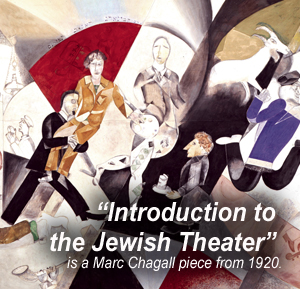
About those murals: The Belarus-born Chagall painted them in 1920 for the inaugural production from the Moscow State Yiddish Theater, better known by its Russian acronym, Goset. The 7-foot tempera and gouache panels depicting shtetl life — a Torah scribe, a wedding jester and the rooftop fiddler among them — lined the walls of the tiny Goset theater (capacity 92) for three one-act plays by Sholem Aleichem.
All will be on display in the exhibit in a gallery that replicates the original theater’s compact size.
Wasserman notes the works graced the interior walls of the theater, “so if you were in the audience you would have been surrounded on all sides by Chagall. A completely environmental experience. He did this within the space of some 40 days.”
The supercharged Chagall was just one of several artists working in the Russian Jewish theater after the 1917 Bolshevik revolution. The Communists had reversed long-standing czarist edicts confining Jews to the Pale of Settlement, as well as bans on Jewish schools and theaters.
“The new regime supported theater and tried to foster ethnic identities in support of the regime,” Wasserman says. “This was the first time Jews had a state-sponsored outlet for drama, comedy, folk tales, biblical stories and shtetl intrigue.”
The artistic style of Chagall, Isaac Rabinovich, Natan Altman, Ignaty Nivinsky and others in the Jewish theater bore little resemblance to the stodgy Soviet Realism promulgated later by Stalin. It is bolder, having more in common with the avant-garde expressionism then all the rage in the West.

These artists served not only the Goset, which created productions in Yiddish, but also the other main Jewish theater in the USSR, Habima, which performed works entirely in Hebrew. The name itself is Hebrew for “the stage” (today, Habima is the national theater of Israel).
The CJM exhibition includes several items from Habima’s 1922 production of “The Dybbuk,” including costume design sketches by Altman, vintage production photos, a silk and cotton costume, and even the original advertising poster (in Russian).
Naturally, the focus of the exhibition is on Chagall. He not only painted the panels for Goset, but also designed costumes, sets and even makeup for some productions. Samples of all will be on display. A total of 30 Chagall works are in the show.
“You’re really seeing the whole world he was working in and the artists he is influencing,” Wasserman says, noting that Chagall left Russia for good in 1922.
Not long after, Josef Stalin emerged as leader of the USSR, launching a long, murderous reign. Among his chief targets were Jews and Jewish culture.
A mysterious 1952 fire — most likely ordered by Stalin — torched much of the archived materials from the then-defunct Jewish theater. Some of the materials on display, such as pencil sketches of costume designs, have singed edges as a result.
As an adjunct exhibition, the CJM has put together “Chagall in the Bay Area,” featuring 30 Chagall masterpieces culled from local public and private collections. Associate Curator Dara Solomon says the pieces –– mostly sketches and paintings –– add context to the main exhibition by showing what Chagall was up to just before and just after he created his theater works. “It fleshes out the story,” she says.
“The vast majority of works in the show were really unknown until 1985,” Wasserman says. “These materials were not available to researchers in the West until maybe 20 years ago. This is a story being told for the first time.”
Yet in many respects, the story is familiar. Artists yearning for freedom and self-expression take advantage of a moment in history. Chagall and his compatriots then changed history.
“The [theater] companies became catalysts for modernist experimentation,” Wasserman says. “These are extraordinary riches that people will discover.”
“Chagall and the Artists of the Russian Jewish Theater: 1919-1949” will be on display Thursday, April 23, through Sept. 7 at the Contemporary Jewish Museum, 736 Mission St., S.F. Information: (415) 655-7800 or www.thecjm.org.