

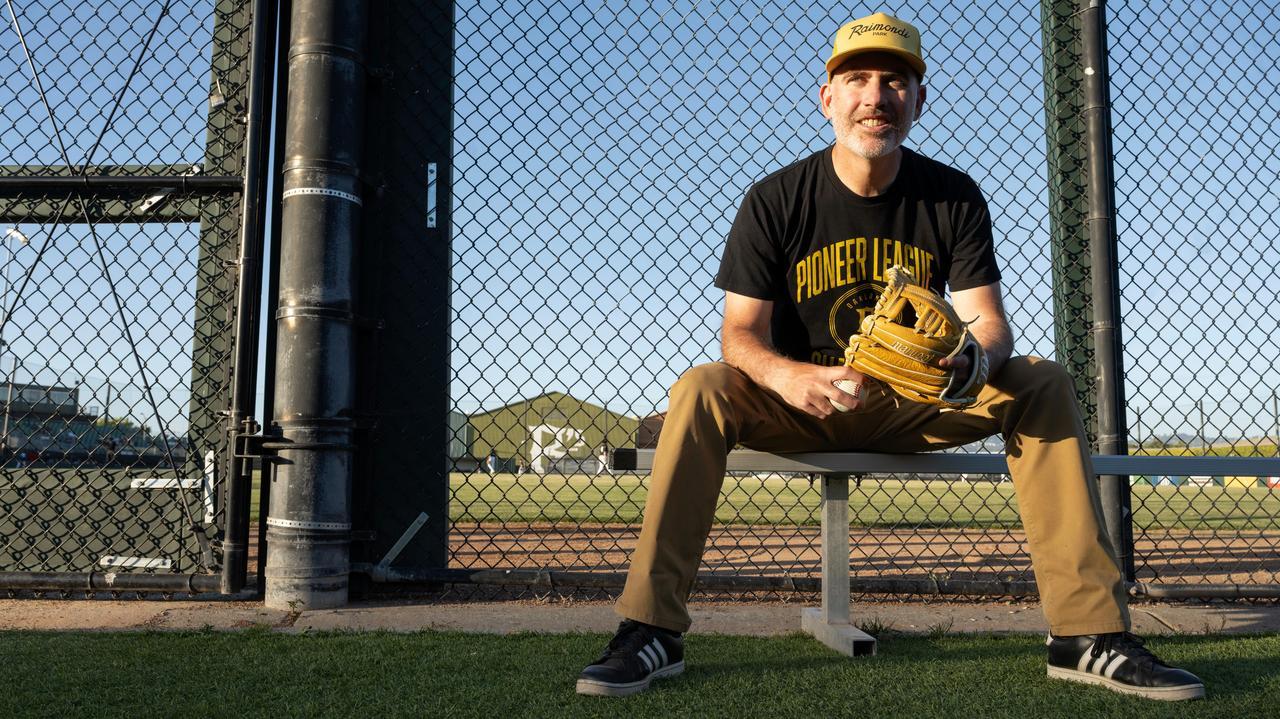
Yeshayah Goldfarb doesn’t remember exactly when he decided to dedicate his life to baseball. As a child, baseball just seemed to be everywhere.
“It was in the air,” Goldfarb said. “Always on in the background.”
Goldfarb’s come-up isn’t exactly a mystery. He was a star player at Berkeley High School and soon after discovered that his real talent lay in stats and talent scouting. His “Moneyball”-style analytics skills were so sharp that he landed a job with the San Francisco Giants right after college in 2000. J. crowned him “an unknown hero” in 2010 after his draft picks led the team’s championship run that year.
Goldfarb worked for the Giants for more than 24 years, most recently as vice president of baseball resources and development. But an East Bay boy at heart, he felt the sting when he learned that the A’s would play their last game in Oakland in 2024, ahead of their eventual move to Las Vegas under new owners.
With heartbreak came opportunity. Bryan Carmel and Paul Freedman, two friends from his childhood Jewish summer camp, approached Goldfarb with a plan to build a local baseball team from the ground up — a team that would stay in Oakland forever.
The Oakland Ballers played their inaugural home game in 2024 at Raimondi Park.
The team is a part of the Pioneer Baseball League, an independent professional league in the western United States that also serves as a launching pad for players hoping to reach a Major League Baseball team.
In a city like Oakland, which has been repeatedly devastated by fleeing sports teams, it would be no easy task to win folks over. Even for a seasoned MLB professional like Goldfarb, the responsibility of building a team strong enough to sustain itself without succumbing to outside buyers sounded intimidating.
Eventually, he was convinced and joined the team as an adviser. After two years, he could no longer stay at arm’s length. At the start of this year, Goldfarb became the team’s first president, officially working alongside Ballers co-founders Carmel and Freedman. He isn’t crunching numbers or poring over player stats, though.
Responsible for boosting the marketing of the young team, Goldfarb is working to tap into the same baseball fandom he remembers from childhood. He is infusing the spirit of the game into the fan experience with special promotions, inter-inning games, and theme nights.
With the team’s second annual Jewish Heritage Night coming up on Aug. 11, J. spoke with Goldfarb about growing up as a baseball fan and how the Ballers came to be.
This interview has been edited for length and clarity.
How far back do you trace back your baseball lineage? Do you remember a moment when baseball became the center of your life?
As early as I can remember actually. The other day my dad gave me a 1980 Dodgers pamphlet that he had bought at a game, and he said that was my first game. I was 2 years old then.
My parents being the most religious members of the Aquarian Minyan [a Berkeley Renewal congregation], we didn’t drive on Shabbat. But I always wanted to play baseball. There was a game called Strikeout that was very common in the Bay Area. I would always play it against my dad on Shabbat, but there were [religious] rules around carrying [anything].
So as a little kid, I’m like, “Well, can’t we just, like, put the ball in our pocket?” or “The park has a gate all the way around it, so it’s kind of like an eruv.” And so ultimately, I was able to convince him, and we would go there every Saturday and play Strikeout. That became a tradition between us.
Your parents, Yehudit and Reuven Goldfarb, are known for their contributions to the Renewal movement and specifically to Aquarian Minyan. Your father even wrote an essay about the connection between baseball and Kabbalah. What do you think about this idea that baseball is a Jewish sport?
A lot of Jews migrated to the United States around the turn of the century through the 1920s, going through New York City. My dad’s family went through that.
I think baseball represented America for a lot of people at that time, and it’s such a sport that’s passed on from generation to generation. I feel like it’s been passed on to me.
What was it like for you when the A’s left? What did you lose with their departure?
There’s nothing like sitting in a stadium with 40,000 fans all chanting “Let’s go, Oakland!” A lot of people took BART there, so I have memories of moving inch by inch with people next to me, chanting. You can smell them. It’s a community, and it’s joy. It’s like a fabric of who we were in the East Bay related to sports, and that’s what I grew up with. I think there’s a level of sadness [about] how it ended and why it ended. I think it frustrated a lot of people.
But then in 2023, an opportunity to try to revive what Oakland was losing came up. Tell me that story.
I got a call from Bryan Carmel. We’ve been best friends since we were in a bunk together at Camp Tawonga when we were 12. He called me on FaceTime, and the first thing out of his mouth was “Can I record this?” Then he says, “I’ve got an idea. Me and Paul,” the other co-founder, “we want to start a team in Oakland, because the A’s are leaving.” [Carmel is now the Ballers’ chief experience officer, and Freedman is CEO.]
I was like “You guys are nuts, I’ll call you later.” And as we talked through it, I realized it was just such a good idea. The hope was to kind of fill that void. There was so much that the A’s had brought the community that was going to disappear.
What was the tipping point that took you past that knee-jerk rejection of the idea to then realize that you should be involved in the new team?
It happened pretty quickly. Early on I kept telling them about the things that would make it very difficult. I think what kept calling me back to it is just the sadness of the team leaving, and that something needed to be there.
That’s really become the ethos of the Ballers. It’s really great for a mother or father to be able to pass that feeling onto their child and their local community that they felt with the A’s growing up here.
At the same time, I’m sure there is still something unique about the Ballers.
We’re not trying to be Major League Baseball. This is a much more intimate setting at Raimondi Park. We can hold 4,000 fans there, so you have a closeness to the game. There’s really no bad seat in the ballpark because you’re so close.
In your current role as team president, you’re very much not doing the same player analytics you did with the Giants. What is your main job now?
We have a responsibility to keep the team here for a long time, so my focus now is: How do we make a profit? We’re still a startup, and every morning I wake up thinking: How can we make this a sustainable team that lasts forever in Oakland?
Then there are also ways to create fun and joy that are beyond the game. When you walk through our gates, every single game, you’re going to have a giveaway. We also have a theme for every single game. I’m trying to have themes that really match and reach people at different levels.
For our upcoming Jewish Heritage Night, we’re calling it “Bay Mitzvah.” It’ll be a party-themed celebration of Jewish culture, which fits into the joy we want all of our fans to feel when they walk through the gates.
We’re trying to create a community feeling of joy that exists even outside of the game of baseball but still interacts with it. In some ways it’s easier to do that in a smaller setting rather than with a huge stadium and a bunch of people.