

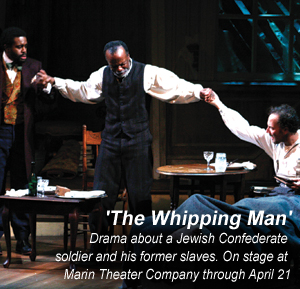
On a stormy night, in a ransacked Richmond, Va., manor right after Gen. Robert E. Lee has surrendered, a newly freed slave greets the returning son of his master with these words: “Baruch ata Adonai Elohenu melech ha’olam.”
That’s the wild world writer Matthew Lopez created in his 2010 play “The Whipping Man.” The third-most-produced work for the stage last season, according to the trade organization Theatre Communications Group, “The Whipping Man” has its Bay Area premiere at the Marin Theatre Company Friday, March 29 and runs through April 21.

The drama tells the story of a wounded Confederate soldier who makes his way home in the days after Lee’s surrender at Appomattox in 1865. Waiting for him are two family slaves — make that, former slaves — who survived the destruction of Richmond and the ensuing privation.
As a twist, all three are Jewish, with each harboring deep secrets. And — perfect for Passover — there’s even a seder.
Lopez, 35, knew as he began work on the play that he did not want to tread familiar ground. When his father, a Civil War buff, gave him a book about Jewish life and Jewish slave owners in the antebellum South, Lopez’s story began to take shape.
“I was struck by the incongruous nature of Jewish slave owning,” Lopez said from his Los Angeles home. The idea doesn’t fit. To find out there were Jewish slave owners, and this notion of Jewish slaves, I knew I had found the thing to write about.”
Though only three characters populate “The Whipping Man,” with all the action taking place on one set, Lopez managed to capture the sweep of the Civil War in his miniature tableau.
“It’s a cast of thousands,” Lopez said of the unseen action offstage. “In this play the trick was to keep the action onstage limited, but to keep the world outside roiling.”
Things get pretty hair-raising onstage as well. When Caleb, the wounded captain, reveals a nasty gunshot wound to the leg that is quickly turning gangrenous, his former house slave, Simon, an experienced medic’s assistant, declares the leg has to be amputated.
That happens onstage.

“We’ve had fainters,” Lopez said of past performances. “I am a sucker for the grand theatrical gesture. I couldn’t think of anything more exciting and dangerous than an onstage amputation scene. Most directors are pretty bloodthirsty, so when given a scene of great violence they go for it.”
In researching the play, Lopez read up on Jewish life in the antebellum South. Though he admits he found no proof that slaves converted to Judaism, he said there exists some indirect evidence. Either way, making his two black characters Jews was, he said, “a fictive leap of faith.”
There’s also that makeshift seder held near the end, perfectly illuminating the play’s contrasting themes of slavery, redemption and responsibility.
Of mixed Polish–Puerto Rican ancestry, Lopez did not have to go too far to research the Jewish aspects of his play. Raised Episcopalian, he grew up attending seders and other Jewish holiday events hosted by his Jewish aunt and cousins.
He did learn that Jews of the era, including rabbis from the North and the South, would sometimes cite the same Torah passages to either defend or condemn slavery.
“There was a lot of moral relevancy going on,” he said. “People were twisting themselves into moral pretzels to justify something unjustifiable.”
That “peculiar institution,” as 19th-century Southerners often called slavery, obviously had a corrupting influence on the nation then, with its echoes still heard today.
Lopez was sensitive to that as he wrote his play, which humanizes Caleb, the Jewish slave owner, but only so much.
“The South was a hotbed of daily, ritual cruelty,” he said. “And it knew no boundaries between class, gender or religion. If you were infected with the disease of slave owning, you had it outright. There was no such thing as a ‘good’ slave owner.”
Lopez went on to write a successful follow-up play, “Somewhere,” about his own quirky family (which was staged by TheatreWorks in Mountain View earlier this year). Lopez currently works as a staff writer on the HBO show “The Newsroom,” with Oscar- and Emmy-winning writer Aaron Sorkin.
Lopez hasn’t completely traded the stage for Hollywood, however. His next play, slightly different from “The Whipping Man,” tells the story of a straight Elvis impersonator who becomes a drag queen.
Meanwhile, “The Whipping Man” continues its triumphant string of productions across the country, including this latest run in Marin (a co-production with the Virginia Stage Company). While Lopez finds its ongoing popularity gratifying, he says the thrill of having a hit first play has started to wear off.
“I’ve begun to let go of the play a bit,” he said. “It’s a nice feeling because it’s like sending your kid off to college and trusting they’ll be fine. But even if they’re not, there’s nothing you can do.”
“The Whipping Man” plays through April 21 at the Marin Theatre Company, 397 Miller Ave., Mill Valley. Tickets: $36-$52. (415) 388-5208 or www.marintheatre.org
Marin Theatre Company dramaturg Margot Melcon will give a talk on “Passover and American Slavery” at 1 p.m. Wednesday, April 3 at the JCC of San Francisco, 3200 California St., S.F. Free. www.jccsf.org