

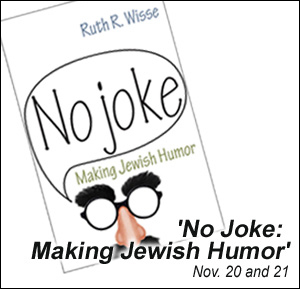
Ruth Wisse received an unexpected fringe benefit from having written her book “No Joke,” a scholarly inquiry into the nature of Jewish humor.
“The most wonderful payoff is people send me jokes,” says the author and Harvard Yiddish literature professor, “and some of them I incorporate in my talks.”

She’ll be giving a pair of those talks in the Bay Area next week, with appearances Wednesday, Nov. 20 at the Addison-Penzak Jewish Community Center in Los Gatos and Thursday, Nov. 21 at the JCC of San Francisco.
Now that she’s doing material, Wisse, 77, joins in the grand tradition of Jews amusing each other with comedy, albeit with a scholarly bent.
“There’s the great advantage of humor as a way of coping with the incongruities of life,” Wisse notes, “but at the same time, there can be too much of it. I’m fond of [Yiddish short story writer] Sholem Aleichem’s idea that laughter is good for you. Doctors prescribe laughter. But he realized that doctors also warn against overdose.”
Overdose on humor? It’s possible, says Wisse, who points to the new Pew study of the American Jewish community, which finds 42 percent consider humor essential to their Jewish identity. Only 19 percent consider Jewish observance essential.
“Isn’t that a joke?” she asks rhetorically.
In “No Joke,” Wisse surveys Jewish humor as far back as the Torah and as recent as Mel Brooks’ Broadway hit “The Producers” and Larry David’s HBO hit “Curb Your Enthusiasm.” Among her conclusions: Jewish humor, especially in post-Enlightenment Europe, had a self-denigrating quality that reinforced stereotypes. This was humor from Jews, about Jews, and not the caustic anti-Semitism coming from non-Jews.
 “Many were caught in the desire to get along and advance in the surrounding culture,” Wisse says. “But if the general atmosphere is antagonistic toward Jews, then they have to choose to reject more and more in themselves in order to advance.”
Her book profiles figures such as 19th-century German Jewish humorist Heinrich Heine, who converted to Christianity to find an audience. She also writes about Jewish humor under Hitler and Stalin (hint: it’s dark) as well as in Israel, where humor can take on equally dark hue thanks in part to tensions with neighboring Arabs.
She also analyzes the importance of the Borscht Belt resorts in New York’s Catskill Mountains, which provided a breeding ground for many Jewish comedians in the last century, and spurred the commoditization of humor.
“The gentile hotels and resorts did not think providing humor 24 hours a day was their function,” Wisse says, “whereas in the Catskills, the idea caught on. Waiters were supposed to be funny. Busboys were supposed to be funny, not to speak of evening entertainers. This was a natural fount of talent.”
Wisse’s feel for Yiddish-flavored humor is understandable. Born in a small Romanian town (now part of Ukraine), she grew up speaking Yiddish and German. Her family fled the Nazis in 1940, settling in Montreal. She later moved to the United States, becoming a Harvard professor and putting her Yiddish skills to good use.
She’s heard all the Yiddish jokes, curses and put-downs, and sees the humor as an outgrowth of an ancient Jewish credo.
“If Jews are a self-disciplining people, then Jewish civilization is one of self-accountability,” she says. “That’s what the Torah is: a very exacting constitution and legal system. If what it inculcates is a great sense of self-discipline, than the corollary of that is humor that makes fun of oneself.”
With her book packed with juicy Jewish quips and tales from across the ages, Wisse shows she has a good sense of humor, too.
This despite the fact that she takes the subject very seriously.
“Some people who expected a joke book said they were disappointed,” Wisse says of her work. “So it’s nice when people who expected a serious book are delighted to find there are great jokes in it.”
“No Joke: Making Jewish Humor” by Ruth R. Wisse (296 pages, Princeton University Press, $24.95)
Ruth Wisse will speak at 7 p.m. Wednesday, Nov. 20 at the Addison-Penzak JCC, 14855 Oka Road, Los Gatos. www.svjcc.org. Also 7 p.m. Thursday, Nov. 21 at the JCCSF, 3200 California St., S.F. www.jccsf.org