

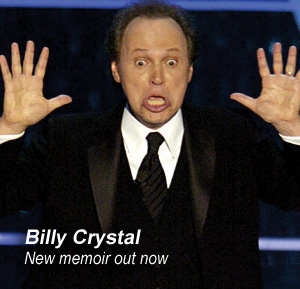
After suffering a tough personal loss early in life, Billy Crystal hasn’t been afraid to show his serious side.
This year marks the 50th anniversary of the death of Crystal’s father, prompting the famed Jewish entertainer to perform the autobiographical one-man show “700 Sundays” for another run on Broadway. The show, which first opened in 2004 and earned Crystal a Tony Award in 2005, runs through Jan. 5 at New York City’s Imperial Theatre.

Crystal also has a new book, “Still Foolin’ ’Em: Where I’ve Been, Where I’m Going, and Where the Hell Are My Keys?” Part memoir, part rumination on turning 65, it, too, brings out the comic’s serious side.
During a versatile career in the entertainment industry, Crystal has found success as a performer in film and television, and behind the scenes as a writer, director and producer.
In “700 Sundays,” Crystal plays numerous characters that have influenced who he is today, from his youth in the jazz world of Manhattan through his adult years. Its themes — family and fate, love and loss, and growing up Jewish — display the multidimensional nature of a man mostly known for humor.
“The work he has created for stage, film and television has made an indelible impression,” said John Dow, vice president of the JFK Center for the Performing Arts, which in 2007 awarded Crystal the Mark Twain Prize for American Humor. “It is the work of not just a humorist but also a humanist.”
Giving back is something Crystal takes seriously. One of his most significant philanthropic endeavors is Comic Relief, whose fundraisers he emcees. Created in 1986 by comedy writer Bob Zmuda to raise funds to help those in need, the nonprofit has raised more than $50 million.
His name is also well known in Israel. In its 13th year, the Billy Crystal Project for Peace through the Performing Arts offers a wide range of workshops to both Jewish and Arab theater artists and students, in a program aiming to create cross-cultural understanding through the common ground of theater.
Born in Manhattan and raised in the Bronx and Long Island, Crystal and his older brothers Joel and Richard were the sons of Helen and Jack Crystal, who owned and operated the Commodore Music Store, founded by Helen’s father. The three brothers entertained friends and family by reprising comedy routines from such greats as Bob Newhart, Rich Little and Sid Caesar, learning from records their father brought home from the store.
With the decline of Dixieland jazz around 1963, however, Jack Crystal lost his business and died later that year at the age of 54 after suffering a heart attack while bowling.
“He worked so hard for us all the time,” Crystal wrote of his father in the “700 Sundays” book. “He held down two jobs, including weekend nights. The only day we really had alone with him was Sunday. Sunday was our day for my two brothers and I to put on a show and make them laugh. And Dad would come in like three, four o’clock on a Sunday morning after working all weekend. Just as the sun came up, I would tiptoe over to their bedroom, which was right next to my room in the back, and I would quietly open the door just a little, and there they would be, Mom and Dad, lying there, looking so quiet, and so peaceful together. And I would sit in the doorway waiting for him to wake up, just to see what we were going to do together that day. I just couldn’t wait for Sundays. I couldn’t wait for Sundays. He died suddenly when I was 15. I once calculated that I had roughly 700 Sundays. … Not a lot of time for a kid to have with his dad.”
Although loss is at the center of “700 Sundays,” Crystal keeps the mood lighthearted.
“There is loss everywhere — jazz dies, his mom dies, neighborhoods change, his beloved Yankees decline and memories fade. But Crystal, under Des McAnuff’s tight direction, never gets maudlin,” Mark Kennedy wrote for the Associated Press.
“He always knows when to dispel the darkness with a laugh, as when he mimics the funeral director’s lisping voice — My condolenchess to the family of the decheassed.” That prompts Crystal to complain, “My father’s dead, and I have to talk to Sylvester the Cat?”