
Expecting an audience of some 35,000, the 35th annual San Francisco Jewish Film Festival will bring 70 films from 17 countries to Bay Area screens this summer.
The diverse lineup of documentaries, dramas and comedies screens from July 23 to Aug. 9 at five theaters in San Francisco, Palo Alto, San Rafael and the East Bay, with a new venue in Oakland, the 400-seat Lakeside Theater within the Kaiser Center by Lake Merritt.

Adding to the festivities, the opening night party takes place at the Contemporary Jewish Museum.
“It’s a huge Bay Area cultural community event,” said Lexi Leban, executive director of the festival. The festival is the signature event of the umbrella organization now known as the Jewish Film Institute, which holds year-round programming.
This year’s offerings range from Middle East politics to comedies to films focusing on music and the arts.
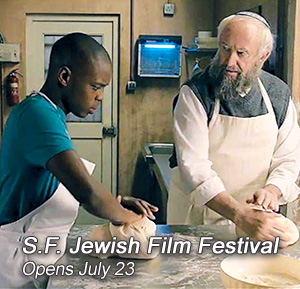
The festival’s opening night film, “Dough,” a British entry directed by John Goldschmidt, tells the story of an aging kosher baker whose Muslim apprentice revitalizes business by adding cannabis to the challah. Goldschmidt and actor Jerome Holder will attend opening night at the Castro Theatre in San Francisco and the Palo Alto showing on July 26.
The centerpiece documentary, “The Armor of Light,” by director Abigail Disney, chronicles the Rev. Rob Schenck, an evangelical, militant pro-life activist (raised Jewish) who becomes concerned about gun violence and teams up with Lucy McBath, mother of an unarmed teenager murdered in Florida, to fight against stand-your-ground laws.

“He reveals himself to be a very open and critical thinker,” said Leban, adding that McBath will attend the festival.
“As I AM: The Life and Times of DJ AM” anchors the Next Wave portion of the festival, aimed at moviegoers ages 35 and under. With that in mind, the July 30 screening at San Francisco’s Castro Theatre will be followed by a late-night party deejayed by Mix Master Mike at the Public Works SF.
Directed by Kevin Kerslake, the documentary traces the short life of DJ AM (born Adam Goldstein), a successful DJ who died at age 36 of a drug overdose a year after surviving severe burns in a plane crash. The film features footage of DJ AM performing the first rap he ever wrote, which was about Hebrew school.
“Even though it’s a sad story, it’s inspiring in many ways,” said Jay Rosenblatt, program director. The film chronicles DJ AM’s musical journey and collaboration with hip-hop stars. Though he struggled with his own drug addiction, he helped others become sober.
A film about New Yorker cartoonists, “Very Semi-Serious,” will precede Berkeley’s “Big Night” celebration on Aug. 1. The film, at California Theatre, includes interviews with the magazine’s best-known cartoonists, many of them Jewish, and provides insights into their quirky points of view. Cartoonist Bruce Eric Kaplan, known as BEK, will attend the post-film party at the David Brower Center in Berkeley.
 On July 31, five films relating to social justice screen at the Castro to mark Take Action Day, an event devoted to community engagement. Festivalgoers can buy a daylong pass, which includes entrance to all five movies, a panel discussion with filmmakers and a party in the mezzanine.
Eight documentaries address the Israeli-Palestinian conflict, and former Jerusalem bureau chief for the Washington Post Janine Zacharia will moderate a panel discussion with four of the filmmakers Aug. 1 at the Castro.
This year’s Freedom of Expression award goes to Lee Grant (born Lyova Haskell Rosenthal). The veteran actress, director and producer will accept her award onstage at the Castro following the screening of her first directorial feature, “Tell Me a Riddle.”
The festival closes on a high note with “East Jerusalem, West Jerusalem,” an Israeli film featuring singer-songwriter David Broza.
The San Francisco Jewish Film Festival runs July 23-Aug. 2 at the Castro Theatre, S.F.; July 25-30 at CinéArts@Palo Alto Square; July 31-Aug. 6 at the California Theatre, Berkeley; Aug. 7-9 at the Lakeside Theater, Oakland; and Aug. 7-9 at Christopher B. Smith Rafael Film Center, San Rafael. Complete schedules and pricing are at www.sfjff.org.
Hit ‘refresh’ — it’s now the Jewish Film Institute
Lights, camera, rebrand!
It’s official. Nearly four decades into its existence, the San Francisco Jewish Film Festival is undergoing a makeover, renaming itself the Jewish Film Institute. The change coincides with the start of the 35th annual film fest, which opens July 23.
 “It’s a way to clarify to our audience the breadth and scope of what we do,” said JFI executive director Lexi Leban of the name change. “There’s a lot to a name. A festival connotes something seasonal. San Francisco connotes something regional. We’re beyond that. We’re really solidifying our sustainability.”
Although the annual film festival remains the flagship event, the Jewish Film Institute will expand its profile as a full-service media arts organization.
Programs that fulfill its mission include the New Jewish Filmmaking Project (which mentors budding filmmakers), a filmmakers-in-residence program, year-round screenings and “JFI On-Demand,” a new partnership with Vimeo that makes available for online streaming some 1,500 films from the JFI Film Archive.
Leban said streaming is a good way for those unable to attend the festival to see some of the films that have made the San Francisco Jewish Film Festival the largest event — and the first in the United States — of its kind. “The ramp-up of online material will increase the depth of engagement with the festival,” she added.
JFI program director Jay Rosenblatt stressed the importance of year-round screening, noting, ‘There are some films we cannot get for the festival, but with year-round screening we can now show them.”
Leban said the JFI, headquartered in the up-and-coming mid-Market area, also intends to serve as a consultant for other Jewish film festivals around the world. — dan pine