

San Francisco Jewish Film Festival Screenings
Looking at her portrayals of posh, pampered matriarchs in films such as “The Landlord” and “Shampoo,” one might guess Oscar-winning actress Lee Grant had grown up on Park Avenue or Rodeo Drive.
Instead she grew up near Harlem. Born Lyova Rosenthal, she was the granddaughter of poor Jewish immigrants and, as a girl, aspired to the American dream she saw depicted on the silver screen.
Despite humble beginnings, the actor-director has won two Emmys, two Oscars and the affection of film fans around the world.
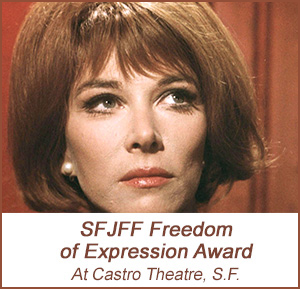
This year, the San Francisco Jewish Film Festival presents its Freedom of Expression Award to Grant. Now in her late 80s, she’s as feisty as ever, and will be on hand to accept the award Sunday, Aug. 2 at the 35th anniversary screening of her directorial debut feature, “Tell Me a Riddle.”
That film, which stars the late Melvyn Douglas and Lila Kedrova as an aging Jewish couple on a visit to their freewheeling granddaughter in San Francisco, met with praise when it came out in 1980.
Not so much from its director today.
“When I see it now I say, ‘Oh, why didn’t I have another editor come in?” Grant admits from her New York home. “It was so self-indulgent.”
She is similarly frank in her 2014 memoir, “I Said Yes to Everything.” In it Grant recounts her New York girlhood, her fast rise as a starlet in the early ’50s, and then 12 years in career exile due to the Hollywood blacklist.
Her rebound as one of Hollywood’s busiest actresses from the late ’60s through the ’90s is a testament to her talent and tenacity.
As she sees it, it started in the Upper West Side neighborhood of her childhood. Grant remembers her Yiddish-speaking grandmother working away on a sewing machine and a grandfather who rarely set foot in his hardware store because he spent most of his time praying in shul.
This wasn’t the Lower East Side. Grant remembers kids from the neighborhood Catholic school throwing nails at her and yelling, “You killed Christ,” while the nuns stood by.
But she also remembers her mother’s infatuation with the glamorous women of the movies, the “ladies [who] were tall and rich and spoke in high voices,” she says. Her mother put her on the stage by age 5, which set Grant on a path toward an acting career.
She scored a 1951 supporting actress Oscar nomination for her debut role in “Detective Story,” but it wasn’t long before she vanished from the screen. Her then-husband, writer Arnold Manoff, was a card-carrying Communist, and after she publicly eulogized a party member, she found herself on the radar of the House Un-American Activities Committee.
She didn’t appear in another film for a dozen years.
Grant says she used that forced exile to get the education she never had as an aspiring young actor. And when she made her comeback, she came back with a vengeance. She won an Emmy for her work on the popular prime time soap, “Peyton Place,” then sealed her reputation with juicy film roles, notably her Oscar-winning turn as desperate housewife Felicia in “Shampoo.”
“It was the ’70s,” Grant says, ”the time when the directors and writers had breakthroughs and the studios said, ‘OK, we don’t know what to do.’ ”
Grant says her Oscar was a turning point that led her to pursue directing. She created a string of documentaries, one of which, “Down and Out in America,” earned her a second Oscar, this one for best documentary feature.
She continued to act and direct well past the turn of the millennium, but she has slowed down in recent years, mostly to write her memoir, which she describes as a pathway to “come to terms with myself.”
“I sat and wrote myself out,” she says of the book, which she wrote by hand. “I never expected it to become a book. It was the next new experience for me. I always love new.”
Grant recently returned from Israel to witness the bar mitzvah of her grandson, held at the Kotel. She isn’t religious herself, but she says she is glad Jewish tradition survives in her family.
As for what’s next, Grant isn’t sure but whatever it turns out to be, as her book title suggests, she’ll probably say “yes.”
“My life has always been a series of strange turns,” Grant says. “This ‘Candide’ quality to my life, of slipping this way and that way, and just accepting the twists, that was the big lesson of my life.”
Lee Grant will accept SFJFF’s Freedom of Expression Award and speak at the screening of “Tell Me a Riddle,” 2:35 p.m. Sunday, Aug. 2, Castro Theatre, 429 Castro St., S.F. After, she will sign copies of “I Said Yes to Everything: A Memoir.” www.sfjff.org