
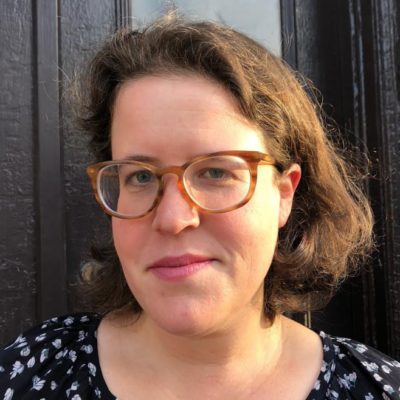
Leah Lax used to pull her car over on the side of the road and change her clothes before attending creative writing classes at the University of Houston. Off came the long skirt and wig; on went the blue jeans. She left her husband, seven children and closed Hasidic world behind as she dipped a toe into a world inspired by free ideas rather than restrictions.
For 25 years, Lax’s life revolved around the demands of being a wife and mother in Houston’s small Lubavitch community. It wasn’t a life she was born into; she joined Hasidism as a teenager, enchanted by the community and the spirituality she encountered there while trying to leave behind a chaotic home life.
As the years passed, she felt oppressed by the community’s rules regarding women; literature and earning a master’s degree in creative writing would ultimately open the door for her to find a way out of that life.

“In the Lubavitch community, secular reading for women isn’t nearly as frowned upon as it is for men. It’s almost like devalued literature is OK for devalued people,” said Lax, who is scheduled to speak at Book Passage in San Francisco on Wednesday, July 13.
Her topic will be her 2015 book “Uncovered: How I Left Hasidic Life and Finally Came Home” — the first memoir, she says, written by a lesbian about leaving Hasidic life. Not only was the book featured in the Advocate and on NPR, but it also is being adapted into an opera by composer Lori Laitman.
Lax came out as a lesbian and left the Lubavitch movement 14 years ago; she and her wife married last year.
A turning point for her came years ago, when she first decided to explore secular literature, and she happened to pick up an anthology by noted feminist and lesbian poet Adrienne Rich. “I didn’t know I was going home with an armful of outrageous feminist voices, just that they spoke to me,” she said.
With “Uncovered,” Lax has joined that chorus of voices.
“I fell into Hasidism as a girl who had never been kissed,” Lax told J. “It was kind of like putting on a costume.”
Lax grew up in Texas in a liberal, secular Reform Jewish family; her mother was a talented artist but inconsistent and at times neglectful, Lax said. At 16, she attended an educational weekend event at a local synagogue that was hosting Lubavitch Jews.
 “I fell in love with them because of their mysticism, because of their camaraderie, because of their music, because I was naive and young,” Lax recalled. “There is a sort of a homosexual undertow to those kinds of communities because they are so gender-segregated. Imagine the men arm-in-arm dancing in the night. It seemed so wonderfully outrageous to me.”
Lax attended a Chabad summer program and came back committed to leading a Hasidic life, though inwardly she harbored confusion about her choice. She started college and soon got engaged at her rabbi’s suggestion. By 19, she was married to a man seven years older than her; she would have seven children with him over a 10-year period.
“Every [Hasidic] role model for women is a model of self-sacrifice, and the work level and also the economic demands are not sustainable,” Lax said. “There are huge similarities with the far right of every religion. I don’t know why they all say women should cover their bodies and cover their heads and make motherhood their prime role and not use birth control.”
A pivotal moment for Lax came when she became pregnant “one time too many” and wanted an abortion.
Though there were health risks, the pregnancy was not life-threatening and she said her husband accused her of wanting to murder the baby. She consulted with the rabbi, who ended up approving the abortion, but told her never to tell anyone about it. That experience motivated Lax to take ownership of her life and her body, though it would still be years before she left religious life.
“I realized I had turned over a shocking decision in life to a father figure and let him make it,” she said.
Now, as a writer and an out lesbian, Lax lives a life entirely different from the one she built in the Lubavitch community. She and her wife married in Washington, D.C., while the Supreme Court was hearing oral arguments in the Obergefell v. Hodges case, which would legalize same-sex marriage nationwide. The day after the ceremony, the newlyweds joined the marriage equality protesters outside of the court.
Lax has worked hard to maintain her relationship with her seven children, who were between the ages of 14 and 23 when she left the Hasidic world. At that time, one child had already left Hasidism for what Lax deemed political reasons; three others left after she did. Her departure did cause something of a rupture in the family, she said, but despite all that, she is now a proud grandmother of nine.
“I wear blue jeans and I live with a woman,” Lax said, “and I am Bubbe.”
Leah Lax will appear at 6 p.m. Wednesday, July 13 at Book Passage, 1 Ferry Building, S.F. www.bookpassage.com