
film review
Eva Hesse’s childhood was a roller coaster of displacement, reunion, destabilization and trauma. In the journals she kept as a teenager and adult, the German-born, New York-based artist recognized the source of her chronic insecurity.
Yet paradoxically, and remarkably, her work evinces no anguish or suffering; it doesn’t serve to expose or extinguish demons from the past.
From Hesse’s early, brightly colored drawings and paintings through the textured, abstract sculptures and installations that made her reputation, her art comprises a series of experiments in forward-looking forms of expression.

A palpable labor of love, Marcie Begleiter’s densely detailed documentary “Eva Hesse” is a soup-to-nuts portrait that encompasses the artist’s personal life and times — New York in the 1960s — along with her professional development and impact.
Begleiter’s diligence notwithstanding, the 105-minute film never delivers an “aha” moment — when the person and her work snap together, when we understand exactly how Hesse’s defining childhood experiences informed her work.
I’ll venture, though, that Holocaust survivors, and children of survivors, will identify with Hesse’s internalized struggles, and read between the lines of her journals and the recollections of her older sister Helen.
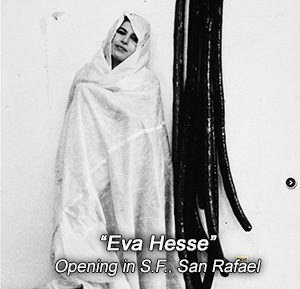
“Eva Hesse” begins its theatrical run Friday, Aug. 19 at the Roxie Theater in San Francisco and the Smith Rafael Film Center in San Rafael, following a brief, sold-out engagement at San Francisco’s Yerba Buena Center for the Arts in May.
The film generally unfolds chronologically in telling Hesse’s story, including her death from a brain tumor at age 34 in 1970.
Eight years before that, the art-school grad fell in love with and married a hard-partying Irish-American sculptor named Tom Doyle. Because her father insisted that she marry a Jew, Doyle willingly converted to Judaism.
Doyle, who was the more advanced and accomplished artist, was offered a residency in Germany a couple years later, and the couple ended up living there for more than a year. Their relationship fractured abroad, in part because of his drinking and flirting, but at the same time, Hesse made a major leap in her art practice from painting to sculpture.
Begleiter uses this period in the film to flash back to Eva’s chaotic childhood. Born in Hamburg in 1936, Eva and Helen were sent on a 1938 Kindertransport to the Netherlands. When their parents left Germany several months later, the family reunited and fled Europe for England and, in short order, New York.
They were the only members of the family to escape the horror of the Holocaust. When Eva’s mother, who suffered from depression and mental illness, learned in 1946 that her parents had died in the camps, she jumped from a roof to her death. (Eva’s parents had separated and her father had remarried by this time.)
While “Eva Hesse” is continually interested in its subject’s mental state, neither the filmmaker nor Hesse’s devoted artist friends are especially keen to psychoanalyze her.
Perhaps she was scarred by the abandonment of her parents as a toddler, though one could also understand her self-doubts given the power held by the “old boys networks” of male gallery owners, museum curators and critics.
Which brings us to another fundamental paradox of Hesse: The insecurities she voiced in her journals, and in letters to mentor and close friend Sol LeWitt (a Jewish American post-modernist sculptor), were matched by an unwavering drive to be an artist and the awareness that she was pretty darn talented.
In fact, Hesse was an extrovert and a lot of fun, by most accounts.
From the outset, “Eva Hesse” is plainly not a study of a tortured artist. Nor was she unrecognized and unappreciated in her own lifetime, for she had a major solo show and made the cover of Artforum before her death in 1970.
“Eva Hesse” opens Friday, Aug. 19 at the Roxie Theater in S.F. and the Smith Rafael Film Center in San Rafael (Not rated, 105 minutes)