

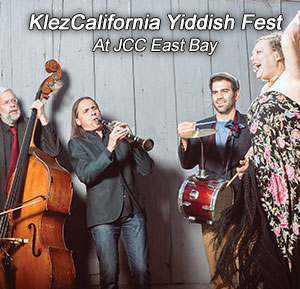
Making kugel and chicken soup might not have been bubbe’s only passion. Organizers of the Yiddish Culture Festival are betting that as a young woman, bubbe also read Karl Marx and considered herself a socialist.
Yes, the 2016 Yiddish Culture Festival is going radical.
The theme of this year’s event — presented by KlezCalifornia and to be held on Sunday, Dec. 4 at the JCC of the East Bay in Berkeley — is radical Yiddish culture.
As usual, the lineup will include singers, dancers, musicians and Yiddishists of many stripes, including klezmer bands such as Veretski Pass, Yiddish songstress Heather Klein and fluent Yiddish speaker Ken Blady, who will teach a class on Yiddish curses.

But the link between Yiddish-speaking Jews and the progressive movements of the last 150 years is undeniable. To that end, the festival will explore that link in a program that should resonate with Jewish Red Diaper babies and fellow travelers. For them, it’s not easy to separate “Das Kapital” from Das Kreplach.
Festival founder Judy Kunofsky, the executive director of KlezCalifornia, sees the term “radical” as signifying not only a political perspective but also a break from the religious and social norms observed by Yiddish-speaking Jews in the 19th and early 20th centuries.
“Radical culture meant a breakaway from tradition,” Kunofsky said. “Jews were breaking away just as Russian intellectuals were thinking about the end of the Czarist era. Jews were among the leaders of the Russian revolutionary movements.”
Many Jewish immigrants brought to America that socialist outlook. The result was an outburst of Yiddish music, theater and literature extolling the socialist ideal.
Mandolinist Gerry Tenney knows all about that artistic expression of radical Yiddish culture. One of the Bay Area’s preeminent Yiddish singers, Tenney specializes not only in Jewish lullabies and folk songs, but revolutionary political anthems, as well. He will perform a set of those at the festival.
One of them, “My Resting Place,” memorializes the 146 garment workers, primarily Jewish and Italian immigrant women, killed in the 1911 Triangle Shirtwaist Factory fire. Another is about exploited workers laughing at the boss behind his back. Others were developed by left-wing Yiddish choruses that melded music and politics. Tenney also will perform excerpts of a folk cantata called “Rebellion and Conspiracy.”

Inspiration for these radical Yiddish songs came “from day-to-day labor struggles,” Tenney noted. “Struggle and exploitation, people being messed over by people in power: Unfortunately these things are still with us.”
Not everything on the festival docket goes back to the time of the czars. Some of the eight 90-minute workshops — four in one session starting at 1 p.m. and four others starting at 2:45 p.m. — will be a lot more contemporary.
For example, Bruce Bierman will lead a workshop on Tony Kushner’s Pulitzer Prize-winning play, “Angels in America.” Dealing with the intersection of the AIDS epidemic, homophobia, left-wing politics, Judaism, the Reagan years and mysticism, the 1993 play sparked a radical leap forward for the American theater.
Bierman, known for his klezmer and Israeli dance workshops, will be returning to his roots in the theater with this improvisational workshop, in which he will coach professional actors through a few key scenes. He will do so embodying the character of Stella Adler, the great Jewish American acting coach who was famously tough on her students.
“I love the tradition of Yiddish theater and all the great playwrights that came out of that,” Bierman said. “Tony Kushner is often considered a prince in the line of great Yiddish playwrights. Clifford Odets and Arthur Miller were writing on social realists. Kushner brought back the dybbuks, the angels, the magic that was in the Second Avenue Yiddish theaters.”

Adler (1901-1992) was a student of the seminal Russian acting teacher Constantin Stanislavski. The daughter of parents who were actors in the American Yiddish Theater, she moved beyond the method acting approach and devised her own techniques that influenced generations.
Bierman will dress up as Adler to inhabit the role. But when he and his actors show up at the festival, things will be entirely improvised.
“I want to do what she did,” he explained, “instill in the audience and students a love of craft. I get to blend my soul with her soul.”
The festival also will include a lecture on Jewish American radicals by historian Elaine Leeder of Sonoma State University, and a workshop titled “Ladies Lib: Songs from Seamstresses to Suffragists” led by Klein. And Tenney will step away from politics to run a sing-along for kids.
After the two sets of workshops conclude, the festival will switch into entertainment mode from 5 to 7 p.m. with “Cabaret by the Bay” and a dance party. The cabaret will include a band, a juggler, perhaps some rapping, a Yiddish chanteuse, a least one accordion and other merriment. The dance party at 6:30 p.m. will be to the music of the Gonifs, and instruction will be provided for those who need it.
KlezCalifornia, a Bay Area-based nonprofit devoted to all things klezmer and Yiddish, is running this festival for the 14th time, with support from 10 other Jewish organizations. Tickets can be purchased for the entire affair, for individual workshops or for the cabaret and dance party.
Kunofsky said the day is for everyone, from fluent Yiddish speakers to those who don’t know “oy” from “vey.” But one thing attendees will have in common is a love and respect for the Yiddish language and the culture it produced.
“Yiddish was the last time language, ethnicity and religion were one in Jewish life,” Kunofsky said. “It was a unity in Jewish life we haven’t seen in a long time.”
KlezCalifornia’s Yiddish Culture Festival, 1 to 7 p.m. Sunday, Dec. 4 at the JCC East Bay, 1414 Walnut St., Berkeley. www.klezcalifornia.org.