

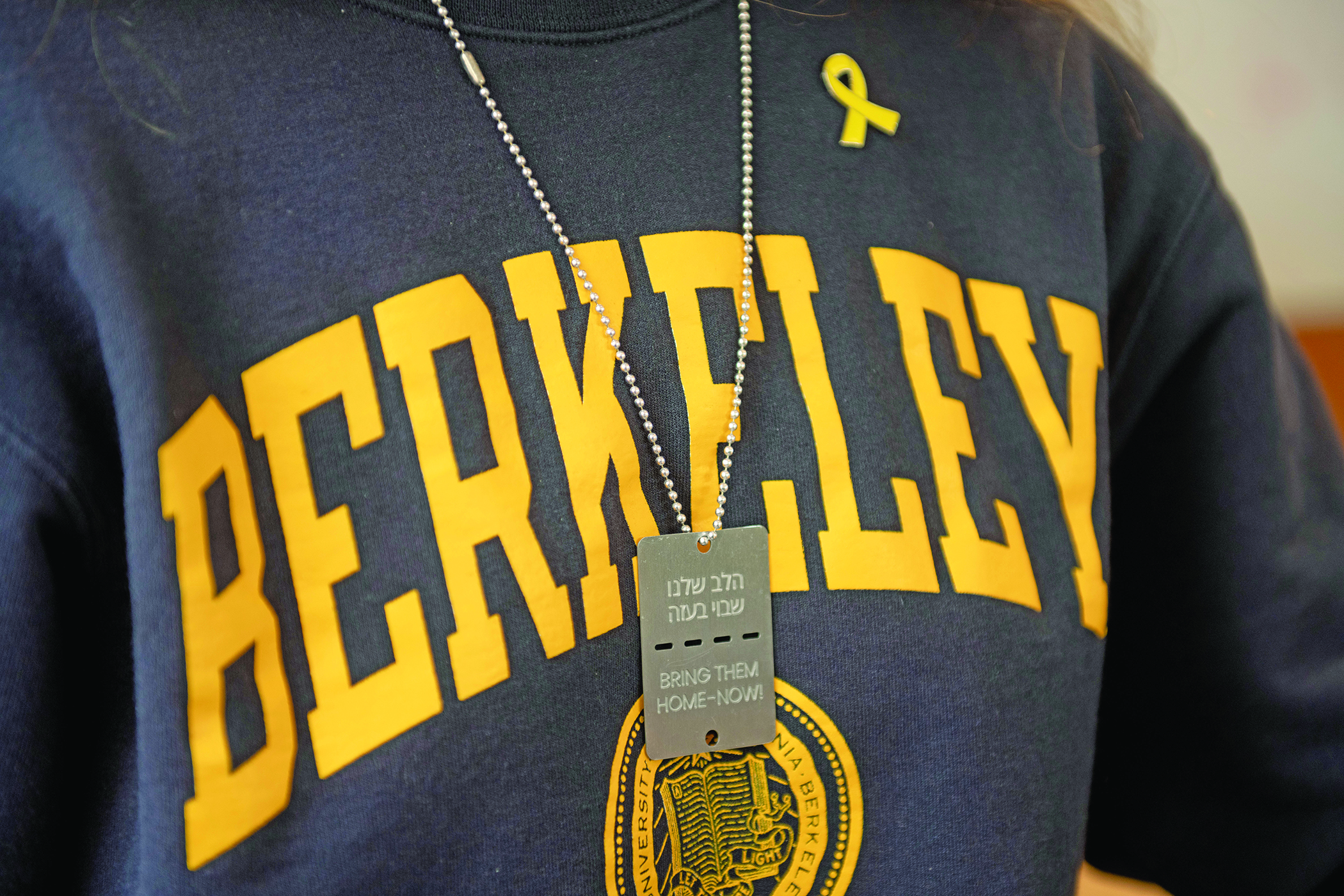
A week after anti-Israel demonstrators nearly incited a riot outside a UC Berkeley theater, some Jewish students on the school’s campus are feeling depressed, ostracized and confused.
“I’m too anxious and sad to go into my departmental building,” said “David,” a first-year student who, like others J. interviewed, would only speak on the condition he be identified using a pseudonym, fearing for his safety and possible academic repercussions. “I have anxiety every time I walk past Sather Gate. I feel I’m too anxious and sad to be in class.”
David described his experience at the university as a “trainwreck.” He said he’s been subjected to antisemitic rhetoric from a professor and other students on campus and on social media. He does not identify as a Zionist and now feels he does not fit in anywhere on campus, so much so that he is considering leaving the school.
“I feel harrowingly lonely, because it really feels like there’s no one to speak to about this, especially because I don’t feel super comfortable hacking through conversations with Jews who are much more right-wing than me,” David said. “It’s so depressing.”
On Monday, a week after protesters shut down a talk at Zellerbach Playhouse by an Israeli reservist and lawyer, forcing their way into the building and injuring some Jewish students, J. met with a small group of students who described similar feelings of anxiety on a campus now under federal discrimination investigation for its handling of antisemitism. While their sentiments do not represent the totality of Jewish experience on campus, they nevertheless reflect a growing sense among some students that the university feels less comfortable for Jews than it once did.
The students shared their stories on the first day of “apartheid week,” with scheduled events “surrounding the history of Palestinian struggle,” according to the Bears for Palestine.
Related: UC Berkeley police begin criminal probe of anti-Israel protest that turned violent
Daniel Solomon, a Ph.D. history student who has been vocal about the climate for Jews on Berkeley’s campus, said every time he has raised concerns to colleagues and administrators in his department about antisemitism, anti-Israel comments or calls to action, he becomes more ostracized.
“Each time I point out communications that are offensive, I’m accused of being uncivil,” said Solomon. “And I said to a department administrator, ‘This is, like, Orwellian. You’re telling me that I have to be civil as they promote barbarity.’”
Hannah Schlacter, a second-year MBA student from Chicago and a member of Jewish Americans for Fairness in Education, believes the failure of the university’s administration to effectively condemn violence against Jewish students in the past led to the incident at Zellerbach Playhouse. Schlacter submitted a 33-page testimony to Congress for a Feb. 29 hearing about campus antisemitism. “Before Feb. 26, I did not feel safe outwardly expressing my Jewish identity at Berkeley,” she told J. “After Feb. 26, the underlying root cause of that sentiment continues. By and large, the reason the riot happened is because when you don’t call out hate against Jews, it continues to happen.”
“Rachel,” who is 18 and a freshman, says the school has reached a “tipping point.”
“[Protesters are] saying, ‘globalize the intifada,’ which Jews understand as a call for violence,” she said. “And that’s not how it was treated by the administration. And now it’s crossed the line into violence where people were assaulted, and that’s a crime.”
Rachel was born in Israel but grew up in Southern California. She did a gap year volunteering in Jerusalem before starting at Berkeley in the fall. She lives in one of the on-campus dorms and says students on her floor are vocally anti-Israel. She often chooses not to be visibly Jewish or display items that identify her as Israeli.
“It’s not like I feel like on campus I’m going to be attacked or harassed, but it is kind of always in the back of my mind,” she said. “In conversations with people, it’s like, ‘Do I mention that I’m Israeli? Do I bring my gap year up at all? Is that going to make the conversation go in a direction I don’t want it to go?’”
Rachel said statements from the university and its pursuit of a criminal investigation are a good response to the Feb. 26 incident, as long as they are followed up by action.
“How bad does it have to get before something is done?” she said. “How serious of an injury do they need to see before they’re going to acknowledge that this is a problem?”
Signs of the heightened tensions on campus aren’t hard to find. Sather Gate is an iconic landmark that many students pass through to attend class. For at least three weeks, anti-Israel activists have been demonstrating there daily, displaying Palestinian flags and posters and playing a 10-minute, amplified audio recording on repeat. The audio features a continuous drone sound, the voices of several people purporting to be besieged Gazans and a mock Israeli announcing that bombs will be dropped, followed by the sound of an explosion and screaming.
Demonstrators said that the audio was sourced from “many places,” including Red Crescent, the humanitarian organization that services hospitals and provides emergency medicine and ambulance services in Palestinian areas. The recording, they said, was edited together by Cal students.
When this J. reporter began to film the action at Sather Gate, demonstrators wearing masks blocked the camera with a kaffiyeh.
David, the first-year student, reported being harassed in a similar way on the same day. According to a statement he made to a professor and shared with J., as he walked toward the gate, a demonstrator began to film him. When he asked why, she refused to answer and was soon joined by five or six others who surrounded him, circling and recording him.
“This is when antisemitism gets physical,” David said. “I am now too scared for my safety to walk through Sather Gate to get to Dwinelle.” Dwinelle Hall is the second-largest building on campus.
Despite the fear and unease among Jewish students, Rachel said she is glad so many are continuing to show up and not backing down.
“It’s really important that there is that strong Jewish community on campus, and not to let [aggressive actors] push us out,” said Rachel. “To say, like, ‘No. You can be hateful, but we’re still going to be here.’”