
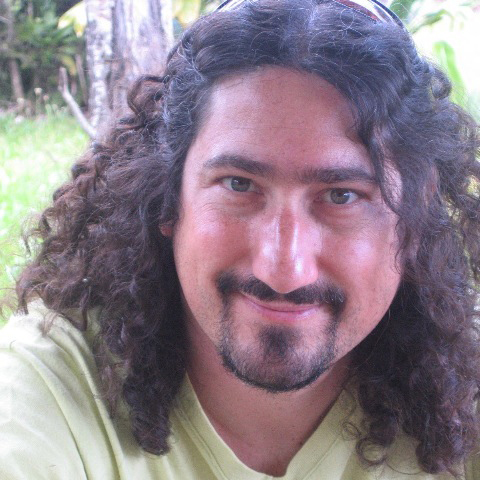

Israeli American pianist and composer Noam Lemish knows all about making music from a multiplicity of perspectives.
“Pardes,” his 2018 album with guitarist and oudist Amos Hoffman, is a sumptuous body of jazz arrangements largely based on liturgical and folk tunes from Yemenite and Moroccan Jewry.
But Lemish doesn’t just play culture-spanning music. He’s also a music professor at York University in Toronto and the author of a new scholarly book, “Transcultural Jazz: Israeli Musicians and Multi-Local Music Making.”
Expanding on his doctoral dissertation, the book delves into various examples of “cultural-blending through the lens of Israeli jazz musicians, starting with the wave of early players who came to New York City,” said Lemish, who will perform shows with Hoffman this month at Sonoma State University, San Francisco’s Bird and Beckett Books & Records and The 222 in Healdsburg.
Lemish, who hails from an Ashkenazi family, is no stranger to the local jazz scene. He was born in Ohio, raised in Tel Aviv and moved to the Bay Area in 2002 to study music at Sonoma State University. Over the next decade, he established himself as one of Northern California’s most exciting young accompanists, composers and bandleaders.
“He is one of our most talented and accomplished alumni,” said Sonoma State professor Brian S. Wilson, who runs the school’s Jewish studies program and has presented Lemish and Hoffman as part of the Jewish Music Series he curates.
“It’s so gratifying to see Noam making his mark, especially with such important work as this collaboration,” Wilson added. “Even with the use of electric guitar, each beautiful old melody retains its spiritual essence while couched in a jazz idiom. Noam and Amos are masterful collaborators bringing an understated creativity to music of a higher order.”

Hoffman grew up in an Ashkenazi family in Jerusalem and started to play oud, a Middle Eastern lute, around the age of 10. His formal studies focused on classical guitar. Oud was for casual playing, figuring out songs he heard on the radio by ear, “songs we used to sing in the neighborhood,” he said. “As a teenager I was mainly playing jazz, and oud was something I played at home for myself. I went to school with kids and grandkids of oud players, and I kind of figured out how to do it.”
After moving to New York to pursue his love of jazz in the early ’90s, he started making his way on the scene, performing weekly with saxophonist Jay Collins. Hanging out at Hoffman’s apartment one afternoon, Collins noticed the oud in the corner and encouraged him to bring it to their gig. Collins often played the bansuri, an Indian bamboo flute, which blended well with the delicate tonality of the oud.
“People were like, this is a hip sound,” recalled Hoffman, who now lives in South Carolina. “Back then nobody had heard oud before.” Encouraged by both his American and Israeli colleagues to keep working on it, “slowly oud became a big part of what I was doing,” he said. “It wasn’t anything I was planning.”
One of the musicians who loved the sound of Hoffman’s oud work was bassist Avishai Cohen, whose work with piano legend Chick Corea marked a watershed in visibility for Israeli jazz musicians. Lemish became aware of Hoffman via his oud and guitar work on Cohen’s 1998 debut album “Adama” on Corea’s label Stretch Music.
Years later, with Canada’s generous support for the arts, Lemish sought out Hoffman to collaborate on a concert in Toronto. They quickly established a deep rapport, which led to the album “Pardes.” (It is not unusual in Israel for Ashkenazi musicians to riff on Mizrahi melodies.)
In addition to the Mizrahi material, the album includes popular songs that have circulated in Israel since the 1950s that Lemish describes as an invented folk song tradition “that Israeli jazz artists use as source material like American standards.”
As for why Israeli musicians are so drawn to jazz and have contributed so widely to the tradition in recent years, Lemish argues that Israeli culture is “already transcultural. Many musicians’ parents come from different ethnic origins, half Mizrahi and half Ashkenazi. You mix that with jazz, which is also a transcultural music to begin with, and you get what I describe as a blend of blends.”