

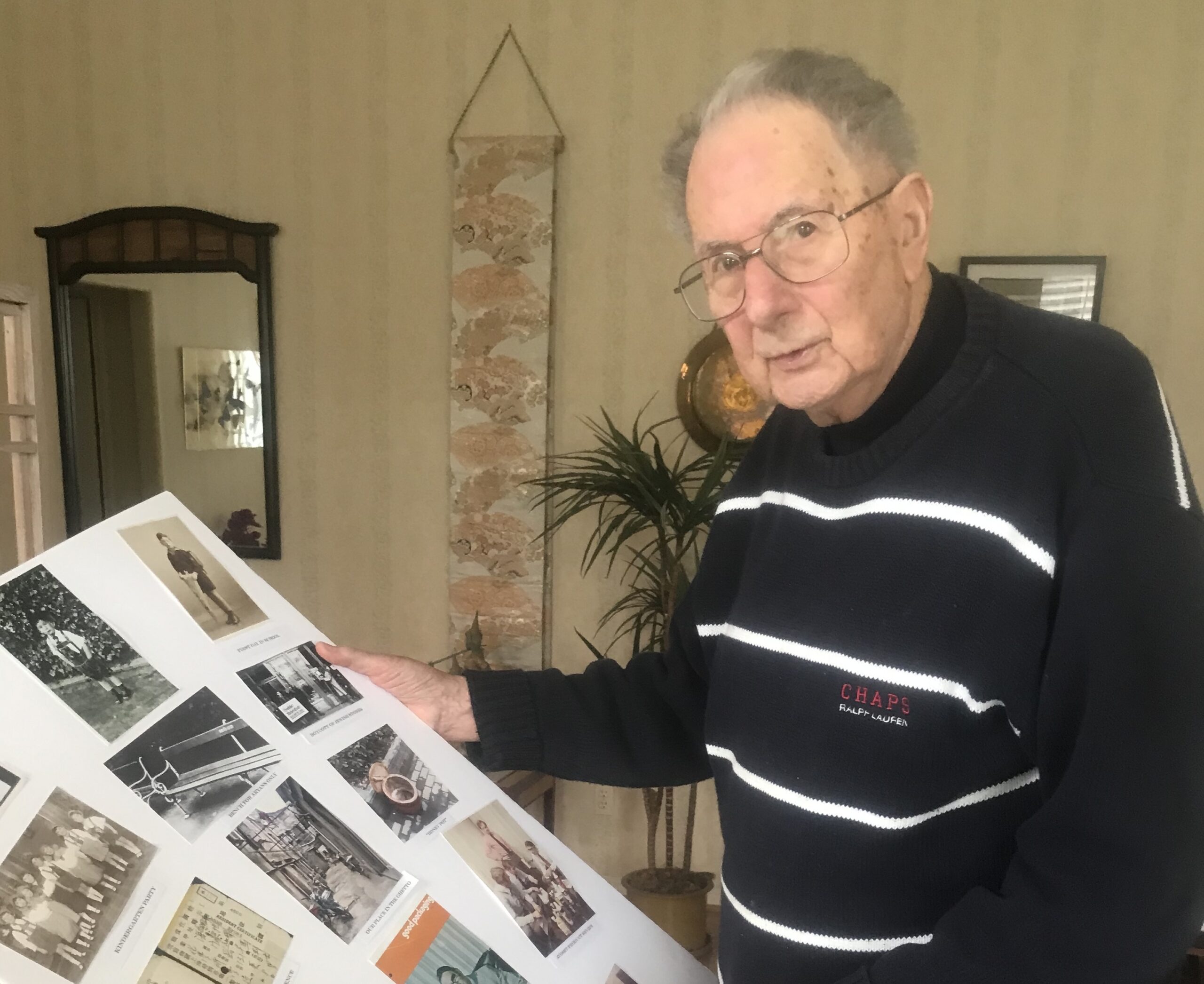
“You’ll have lunch, yes?”
Well, yes. Who doesn’t want lunch? When I arrive at Ernie Glaser’s home in Rossmoor, the retirement community in Walnut Creek, the table is already set with bagels, lox, cream cheese, capers and sliced tomatoes and onions.
Glaser busies himself popping bagels in the toaster oven, pouring glasses of water, making sure napkins are beside the plates, moving back and forth constantly. The kitchen, indeed the entire home, is immaculate. Does he have someone living with him to help?
Glaser looks taken aback. Why would he need that? He has someone come in to clean twice a month, more than enough, he said.
After all, he wasn’t turning 100 for another couple weeks.
“My mother had a bubbe meise,” he said, referring to the Yiddish phrase for an old wives’ tale. “Children born on Sunday are lucky throughout their lives. That holds true in my life. I’ve been extremely lucky.”
As he writes in the introduction to his 2017 self-published memoir, “A Life Well Lived,” he was a “penniless German-Jewish kid who spent the Second World War in China, was interned by Japanese authorities, came to the United States, graduated from two top universities, raised a family and became a business executive.”
He also became a stalwart in the East Bay Jewish community, active in federation, the American Jewish Committee, the American Israel Public Affairs Committee and Temple Isaiah in Lafayette.
Ernst Adolf Berthold Glaser was born in Berlin on March 2, 1924. His father sold agricultural jute and hemp products. The family was not religious, although Ernie became a bar mitzvah and they attended a Liberal synagogue for the High Holidays.

At 10, Ernie was admitted to the local Realgymnasium, or pre-university secondary school, despite its 1% Jewish quota. When the family’s rabbi told his parents he’d be the only Jew in a class full of Hitler Youth, they sent him to a private school for Jews instead.
That was where he first developed his connection to pre-state Israel, via the Jaffa oranges that students received every Friday. (Jaffa oranges were a big export and became an important Zionist symbol after World War I.) He joined Hashomer Hatzair, a Labor Zionist youth group.
“That made my parents very unhappy,” he recalled. “They were not Zionist at all.”
Like other assimilated German Jews, Glaser’s parents did not consider leaving even as restrictions on Jews grew harsher through the 1930s. As friends and relatives began to be arrested, however, they started to look for a way out. By the summer of 1939, the only destination open to Jewish refugees was Shanghai, China, so that’s where they headed.
Jews were only permitted to take the equivalent of $4 per person when leaving Germany, but Glaser’s father managed to deposit some funds with the shipping company. It had to be spent on board, but there wasn’t much to buy. So before arriving in China, Glaser’s father spent the last of it on a case of Curaçao triple sec liqueur that he bought from the bartender.
That purchase proved fortuitous. Life in Shanghai’s Jewish quarter was cramped, food was scarce and jobs hard to come by — even before the Japanese occupied the city in 1943. So Glaser’s father figured out what was in triple sec and began making his own “bathtub gin” out of grain alcohol and dried fruit. He sold the stuff to local German speakers, mostly European businessmen. The family lived in one room, and the liquor-making took place on a small patio.
The Glasers spent eight years in Shanghai, and Ernie moved through a series of odd jobs, eventually ending up as an apprentice in a Swiss-owned import-export business. By the end of the war in August 1945, Glaser was 21 and weighed 125 pounds “and my parents were equally thin.”
But, he acknowledges, they were better off than most European Jews. And in 1947, they made it to the United States, docking in San Francisco on the Fourth of July, greeted by a representative from San Francisco’s Jewish Family Service Agency.
Glaser’s mother soon got a job running the mikvah in the Mission District, which came with an apartment. Glaser, then 23, got a job with a customs clearinghouse, spending weekends and evenings with other Jewish refugees from Shanghai. They’d go dancing at the JCC, where he ran into old friends.
Then he got his draft notice. “I was A-1,” he said. “The only way to stay out of the Army was to go to college.”
Glaser enrolled in City College of San Francisco, transferring in his second year to what later became UC Davis, where he majored in food science. He suspects his early years of food deprivation had something to do with that choice.
Taking an early employer’s advice that the “closer you sit to the cash register, the more money you’ll make,” he got his MBA from Stanford University. He married and had two sons. After several jobs in food manufacturing, he ended up at the Oakland-based Avoset Food Corp., where he eventually became president.
Glaser and his wife, Elly, were deeply involved in the Bay Area Jewish community. Elly, who had enlisted in the U.S. Marine Corps during WWII, became a freelancer for the Jewish Post and Opinion in Indianapolis, wrote the column “Honorable Menschen” in the Jewish Federation of the Greater East Bay’s weekly newsletter and was an oral historian.
Ernie was one of the founders of the local AIPAC branch, serving first on its board, then on its national advisory committee. He resigned when he felt it was moving too far to the right, in line with the rightward shift of the Israeli government.
He served on the East Bay Federation’s board for years, including two years as its president, and sat on the local AJC board. The couple were active members of Temple Isaiah.
“I was a tummler,” a mover and shaker, he said with a laugh.
The couple traveled extensively, through Ernie’s work and their Jewish involvement. Once, together with San Francisco AIPAC leader Naomi Lauter, Glaser accompanied Lt. Gov. Leo McCarthy on a trip to Israel aimed at strengthening the Jewish state’s agricultural technology ties to California.
His first visit back to Germany, which was for business, was hard. “I couldn’t bring myself to speak German there,” he said.
He returned many times, though, including with an AJC mission and a trip for Holocaust survivors sponsored by the German government. Then, in 2023, when he was 99 years old, the Institute for Social Science Research, Education and Counseling, a Holocaust education organization based in Nuremberg, invited him to tell his story by Zoom to groups throughout Germany.
His first gig was a lecture to a college in Bavaria.
“I hadn’t spoken much German since my parents died 50 years ago, so I had the idea of writing out my speech and pasting it on a board in front of my computer, like a teleprompter,” he said.
On March 13, for his third Zoom lecture through the organization, he will address a conference of social scientists in Wurzburg. It’s something he thoroughly enjoys, especially the Q&A afterward.
Elly died in 2016. He misses her terribly but said he did not allow himself to sink into depression. That’s not what gets you to 100.
“First is attitude, that plays a big role,” he said. “I’ve also exercised my entire life.” He has a stationary bike in his bedroom, along with weights, a mat and exercise bands. He tries to work out every day for “an hour and 15 minutes,” he says with typical German specificity, although now he’s down to about four or five days a week.
Most of all, he is always around people.
“I always had a lot of friends,” he said, including his current “lady friend” who he described as “quite a gal.”
Yes, he smiles. “I certainly have been lucky.”