

Books coverage is supported by a generous grant from The Milton and Sophie Meyer Fund.
Next time you punch an address into a mapping app, take a moment to thank Albert Einstein for getting you where you need to go.
His general theory of relativity underlies the science that lets Global Positioning System satellites and your Earth-bound device communicate with the incredible precision needed to guide you to your destination.
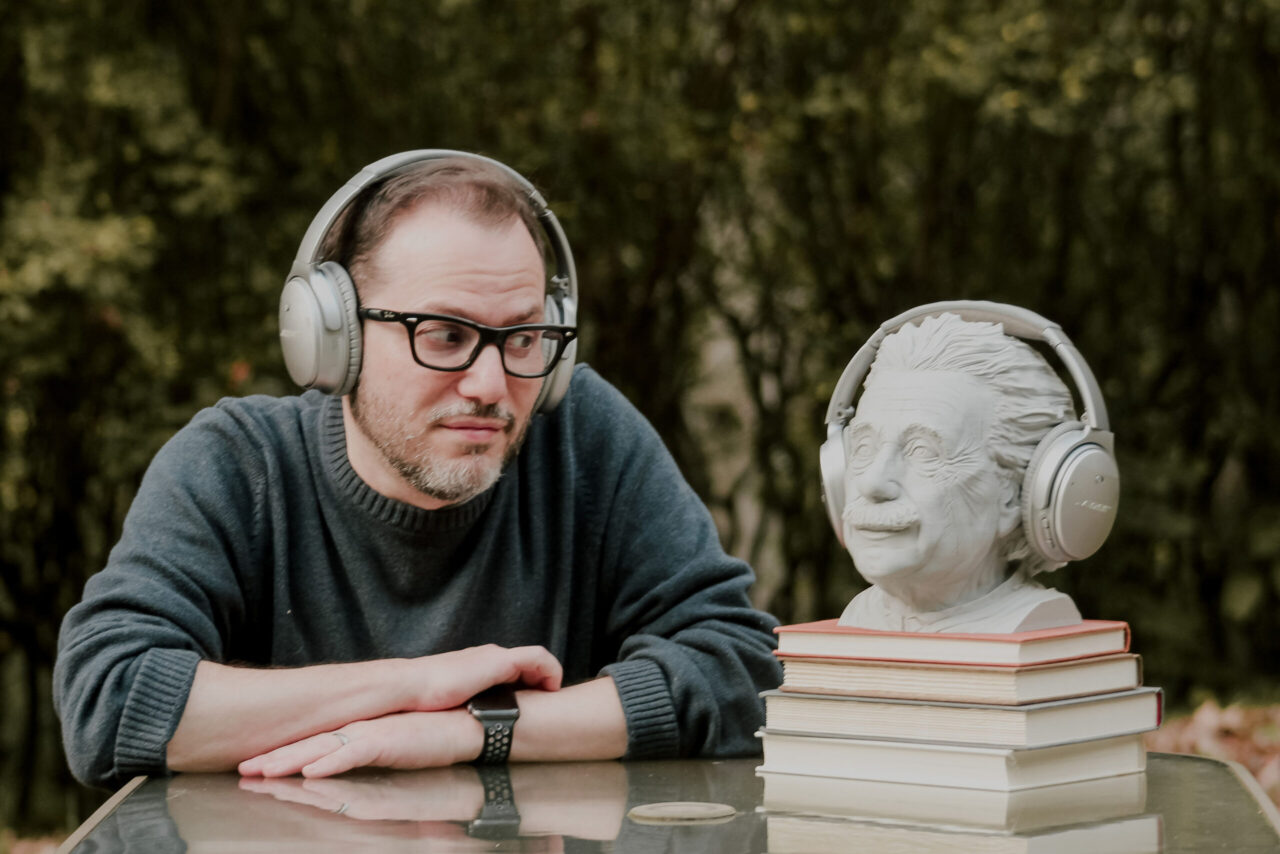
The Nobel-winning theoretical physicist is “probably more relevant today than he ever was,” said Benyamin Cohen, author of the 2023 book “The Einstein Effect: How the World’s Favorite Genius Got into Our Cars, Our Bathrooms, and Our Minds.” It details the many ways the scientist’s ideas still pop up in modern life, including in remote controls, fiber optic cables and scanners at checkout lanes.
“I wanted to write the book to show people that every day you’re using technology that Einstein invented,” Cohen said.
He’ll speak about Einstein’s enduring impact on Thursday, March 28, at the Oshman Family JCC in Palo Alto. The 7 p.m. talk is part of the JCC’s 2024 cultural arts season featuring writers, musicians and other creatives.

Cohen, 48, didn’t only write a book on the German-born Jewish scientist. He also runs the official accounts of the “world’s favorite genius” on Instagram, Facebook and X (Twitter). Together, the accounts tally some 20 million followers.
“He has more Facebook followers than Tom Hanks or the Rolling Stones,” Cohen said. “I think he’s the most active dead celebrity on social media.”
In his social media role, Cohen posts Einstein quotes, photos, fan art, trivia and links to physics studies. Students around the world message the accounts for assistance with science homework. (Sometimes Cohen responds with words of encouragement.) Physicists also share their latest research with the accounts, and producers of Einstein documentaries ask for help promoting their films.
“Being Albert Einstein to his adoring 20 million fans is an awesome responsibility and one I don’t take lightly,” Cohen said. “I always triple-check everything before I post it.”
Cohen works on those accounts from his home in the Appalachian Mountains of West Virginia. He lives there with his wife, their three dogs, a cat and a flock of 20 chickens they call “Co-hens.” One of them, a black Polish chicken with a puffy crown of white feathers, is named Albert Einstein.
Cohen isn’t a scientist himself. He first became obsessed with Einstein as a journalism undergrad at Georgia State University in the mid-1990s after hearing the bizarre true story about the pathologist who stole Einstein’s brain while performing an autopsy on him, apparently hoping the gray matter could reveal the key to being a genius. That stranger-than-fiction tale led Cohen to wonder what else he didn’t know about Einstein. He dove in headfirst, absorbing everything he could about Einstein through books and movies. Later, as a journalist, Cohen wrote about him, too.
That coverage led Einstein’s estate to offer Cohen the social media gig in 2017. He calls it a side hustle, given that he’s also news editor at the Forward. Even so, sharing Einstein’s life and work with the world filters into his own daily life and identity.
“I kind of live and breathe Einstein,” said Cohen, who jokingly calls himself a “likable idiot” and often finds himself returning to his favorite Einstein quote: “I have no special talents. I am only passionately curious.”
The author considers Einstein his idol — not only as a thinker but as a humanitarian. Einstein was outside Germany when Hitler came to power in 1933 and realized he couldn’t return, becoming a refugee before obtaining U.S. citizenship in 1940. Einstein founded the International Rescue Committee in 1933 to help fellow refugees from Nazi-controlled Europe and later became active in the U.S. Civil Rights Movement.
Cohen also looks up to Einstein as someone who took pride in his Jewish identity.
“He experienced the worst of the worst,” Cohen said. “Einstein, despite everything he went through, was a very proud Jew, a very open Jew.”
Spending so much time inside Einstein’s head, Cohen feels confident predicting how the man might react to life today, in the technological realm and beyond, were he still alive. The author didn’t hesitate when asked how the famed scientist would respond to the global antisemitism that’s erupted since the Oct. 7 Hamas massacre in Israel.
“When we’re experiencing the rise in antisemitism, our initial reaction may be to shut ourselves off or hide our Judaism, take the kippah off when out in public, or not be so out and proud as a Jew,” Cohen said. “I think what Einstein would say is to do the opposite of that. I think he would say, ‘If you hide your Judaism, you’re letting the other side win.’”