

An Israeli American Jew has resigned from a commission that advises the city of Davis on human rights and equity, saying he felt excluded and faced antisemitic hostility from fellow members over the nearly two years he spent in the role.
“I will no longer serve as the commission’s punching bag while providing the appearance of ideological diversity and legitimacy,” Amir Kol, a professor at the UC Davis veterinary school, said in a statement announcing his resignation on May 28 at the most recent meeting of the Human Relations Commission.
The commission is an advisory group of volunteers tasked with making recommendations to address discrimination and promote equity in the city, according to its website. At least a dozen Bay Area cities have similar commissions.
In his resignation statement, Kol described a pattern of obstruction throughout his tenure. When he proposed a community olive harvest to bring people together across cultures, he said, a fellow commissioner accused him of trying to erase a “narrative of Palestinian resistance.” And when he organized a celebration for Jewish American Heritage Month, he said, the commission attempted to “micromanage” it.
Both events went forward anyway. More recently, a May 1 rally in Davis’ Central Park featured a banner reading “Long Live Al-Aqsa Flood” — Hamas’ name for the Oct. 7, 2023, attack on Israel — with a Human Relations Commission member in attendance, Kol said.

Kol told J. he decided to finally step down after contending with the creation of a report on the experiences of Muslim, Arab and Palestinian residents of Davis. Kol said he felt the way the report was drafted minimizes allegations of antisemitism related to incidents described in it.
The report surveyed Muslim, Arab and Palestinians residents and found that they reported “high levels of discrimination and exhaustion” as well as a “pattern of fear of retaliation” for voicing complaints of discrimination or “any conversation that indicates care for Palestinians.”
Kol shared his concerns about the report at commission meetings and then laid them out in an article published by a local news site.
“The report repeatedly accuses Jewish and Zionist organizations of ‘surveillance and harassment’ simply for attending public events and recording protests –– activities that are lawful and constitutionally protected,” Kol wrote in the article. “No distinction is made between harassment and legitimate disagreement.”
The report and its recommendations were the “last straw,” Kol told J. “I just felt like there’s no point. My energy can be better spent somewhere else.”
None of the six other commissioners who served with Kol responded to J.’s request for comment. A city spokesperson declined to comment and noted that commissioners are not authorized to speak to the press as official representatives of city hall.
“I entered the Human Relations Commission believing that despite disagreements, we could still work together in good faith to strengthen our community,” Kol said in his resignation statement. “I leave with the conviction that real change will not come from this commission as it currently exists.”
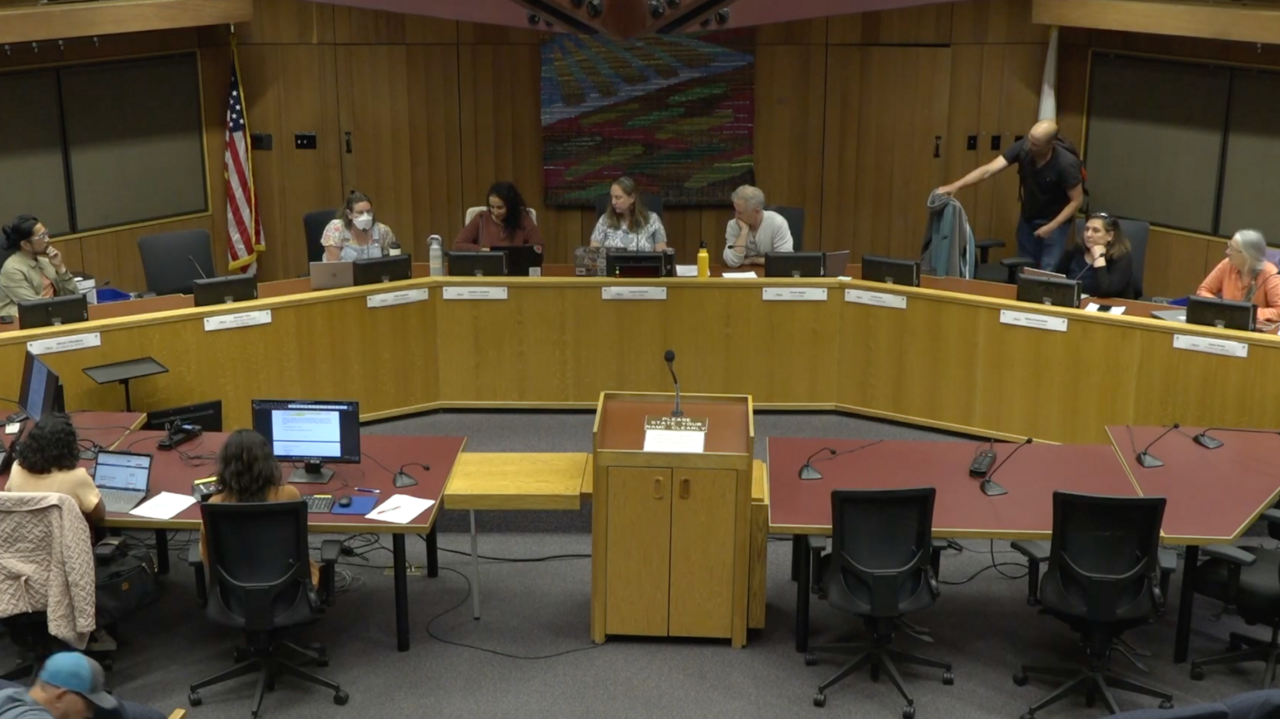
The response at the meeting to Kol’s resignation statement was muted.
“I appreciate you taking the time to explain your perspective on everything and to explain to us why you’re leaving,” commission co-chair Leonie Pickett said at the meeting.
Ellie Kaplan, the commission’s other Jewish member, was one of the report’s three authors. At the meeting, Kaplan said she was “proud” of the commission’s work. (She will stop serving before her term is up in 2029 due to a planned relocation.)
Mariela Socolovsky, CEO of the Jewish Federation of the Sacramento Region, said Kol’s experience isn’t an isolated case.
“We have observed instances in which antisemitism is minimized, rationalized or treated differently than other forms of hate and discrimination,” she wrote in an email to J., citing private conversations with Jewish residents. “We see this reflected not only in public discourse and civic processes, but also in educational settings.”
In 2024, Israel advocacy group StandWithUs filed a complaint with the U.S. Department of Education’s Office of Civil rights accusing UC Davis of failing to enforce nondiscrimination policies and address a “pervasively hostile” atmosphere for Jewish and Zionist students. The university resolved the complaint in 2025 by agreeing to require campus investigators to undergo antisemitism training and audit all complaints students filed from 2023 through 2025.
Kol said he applied to become a commissioner shortly after the Oct. 7 Hamas attack, out of a desire to help strengthen the community amid what he described as a “wave of antisemitism on campus and in the city.”
“Oct. 7 was a watershed moment,” Kol said. After moving from Israel to Davis with his family nearly two decades ago, he “felt like this is my home, and I need to fight for my home.”
Kol said he will remain active in community affairs, but not at the municipal level.
“I’m more interested in working within the Jewish community, whether it’s locally within Davis or the broader Sacramento region,” he told J. “That’s where my heart is right now.”